Demystify Problem Dependent Power of Quantum Neural Networks on Multi Class Classification
Keywords
Summary
162 words
Critical Evaluation
Value of the Information & Strength of the Argument
The value of the information is high: the talk presents a rigorous theoretical analysis that unifies several aspects of quantum classifiers, providing new insights into when quantum advantages may occur. The argumentation is solid, with clear definitions, formal theorems, and proof sketches. The speaker logically builds from background to the main contributions, supporting claims with mathematical derivations and citations to prior work. The decomposition of expected risk into empirically checkable components is a practical contribution that could guide future research.
Scientific Rigor, Source Quality, Title Accuracy
The scientific rigor is exemplary: the talk is based on a preprint with rigorous formalism, and the speaker carefully defines notation and assumptions. The sources are credible, primarily referencing the arXiv paper and well-known concepts in quantum information theory. The title accurately reflects the content, and the talk does not overclaim; it explicitly notes limitations and open questions. The presentation is in line with academic standards, though the transcript quality limits verbatim verification. No public comments were provided to analyze.
175 words
Title / Content Match
The title accurately reflects the content: the talk systematically investigates the problem-dependent power of quantum neural networks for multi-class classification, including theoretical analysis of risk curves and a proposed method to detect potential advantages.
Quality & Reliability
8/10
The presentation is based on a peer-reviewed research paper (arXiv:2301.01597), presented by the lead author. The talk provides rigorous theoretical analysis with formal theorems and proof sketches. The transcript is somewhat corrupted but the content is clearly scientific and well-structured. The scores reflect the high technical quality and the presence of a preprint reference.
Key Moments
Markers derived by PSI from the transcript: the creator did not define chapters.
- Review of classical AI milestones and quantum AI history.
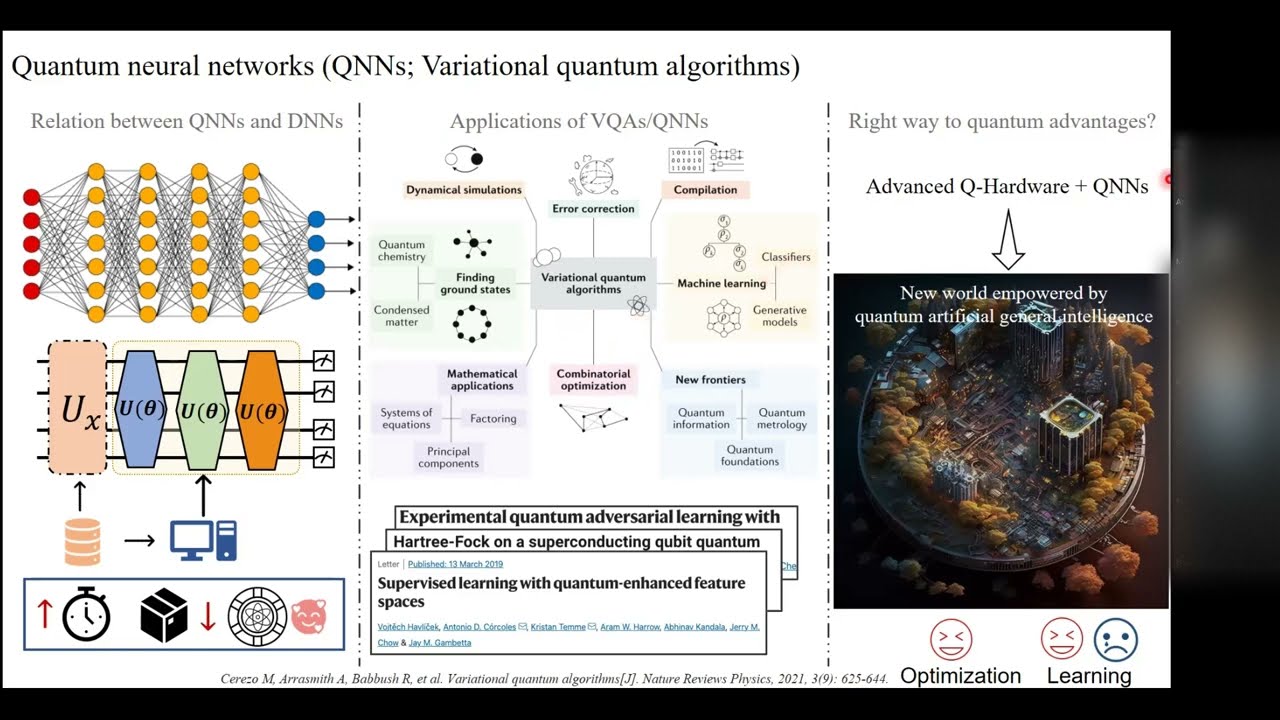
- Introduction to variational quantum algorithms and their NISQ-friendliness.
- Discussion of differences between optimization and learning in quantum networks.
- Benchmark results comparing quantum and classical classifiers on classical and quantum data.
- Statement of the main research question and contributions.
- Formal setup of multi-class classification, expected risk, and empirical risk.
- Theorem 1: conditions for achieving zero expected risk with quantum classifiers.
- Geometric interpretation of conditions; connection to neural collapse and Helstrom bound.
- Discussion of over-parameterized QCs leading to a U-shaped risk curve.
- Proposed algorithm to detect potential quantum advantage and proof sketches.
Cited Sources
- Demystify Problem-Dependent Power of Quantum Neural Networks on Multi-Class Classification (arXiv:2301.01597) — The paper underlying the talk, providing the theoretical results and numerical experiments.
Concurring Sources
- Quantum neural network (Wikipedia) — Provides general background on quantum neural networks and their implementations.
Contribution & Novelties
The talk’s original contribution is a systematic theoretical analysis of quantum neural classifiers, showing that their power is problem-dependent. It unifies trainability, generalization, and expressivity in a single framework, derives a non-vacuous generalization bound, and reveals a U-shaped risk curve for over-parameterized quantum classifiers. The proposed method to probe quantum advantage based on loss dynamics is a practical tool. The work also establishes connections to classical results like neural collapse and quantum measurement bounds.
Pour aller plus loin :
- Helstrom bound — Related to optimal discrimination of quantum states, directly cited in the talk.
- Equiangular tight frame — Mathematical concept used to characterize the geometric conditions for perfect training.
- Double descent — Classical phenomenon in deep learning, contrasted with the U-shaped risk curve for quantum classifiers.
- Quantum neural network — Background on quantum computing and networks; note this Wikipedia page covers broader aspects, but the concept is relevant.
148 words
Radar Profile
The radar profile indicates high scores in technical level and quality of information, with slightly lower but still solid scores in quantity and reliability. This reflects a dense, technical talk with strong theoretical backing, though the transcript quality may limit accessibility.