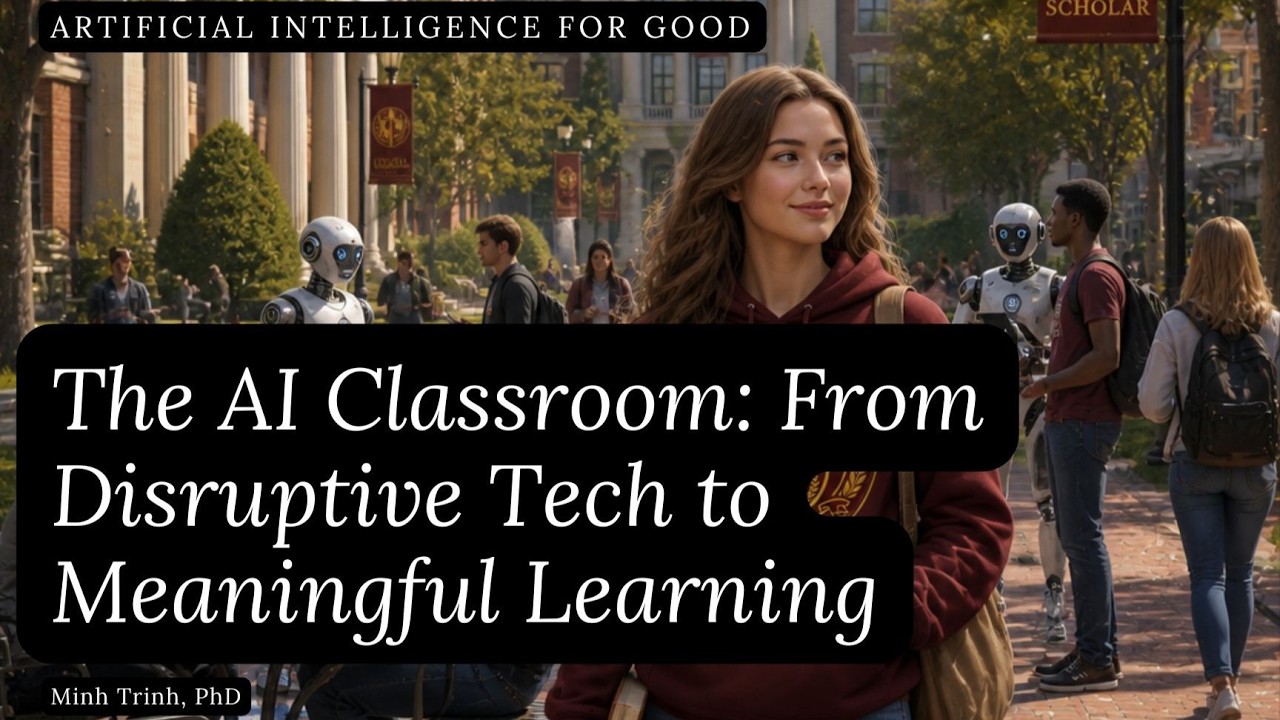
The AI Classroom: From Disruptive Tech to Meaningful Learning
Keywords
Summary
202 words
Critical Evaluation
Value of the Information & Strength of the Argument
The value of this presentation lies in its balanced approach, acknowledging both the opportunities and risks of AI in education. The speaker supports his points with references to studies, reports (e.g., MIT, PISA), and news articles, though he does not always provide concrete citations. His argumentation is logically structured, moving from historical context to current evidence, then to benefits and challenges, culminating in a practical demo. He demonstrates critical thinking by questioning one-sided narratives and highlighting nuances, such as the distinction between using AI for automation versus augmentation. However, the talk relies heavily on anecdotal evidence and personal interpretation, and some points (e.g., the effectiveness of AI tutors) are presented without deep empirical backing. The strength of the argumentation is in its comprehensiveness and honest acknowledgment of uncertainties, making it a useful overview rather than a rigorous scientific analysis.
Scientific Rigor, Source Quality, Title Accuracy
The scientific rigor is moderate: the speaker references specific documents (MIT report, PISA, The Economist) but does not provide direct URLs or detailed sourcing, limiting verifiability. He accurately represents the general findings of these works, though a few interpretations (e.g., the Chinese experiment) are presented without full context. The title ‘From Disruptive Tech to Meaningful Learning’ accurately captures the shift from a focus on technology’s novelty to its educational impact, and the content consistently addresses this theme. The inclusion of a demo product (Rodeo Scholar) is relevant but constitutes a self-promotional element, which is separate from the academic discussion. Overall, the talk is informative but would benefit from more transparent citations and a clearer distinction between established research and personal opinion.
275 words
Title / Content Match
The title accurately reflects the content, which discusses the impact of AI on learning and teaching, and includes a demo of a platform.
Quality & Reliability
6/10
The talk provides a broad overview of AI in education, citing several reports and articles, but relies heavily on personal interpretation without providing specific citations or URLs. The speaker acknowledges uncertainties and presents balanced arguments.
Key Moments
Markers derived by PSI from the transcript: the creator did not define chapters.
- Introduction and outline of the talk on AI in education.
- Historical context: calculators, computers, and phones in schools; mention of MIT's cognitive surrender report.
- PISA results 2025: declining scores, engagement issues, and equity concerns.
- Potential benefits of AI: cost efficiency, personalized learning, accessibility, and scalability.
- Main challenges: disconnect between product and learning, AI detectors, cognitive load, and inequality.
- Discussion on adoption, AI literacy, and equity; intro to demo of Rodeo Scholar.
Cited Sources
- Rodeo Scholar (learning platform) — Mentioned as a platform for students and lifelong learners to preview college-level courses; demonstrated at the end of the presentation.
Contribution & Novelties
This presentation contributes a synthesized overview of the current state of AI in education, bringing together recent reports (MIT, PISA) and media discussions, and offering a balanced perspective that is missing from many one-sided debates. It also introduces a practical tool (Rodeo Scholar) that illustrates how AI can be applied in a real educational setting, adding a concrete example to theoretical discourse. The speaker highlights the crucial distinction between automation and augmentation, which is valuable for educators and policymakers.
Pour aller plus loin :
- PISA — The OECD’s Programme for International Student Assessment, central to the discussion of global education performance.
- Artificial intelligence in education — A broad overview of AI’s role in education, including history and current applications.
- Socratic questioning — A pedagogical method mentioned in the talk as a potential benefit of AI tutors, valuable for fostering critical thinking.
141 words
Radar Profile
The radar profile shows a balanced score across dimensions, with quantite_information slightly higher than others, indicating the talk is rich in content but moderate in technical depth and reliability. The moderate reliability score reflects the reliance on personal commentary rather than deep citation. This suggests a talk that is broadly informative but not a rigorous scientific reference.