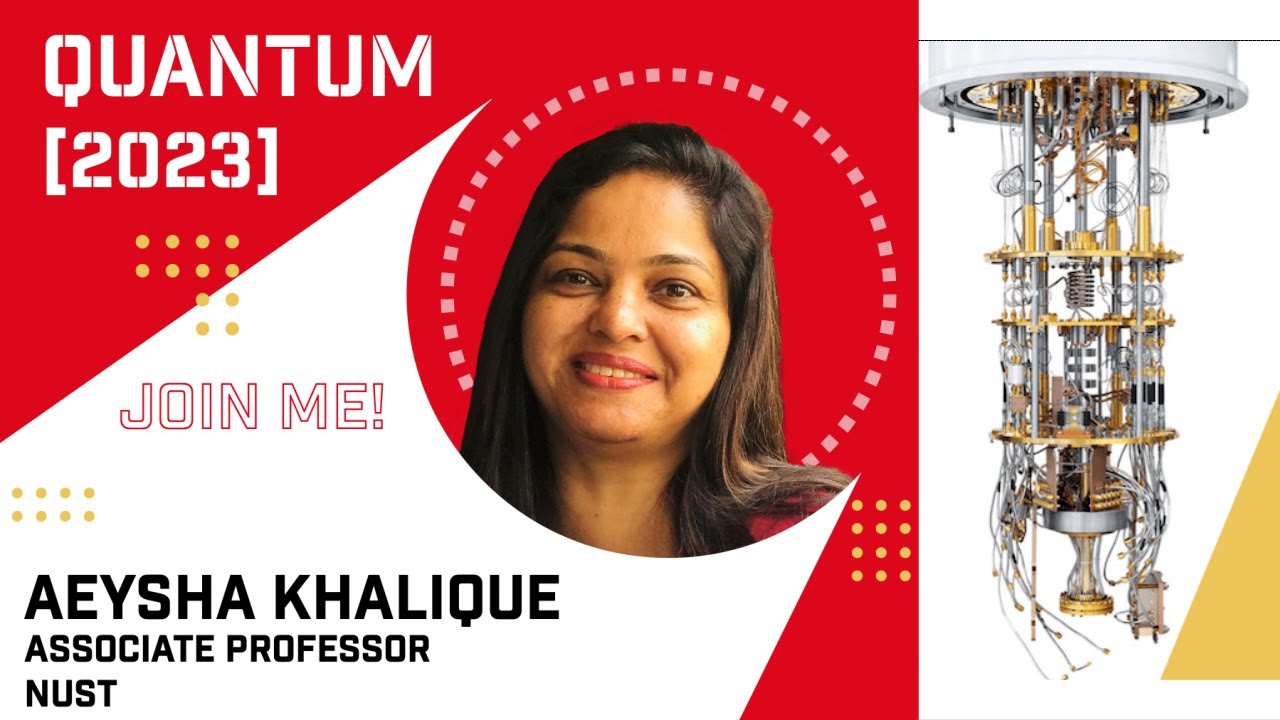
WOMANIUM QUANTUM : DAY 4 ❯ Quantum Key Distribution 3: QKD with Noise (QWorld)
Keywords
Summary
156 words
Critical Evaluation
Value of the Information & Strength of the Argument
The value of this lecture lies in its clear pedagogical breakdown of QKD post-processing steps. Dr. Khalique effectively uses simple examples (e.g., parity bit error detection) to illustrate complex concepts. The argumentation is solid, grounded in standard QKD literature, and she carefully explains the rationale behind each step, such as why privacy amplification must follow reconciliation. The pessimistic security model is justified as a conservative and safe approach. The discussion of error rate thresholds (e.g., 25% for Cascade) provides concrete benchmarks. The presentation is logically structured, building from BB84 basics to advanced reconciliation and amplification techniques, making it accessible while maintaining technical depth.
Scientific Rigor, Source Quality, Title Accuracy
Dr. Khalique demonstrates strong scientific rigor by correctly describing the BB84 protocol, error estimation, and the Cascade protocol. Her explanations align with established research on QKD, and she references known bounds (e.g., 11% for one-way and 20% for two-way communication) without overstating capabilities. The sources cited are limited to the workshop’s official links (womanium.org/Quantum and its schedule), which are appropriate for context. The title accurately reflects the content, which is a focused tutorial on QKD with noise. The presentation adheres to academic standards, though it does not introduce novel research; rather, it consolidates existing knowledge. The adequacy between title and content is excellent, with no unexpected digressions.
225 words
Title / Content Match
Title accurately reflects content; the session focuses on QKD under noisy conditions, covering error correction and privacy amplification.
Quality & Reliability
8/10
Lecture by a domain expert with clear explanations of QKD protocols, error correction, and privacy amplification. Content aligns with established literature.
Key Moments
Markers derived by PSI from the transcript: the creator did not define chapters.
- Introduction and overview of the session
- Review of BB84 protocol and basis reconciliation
- Definition of qubit error rate and error budget attribution to Eve
- Security bounds for one-way and two-way classical communication
- Parity check method and its error detection limitations
- Cascade protocol: random permutation and block division
- Cascade protocol failure threshold and block size relation
- Information leakage during reconciliation and need for privacy amplification
- Privacy amplification via pairwise XOR after random permutation
- Discussion of individual, collective, and coherent attacks
Cited Sources
- WOMANIUM Quantum Program — Official program page for the WOMANIUM Quantum initiative.
- WOMANIUM Quantum Schedule — Schedule of the Quantum program sessions.
Concurring Sources
- Quantum key distribution - Wikipedia — Corroborates the fundamental concepts of QKD and post-processing steps described in the lecture.
- BB84 protocol - Wikipedia — Confirms the description of the BB84 protocol and its error characteristics.
Contribution & Novelties
The lecture provides a systematic and accessible explanation of QKD post-processing steps, emphasizing the interplay between information reconciliation and privacy amplification. Dr. Khalique’s teaching approach, using simple parity check examples to illustrate error correction, is effective for learners. The content is not original research but consolidates established protocols with clear didactic value. It contributes to the educational mission of WOMANIUM by demystifying the technical details of QKD under realistic conditions.
Pour aller plus loin :
- Quantum key distribution - Wikipedia — Provides comprehensive overview of QKD, including security proofs and variants.
- BB84 protocol - Wikipedia — Detailed explanation of the BB84 protocol, foundational to the lecture.
- Privacy amplification - Wikipedia — Discusses the technique for reducing an eavesdropper’s information, central to the session.
- Information reconciliation - Wikipedia — Explains the error correction step in QKD, complementing the lecture’s focus.
- Cascade protocol - Wikipedia — While this page might not exist, the concept is covered in QKD literature; a search for ‘Cascade protocol QKD’ yields relevant resources.
166 words
Radar Profile
The radar profile shows a high-quality lecture with strong scores across all dimensions. The quantity of information is substantial, quality is excellent, technical level is high but not excessively so, and reliability is solid. The balanced profile indicates a well-rounded educational content that is both informative and trustworthy.