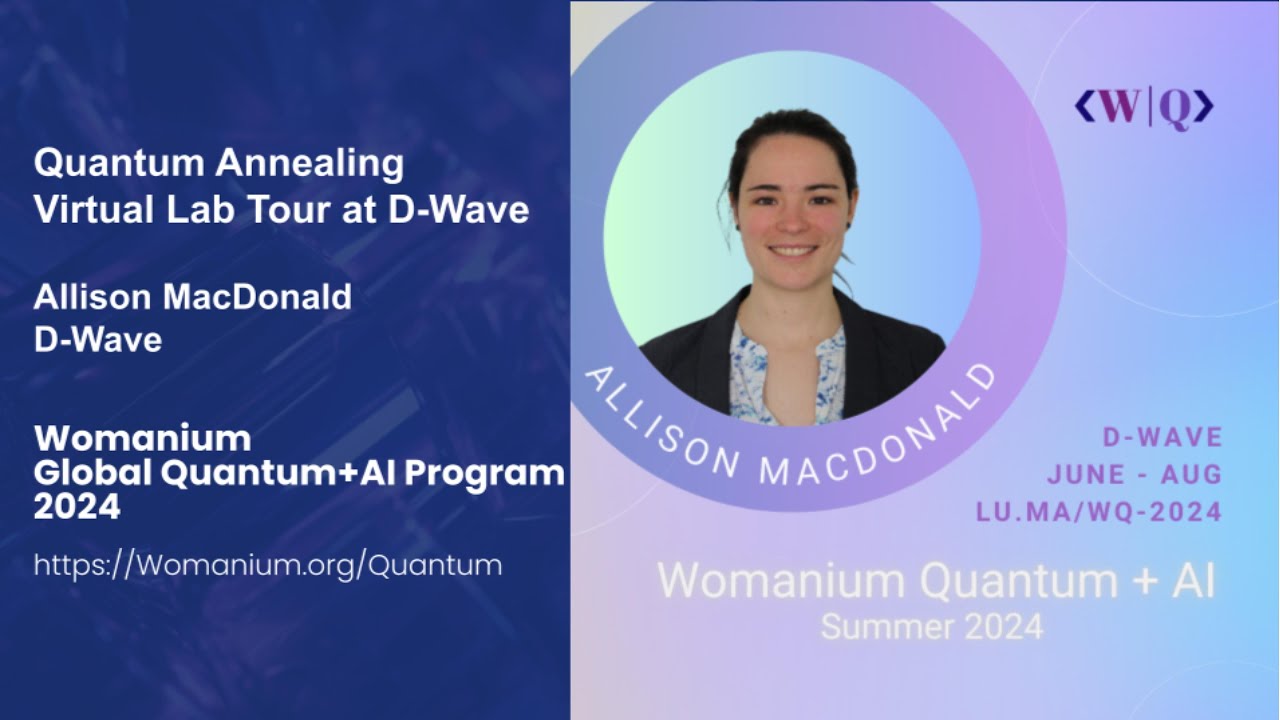
WOMANIUM QUANTUM + AI 2024: DAY 12 ❯ QUANTUM ANNEALING LAB TOUR (Allison MacDonald - D-Wave)
Keywords
Summary
227 words
Critical Evaluation
Value of the Information & Strength of the Argument
The informational value lies in the rare access to an industrial quantum-hardware facility and in the concrete, process-level detail it provides: how a superconducting annealing chip is designed, fabricated, screened, mounted, cooled and calibrated before it can serve customer problems. The explanation of the Chimera unit cell and its tiling is pedagogically effective, and the temperature ladder from 300 K to 15 mK gives a tangible sense of the engineering constraints. The argumentation is descriptive rather than persuasive: the speakers explain what exists and how it works, without claiming quantum advantage or comparing performance to classical or gate-based alternatives. The career segment is anecdotal but coherent, arguing that the quantum workforce needs cryogenics, electronics, systems, software, legal and IP profiles, not only physicists. The main weakness is the absence of any quantitative performance data, error rates, coherence times or benchmarking results, which leaves the audience unable to judge the actual capability of the machines shown. The argument therefore rests on the credibility of the presenter and the visibility of the hardware rather than on demonstrated results.
Scientific Rigor, Source Quality, Title Accuracy
Scientifically, the presentation is accurate at the level of established superconducting-qubit engineering: RF-SQUID loops, tunable couplers, dilution refrigeration stages, magnetic and thermal shielding, vacuum isolation and Faraday caging are all described in a standard and correct way. No primary literature, preprint or technical paper is cited during the talk, and the description links point only to the WOMANIUM programme pages, so the video functions as an institutional presentation rather than a sourced scientific exposition. The title-to-content match is strong: it announces a quantum annealing lab tour with Allison MacDonald of D-Wave, and the video delivers a career introduction followed by a full facility walkthrough. No advertising sequence was identified in the transcript. No viewer comments were provided for analysis.
310 words
Title / Content Match
The title accurately announces a quantum annealing lab tour with Allison MacDonald of D-Wave; the video delivers exactly that, with a brief career Q&A followed by a 20-minute virtual walkthrough of the D-Wave facility.
Quality & Reliability
7/10
The content is a first-hand industrial lab tour given by a D-Wave staff physicist and the Director of Science, describing hardware, fabrication, cryogenics and calibration processes. Claims are technical and internally consistent, with no exaggerated performance claims or marketing hype. However, no quantitative benchmarks, error rates or peer-reviewed results are presented, and the description links only point to the program's own pages, so external verification is limited.
Key Moments
Markers derived by PSI from the transcript: the creator did not define chapters.
- Introduction of Dr. Allison MacDonald and her trajectory from satellite quantum cryptography and LHC physics to low-temperature optomechanics and D-Wave.
- MacDonald describes her role leading processor development and advises that curiosity, perseverance and willingness to learn matter more than a perfect background match.
- Discussion of whether a PhD is required, and emphasis on the breadth of profiles needed: cryogenics, electronics, systems, software, IP and legal.
- Start of the virtual lab tour: D-Wave founded in 1999 by Geordie Rose, first in-house chip fabrication around 2005.
- Museum walkthrough of processor generations, from the first six-qubit chip to the 2,000-qubit Washington chip, plus sample holders and in-house control electronics.
- Explanation of the Chimera unit cell: four horizontal and four vertical superconducting loops coupled at crossings, tiled to build larger processors.
- Temperature ladder from 300 K down to 10–15 mK, colder than the cosmic microwave background, and the need for vacuum and magnetic shielding.
- Sample holder, 8-inch silicon wafer, wire bonds and input/output lines connecting the chip to room-temperature electronics.
- Inside the shielded room: dilution refrigerator stages at 100 mK, 1 K, 4 K, 50 K and 300 K, with thermal and magnetic shielding and a Faraday cage.
- Wafer prober room: automated 24/7 screening of every chip on every wafer to select the best dies for cooling, calibration and customer use.
Cited Sources
- WOMANIUM Quantum programme page — Programme page for the WOMANIUM Quantum + AI 2024 event of which this lab tour is Day 12.
- WOMANIUM Quantum schedule — Schedule listing the sessions, including this D-Wave quantum annealing lab tour.
Concurring Sources
- D-Wave Systems — company and technology overview — Confirms the founding date, the annealing approach and the processor generations described in the museum segment.
- Superconducting quantum computing — Supports the description of superconducting loops, Josephson junctions and couplers used in the Chimera unit cell.
- Dilution refrigerator — Corroborates the staged cooling architecture and the millikelvin temperature range presented in the tour.
Contribution & Novelties
The video’s originality lies in its access to the physical infrastructure of an industrial quantum annealing company rather than in new scientific results. It documents the full pipeline from wafer fabrication and room-temperature probing to dilution refrigeration, shielding and calibration, and it makes explicit that only a small fraction of fabricated chips are selected for customer-facing systems. It also gives a candid view of the workforce composition behind such hardware, arguing that the field depends on electronics, cryogenics, systems and legal expertise as much as on physics. The career testimony of a director of science who entered superconducting technology without prior background in the field is a useful counterpoint to the assumption that only specialists can join quantum hardware teams.
Pour aller plus loin :
- Quantum annealing — Overview of the computational paradigm used by D-Wave systems and its relation to adiabatic quantum computation.
- Superconducting quantum computing — Background on RF-SQUID loops, Josephson junctions and tunable couplers as described in the tour.
- Dilution refrigerator — Explanation of the staged cooling principle that reaches the 10–15 mK operating temperature shown in the video.
- D-Wave Systems — Company history and processor generations referenced in the museum segment.
- Quantum annealing — Encyclopaedic entry on the algorithmic principle behind the hardware shown.
208 words
Radar Profile
The profile is balanced and moderately strong, with information quantity and quality both solid thanks to the detailed process descriptions, while technical level sits slightly lower because the explanations remain accessible and avoid quantitative physics. Reliability is supported by the first-hand industrial context but limited by the absence of cited literature or benchmark data.