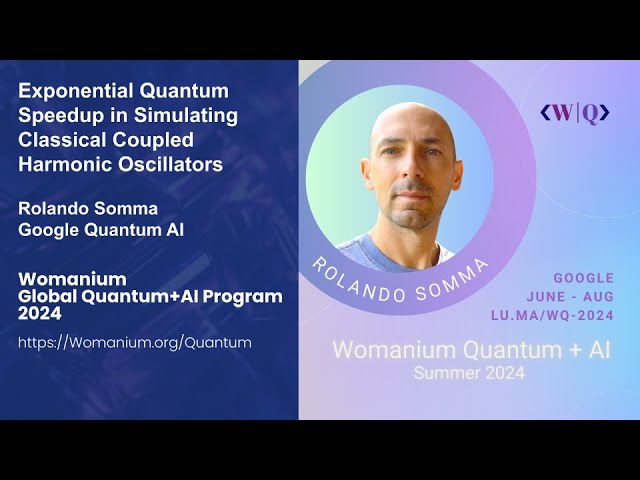
WOMANIUM QUANTUM + AI 2024: DAY 24 ❯ Exponential Quantum Speedup (Rolando Somma - Google Quantum AI)
Keywords
Summary
202 words
Critical Evaluation
Value of the Information & Strength of the Argument
The informational value is high: the speaker clearly distinguishes the reduction step (encoding classical dynamics into a quantum state) from the algorithmic contribution (efficient simulation under assumptions), and from the complexity-theoretic evidence for speedup. The argumentation is structured and honest about the limits of the result. The speaker explicitly states that most exponential-speedup quantum algorithms may never find practical applications, and that this particular result is promising because harmonic oscillators model a vast class of physical systems. The two proofs of hardness for classical computers—BQP-completeness via circuit-to-oscillator reduction and the glued-trees oracle problem—are presented as strong evidence rather than definitive proof of practical intractability. The discussion of assumptions (sparse interactions, compact parameter descriptions, simple initial states) is transparent and avoids overclaiming. The argument that the algorithm is ’the best a quantum computer can do’ for the stated precision is a nuanced point that strengthens the credibility of the result.
Scientific Rigor, Source Quality, Title Accuracy
The talk is grounded in a peer-reviewed publication with named collaborators (Ryan Babbush, Robin Kothari, Dominic Berry, Nathan Wiebe), and the speaker references the paper as the main source for details. The complexity-theoretic arguments are standard and correctly invoked (BQP, BQP-completeness, oracle separation). The title accurately describes the content, though the ‘WOMANIUM QUANTUM + AI 2024: DAY 24’ prefix is an event label. The description provides only the event website and schedule, not a direct link to the paper, which is a minor weakness for source verification. No comments were provided for analysis.
257 words
Title / Content Match
The title accurately reflects the core content: an exponential quantum speedup for simulating classical coupled harmonic oscillators, presented by Rolando Somma of Google Quantum AI. The 'WOMANIUM QUANTUM + AI 2024: DAY 24' prefix is a series/event label rather than a content descriptor.
Quality & Reliability
8/10
The talk is delivered by a recognized expert (APS Fellow, Google Quantum AI) and is based on a peer-reviewed publication with named collaborators. The technical content is presented with appropriate caveats about assumptions and complexity-theoretic evidence rather than overclaiming. The main limitation is the absence of a direct link to the paper in the description, and the transcript is truncated before the applications section concludes.
Key Moments
Markers derived by PSI from the transcript: the creator did not define chapters.
- Introduction of Rolando Somma and his background at Google Quantum AI and Los Alamos National Laboratory.
- Overview of the main result: an exponential quantum speedup for simulating classical coupled harmonic oscillators, with reference to the paper and collaborators.
- Description of the single classical harmonic oscillator, Newton's equations, and phase-space representation.
- Encoding of a single harmonic oscillator into a single qubit via a Hamiltonian that generates rotations.
- Generalization to exponentially many masses coupled by springs, and the definition of the quantum state encoding kinetic and potential energy terms.
- Assumptions required for efficiency: efficient access to parameters, sparse interactions, and simple initial conditions.
- Complexity of the quantum algorithm: polynomial in the number of qubits, logarithmic in the number of oscillators.
- Proof sketch of BQP-completeness via reduction from arbitrary quantum circuits to coupled-oscillator problems.
- The glued-trees problem recast as a spring-mass system, demonstrating exponential speedup in the oracle setting.
- Connection to Grover's algorithm and other quantum algorithms as classical oscillator systems.
Cited Sources
- WOMANIUM Quantum Program — Event website for the WOMANIUM Quantum + AI 2024 program, where the talk was delivered.
- WOMANIUM Quantum Schedule — Schedule of the WOMANIUM Quantum + AI 2024 event, listing the talk by Rolando Somma.
Contribution & Novelties
The talk presents a rare exponential quantum speedup for simulating a classical system, rather than a quantum one. The key novelty is the reduction of classical coupled harmonic oscillator dynamics to a Schrödinger-type equation on a polynomially sized quantum state, combined with a proof of BQP-completeness for the problem. This establishes that the problem is as hard as any problem a quantum computer can solve efficiently, providing strong evidence that classical computers cannot solve it efficiently. The work also connects classical and quantum dynamics in a way that may yield further complexity results, and suggests a new perspective for designing quantum algorithms by viewing them as classical oscillator systems.
Pour aller plus loin :
- BQP — Complexity class of problems solvable by a quantum computer in polynomial time with bounded error, central to the BQP-completeness argument.
- Hamiltonian simulation — The technique used to simulate the Schrödinger-type evolution of the encoded quantum state.
- Glued trees problem — The oracle problem modified into a spring-mass system to demonstrate exponential speedup.
- Harmonic oscillator — The classical system at the heart of the encoding and simulation.
182 words
Radar Profile
The radar profile shows a strong emphasis on technical depth and information quality, with high scores in niveau_technique and qualite_information. The quantity of information is substantial but slightly lower due to the truncated transcript. Overall reliability is high, reflecting the peer-reviewed basis and expert delivery.