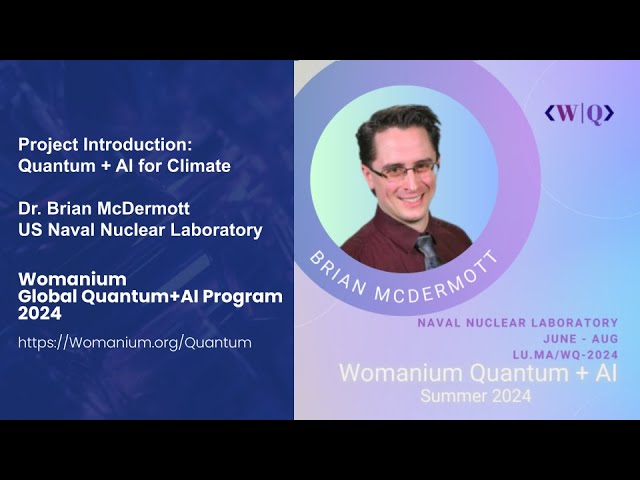
WOMANIUM QUANTUM + AI 2024: DAY 11 ❯ Project: Quantum + AI for Climate (Womanium & NNL)
Keywords
Summary
247 words
Critical Evaluation
Value of the Information & Strength of the Argument
The informational value here is primarily methodological and orientational rather than substantive. The speaker does not present results, benchmarks or data; he presents a framing of a research problem and a set of possible research directions. Within that framing, the value is real: he correctly identifies why Earth-system simulation is hard (non-linear coupled equations, multi-scale physics from cloud microphysics to planetary circulation, extreme computational cost), and he correctly characterises the three generic ways a new technology can help a simulation — speed, accuracy, or access to previously impossible calculations. The list of candidate project directions is concrete and technically literate: AI emulators/surrogate models of coupled climate systems, quantum algorithms for energy materials such as batteries and photovoltaics, quantum or AI treatment of cloud-radiation uncertainty, quantum machine learning for severe-storm identification on radar imagery, and energy-consumption comparisons across quantum hardware modalities. The argumentation is notably balanced. The speaker explicitly states that quantum and AI may well provide no advantage for a given application, and that establishing a negative result is as important as a positive one — a stance that is methodologically sound and rare in popular treatments of these topics. He also warns against the failure mode of treating a research brief as a prompt for a generative model, while simultaneously endorsing generative AI as a legitimate tool for re-explaining difficult terminology. The main weakness is that the argument never advances beyond the level of plausibility: no mechanism is given for why a particular quantum algorithm would beat a classical one on a specific Earth-system task, no complexity argument is sketched, and no existing result is cited to anchor the claims. The reasoning is sound but generic, and the audience is left with a taxonomy of possible projects rather than an argued position.
Scientific Rigor, Source Quality, Title Accuracy
Scientific rigour is moderate. The speaker’s epistemic caution is a genuine strength: he distinguishes carefully between what is possible and what is demonstrated, and he treats null results as informative. The framing of Earth-system modelling is accurate at the level of description. However, the talk is entirely devoid of citations, references, named studies, authors or quantitative claims. No specific paper, dataset, model or benchmark is mentioned, and no numerical figure is given anywhere in the transcript. The description provides only two links, both to the Womanium programme website and its schedule, which are organisational rather than scientific sources; they document the existence and structure of the programme but contain no research content. Consequently, no source cited in this video can be independently checked against the claims made, and the claims themselves are pitched at a level of generality that makes verification largely unnecessary but also limits their scientific weight. On title/content adequacy: the title accurately describes the session as the Day 11 presentation of the Womanium/NNL project on quantum and AI for climate, and the content delivers exactly that. No comments were provided for analysis, so no assessment of audience response is offered.
501 words
Title / Content Match
The title matches the content: it is the Day 11 session presenting the Womanium/NNL summer project on quantum and AI for climate and Earth-system modelling. The title is accurate, though it promises a 'project' rather than results, which is exactly what is delivered.
Quality & Reliability
6/10
The content is a project briefing by a credible speaker (principal R&D engineer at the US Naval Nuclear Laboratory) and is factually careful: it repeatedly frames quantum and AI as potentially enabling technologies rather than guaranteed wins, and explicitly states that negative results are as informative as positive ones. However, it contains no data, no quantitative results, no citations, and no demonstration; it is essentially a description of an open-ended student research project. Reliability of the framing is good, but the informational density and verifiability are limited.
Key Moments
Markers derived by PSI from the transcript: the creator did not define chapters.
- Introduction of Dr. Brian McDermott, principal R&D engineer at the Naval Nuclear Laboratory, and his role leading quantum technology integration.
- McDermott notes the project is unrelated to NNL's core work and is deliberately broad and research-focused.
- Explanation of why Earth systems are among the hardest systems to simulate: multi-scale physics, non-linear coupled equations, need for the largest supercomputers.
- The three ways quantum and AI could help: faster results, more accurate predictions, or new types of calculation.
- Project scope: applying AI, quantum or quantum-inspired methods to weather, climate and atmospheric science, from trace gases to global scale.
- Alternative direction: machine learning on open weather and climate datasets such as cloud formations, precipitation and severe storms.
- The four questions participants must answer: why the problem matters, how it is addressed today, how quantum/AI would improve it, and how an example app would be implemented.
- Concrete project examples: AI climate emulators running on laptops, quantum algorithms for batteries and photovoltaics, cloud-radiation uncertainty, quantum ML for tornado detection, energy consumption of quantum hardware.
- Closing advice: be bold, curious and creative; do not simply paste the project description into a generative AI tool, though using it to re-explain terminology is valid.
Cited Sources
- Womanium Quantum + AI programme page — Official programme page for the Womanium Quantum + AI initiative, referenced in the video description as the main resource for the summer programme.
- Womanium Quantum + AI programme schedule — Schedule of the programme sessions, referenced in the description; documents the context of this Day 11 project briefing.
Contribution & Novelties
The video’s originality lies not in scientific findings but in its framing of a research agenda. It articulates a structured way of thinking about where quantum computing and AI might enter the Earth-system modelling pipeline — speed, accuracy, or new calculable quantities — and pairs that with a concrete, technically literate list of candidate research directions spanning climate emulation, energy materials, cloud-radiation uncertainty, severe-storm detection and quantum hardware energy costs. Its most valuable contribution is methodological: the explicit insistence that demonstrating the absence of an advantage is a legitimate and important research outcome, and the warning against substituting generative AI output for genuine inquiry. It also usefully names the emerging practice of training fast surrogate or emulator models of large coupled systems to run on modest hardware, which is a genuinely active area of climate science.
Pour aller plus loin :
- Earth system model — Background on the class of coupled models the project targets.
- Numerical weather prediction — Explains the operational simulation context and its computational demands.
- Quantum machine learning — Overview of the subfield relevant to the proposed storm-detection project.
- Climate model — Covers model hierarchy, from general circulation models to simplified emulators.
- Surrogate modelling and emulation of climate models — Concept directly tied to the proposed laptop-scale AI climate emulator; no specific URL cited to avoid an unverified address.
222 words
Radar Profile
The profile is that of an orientation and methodology briefing rather than a technical exposition: information quantity and technical depth are moderate to low, while reliability is comparatively high because the speaker is careful about the limits of his claims. The overall shape is a flat, balanced radar, reflecting a talk that is credible and well-framed but deliberately non-technical and unsupported by data or citations.