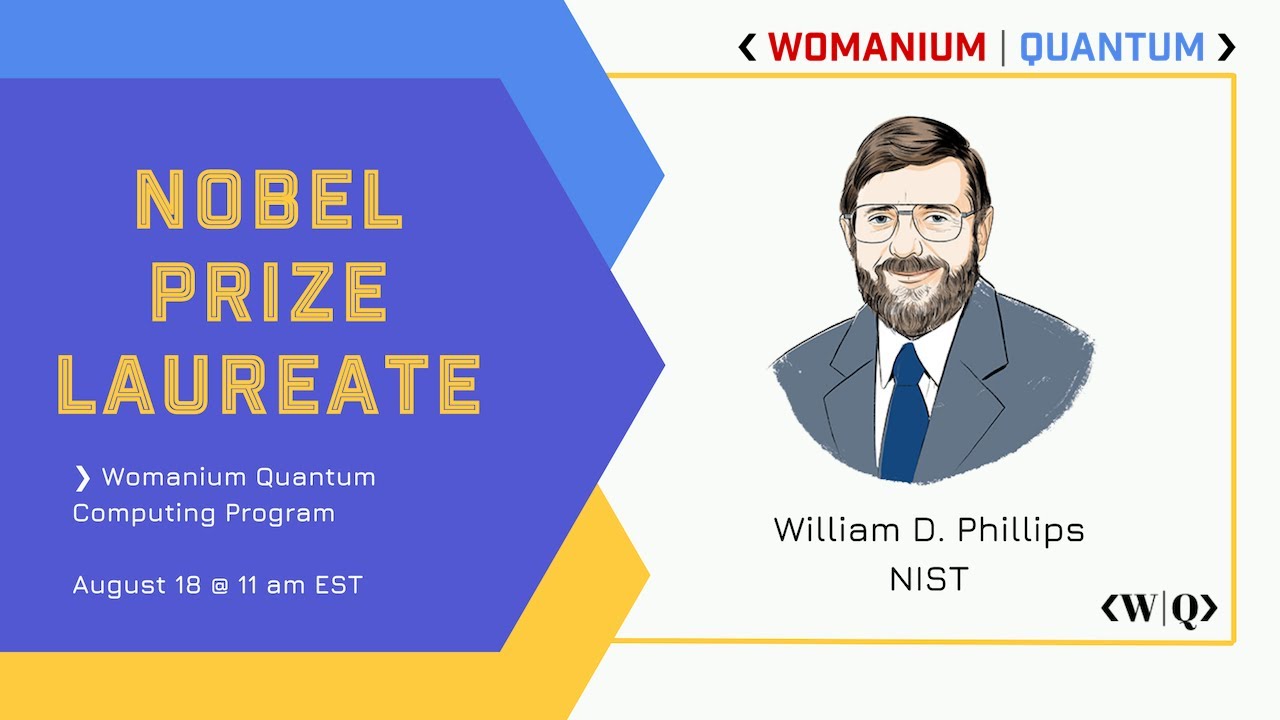
WOMANIUM QUANTUM ❯ Talk with Nobel Laureate William D. Phillips
Keywords
Summary
158 words
Critical Evaluation
Value of the Information & Strength of the Argument
The value lies in the unique first-hand account of a Nobel laureate’s scientific journey, offering inspiration and practical wisdom about the role of curiosity and serendipity. Phillips argues persuasively for curiosity-driven research as a fundamental driver of major discoveries, using his own career as a case study. He provides concrete examples: how a ‘mundane’ measurement strengthened his precision and later proved useful for the muon g-2 experiment, and how his initial resistance to laser cooling evolved into pioneering work. The argumentation is solid, grounded in personal experience rather than abstract theory, but it is anecdotal rather than systematically evidenced.
Scientific Rigor, Source Quality, Title Accuracy
The talk is rigorous in its scientific accuracy, as Phillips is a leading authority, and it aligns perfectly with the title. However, he does not cite external sources or publications; he only references his own work and that of colleagues like Ashkin and Wineland. The description provides links to the event page and WOMANIUM, which serve as primary sources for the talk itself. The title is an accurate label for the content. No external sources are evaluated for concordance.
193 words
Title / Content Match
The title accurately reflects the content: a talk with Nobel Laureate William D. Phillips about his work and career in quantum physics and laser cooling.
Quality & Reliability
8/10
The speaker is a Nobel laureate in Physics (1997) and a leading figure in laser cooling, providing first-hand accounts and expert insights. However, the talk is informal and anecdotal, with no external citations or peer-reviewed references, which slightly lowers the score.
Key Moments
Markers derived by PSI from the transcript: the creator did not define chapters.
- Introduction to WOMANIUM's mission and the importance of quantum science.
- Childhood curiosity, early experiments, and the influence of Marie Curie.
- Tennis story and the decision to pursue physics over sports.
- Graduate studies at MIT with Daniel Kleppner; first encounters with lasers.
- Development of laser cooling: breaking theoretical limits and discovering optical lattices.
- Application to atomic clocks and the impact on timekeeping standards.
Cited Sources
- WOMANIUM Quantum Event (lu.ma) — Event page for the talk with William D. Phillips.
- WOMANIUM Quantum Program — Organization behind the event, advancing quantum STEM education.
Contribution & Novelties
The talk offers a rare, unfiltered view of how a Nobel laureate thinks and works, highlighting the iterative and often unpredictable nature of scientific discovery. Phillips’s emphasis on ‘fooling around’ as a method challenges the common perception of rigid scientific planning. This is an original contribution that can inspire young researchers.
Pour aller plus loin :
- Laser cooling — Core technique discussed, central to Phillips’s Nobel work.
- Optical lattice — Discovery that emerged from laser cooling, now used in quantum simulators and clocks.
- Bose–Einstein condensate — Phillips mentions his early work on BEC; this is a related advanced topic.
99 words
Radar Profile
The profile shows high qualitative and reliability scores, reflecting the speaker's authority and the richness of anecdotes. Quantitative information is moderate, and the technical level is accessible but substantial. Overall, the profile indicates a highly valuable but informal expert testimony.