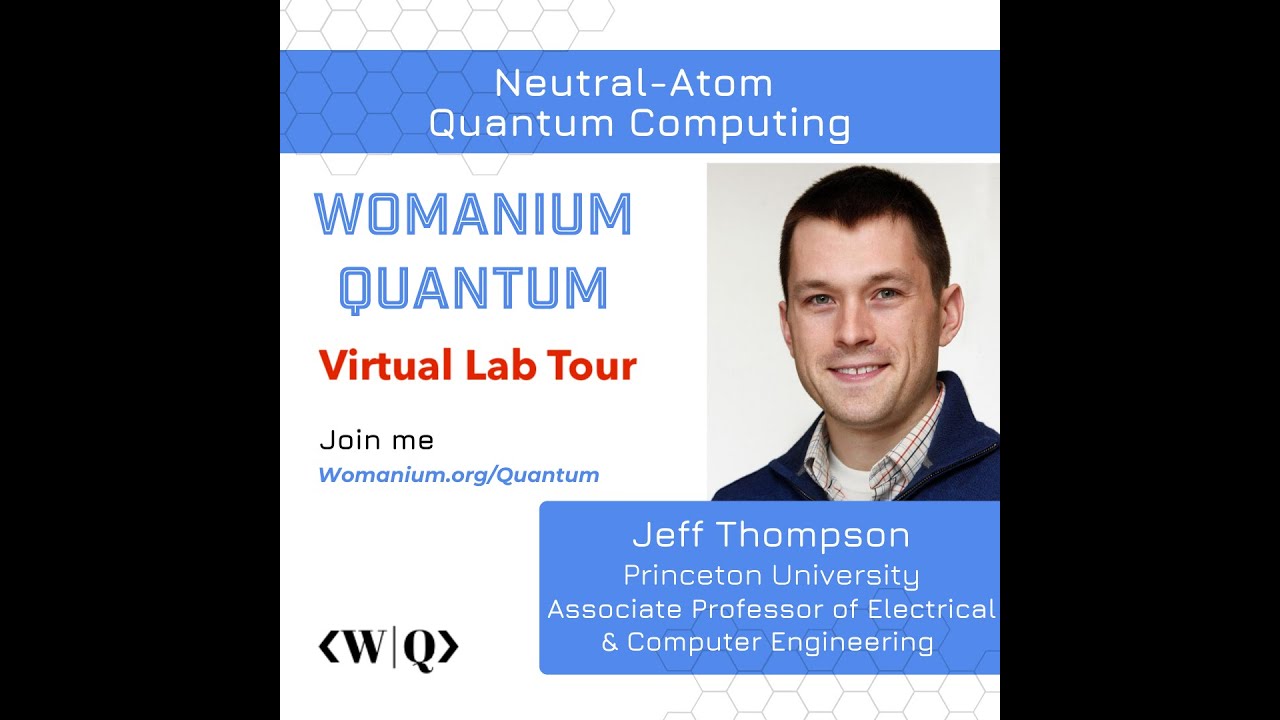
WOMANIUM QUANTUM : DAY 17 ❯ PRINCETON LAB TOUR + Neutral-Atom Quantum Computing + Bloch Sphere
Keywords
Summary
168 words
Critical Evaluation
Value of the Information & Strength of the Argument
The lecture provides a comprehensive and well-structured overview of neutral atom quantum computing, balancing conceptual explanations with concrete experimental details. Thompson’s argumentation is solid: he logically progresses from basic principles to advanced research directions, backing claims with experimental results and comparisons to other approaches. The inclusion of a lab tour adds practical value, making abstract concepts more tangible. While some analogies are simplified, the core technical content is rigorous and benefits from the presenter’s direct expertise.
Scientific Rigor, Source Quality, Title Accuracy
The scientific rigor is high: the talk reflects current research at Princeton and includes references to recent experiments from Harvar, the Max Planck Institute, and other groups. The sources cited are the field’s literature, though no formal citations are given in the transcript; the description links to QWorld and WOMANIUM’s quantum program. The title is accurate regarding the neutral atom topic and lab tour, though the ‘Bloch sphere’ is only briefly mentioned and not elaborated. The video contains a clear educational structure with Q&A segments. No comments were provided for analysis.
182 words
Title / Content Match
The title accurately conveys the main content: a lecture on neutral atom quantum computing, a lab tour, and mentions of Bloch sphere (though the Bloch sphere is not a central topic in the talk itself). The title is slightly broader than the actual emphasis, but the core topics are reflected.
Quality & Reliability
8/10
The video features a university researcher presenting his laboratory work and the state of the art in neutral atom quantum computing. The information is technically accurate and up-to-date, with clear explanations of complex concepts. Minor oversimplifications typical of a broad audience talk.
Key Moments
Markers derived by PSI from the transcript: the creator did not define chapters.
- Introduction and motivations for quantum computing
- Overview of neutral atom quantum computing platform
- Explanation of Rydberg blockade and gate implementation
- Recent experimental results and quantum simulation examples
- Thompson's group research on ytterbium atoms and erasure conversion
- Virtual lab tour and equipment demonstration
- Q&A session covering cost, lasers, and comparisons with other platforms
- Final remarks and acknowledgments
Cited Sources
- QWorld — Mentioned in the video description for further quantum learning resources.
- WOMANIUM Quantum Program — The organizing program for this event, mentioned in the video description.
Concurring Sources
- Neutral atom quantum computing — Review article contextualizing the platform's potential.
- High-fidelity control and entanglement of Rydberg-atom qubits — Supports the gate fidelities mentioned in the talk.
Contribution & Novelties
This video provides an accessible yet detailed account of a cutting-edge quantum computing platform, directly from a leading researcher. It bridges theoretical concepts (e.g., Rydberg physics) with practical laboratory realities, offering unique insights into the challenges and solutions in neutral atom systems. The discussion of erasure conversion for error correction is particularly novel and highlights a promising path toward fault tolerance.
Pour aller plus loin :
- Neutral atom quantum computer — Overview of the platform and its history.
- Rydberg blockade — Mechanism underlying two-qubit gates.
- Quantum error correction — Context for the erasure conversion approach discussed.
96 words
Radar Profile
The radar profile shows high scores across all dimensions, reflecting a well-rounded presentation. The strong technical level and reliability are balanced by excellent quantity and quality of information, making it a valuable resource for learners and practitioners alike.