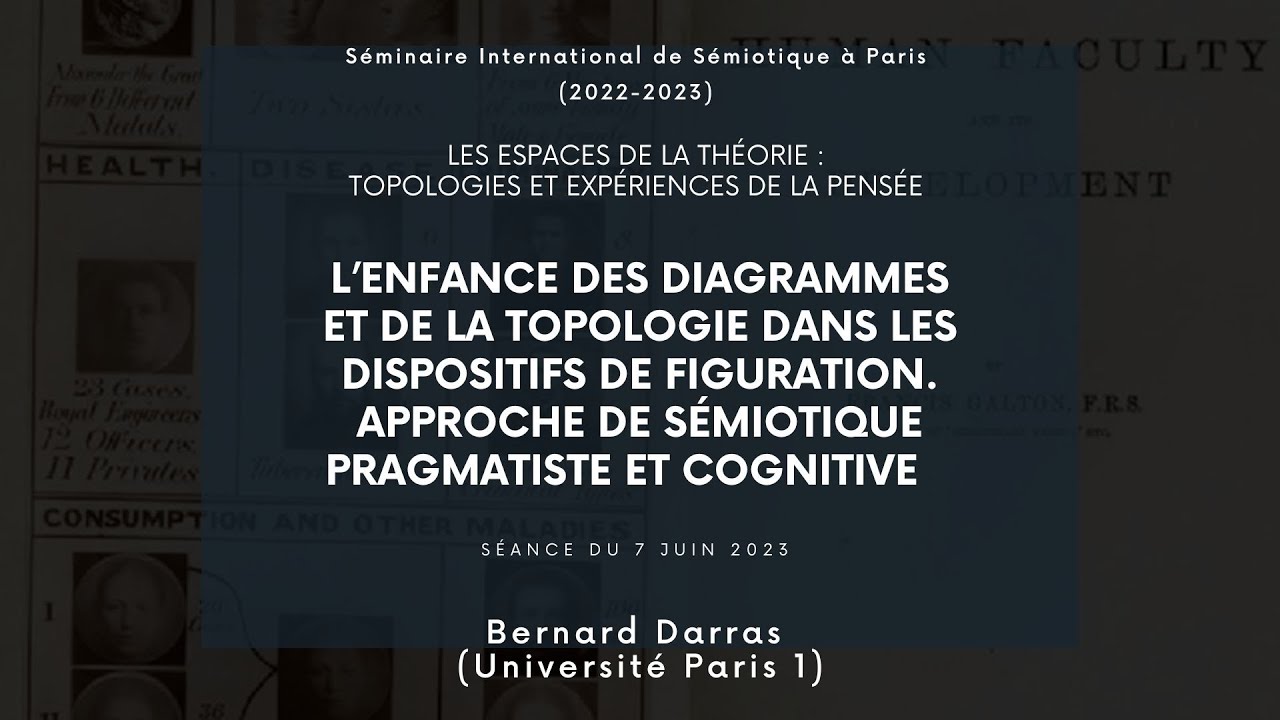
Bernard Darras (Université Paris 1) — Séminaire International de Sémiotique à Paris (07/06/2023)
Bernard Darras (Paris 1 University) — International Seminar of Semiotics in Paris (07/06/2023)
Keywords
Summary
163 words
Critical Evaluation
Value of the Information & Strength of the Argument
The value of this presentation lies in its systematic integration of Peircean semiotic theory with empirical evidence from developmental psychology, anthropology, and signaletics. Darras provides a clear conceptual framework for analyzing diagrams, distinguishing them from other icon types, and demonstrates how topological relations (adjacency, inclusion, etc.) are fundamental to diagrammatic representation. His argumentation is coherent, moving from theoretical definitions to concrete examples, and he effectively argues that diagrammatic thought is a mode of reasoning that goes beyond mere illustration. The insistence on the pragmatic and cognitive dimensions adds depth, and the cross-cultural comparisons strengthen the universality of the claims. However, the lecture assumes some familiarity with semiotic terminology, and the oral delivery sometimes obscures the precision of formal definitions.
Scientific Rigor, Source Quality, Title Accuracy
The scientific rigor is high, as Darras is an established scholar who draws on the works of Charles S. Peirce, as well as commentators like Anthony Jappy, Jean Fisette, and Nicolas Herdesmed. He references his own extensive research, including studies with primates and cross-cultural experiments, which lends credibility. However, specific citations (books, articles) are not named, making verification difficult. The title accurately reflects the content, though it does not mention the specific focus on diagrams and topology. The lecture is well-structured, but the lack of explicit references to peer-reviewed sources is a minor weakness. Overall, the presentation aligns with the standards of an academic seminar.
239 words
Title / Content Match
The title accurately describes the video: a seminar on semiotics given by Bernard Darras at the International Semiotics Seminar in Paris.
Quality & Reliability
8/10
The content is an expert seminar lecture by a university professor, grounded in Peircean semiotics and cognitive approaches. The arguments are logically structured and supported by examples, though no explicit citations of specific works are provided.
Key Moments
Markers derived by PSI from the transcript: the creator did not define chapters.
- Introduction of Peirce's triadic sign and the hypoicon concept
- Definition of diagrams as icons of relations and their role in representation
- Explanation of topological relations: adjacency, inclusion, intersection, and overlapping
- Examples from children's drawings: house and chimney, illustrating adjacency and inclusion
- Cross-cultural examples of inclusion in representations of pregnant women
- Discussion on the critique of 'transparency' as an optical metaphor, proposing topological interpretation
- Summary and implications for diagrammatic literacy and education
Cited Sources
- Charles S. Peirce — Main theoretical reference, his semiotics and concept of hypoicon
- Anthony Jappy — Commentator on Peirce's semiotics
- Jean Fisette — Cited in relation to diagram classification
- Nicolas Herdesmed — Mentioned as a commentator on Peirce
Contribution & Novelties
Darras offers an original synthesis of Peircean semiotics and topology, presenting diagrams as fundamental cognitive tools rather than mere illustrative devices. His empirical approach, using children’s drawings and cross-cultural examples, provides a concrete basis for abstract theoretical concepts. The lecture contributes to ongoing discussions on diagrammatic reasoning, challenging traditional optical interpretations and advocating for a topological perspective.
Pour aller plus loin :
- Peircean semiotics — Overview of Peirce’s key concepts.
- Diagrammatic reasoning — Further reading on the role of diagrams in cognition.
- Topology — Mathematical foundations of the topological approach.
- Hypoicon — In-depth discussion of Peirce’s icon taxonomy.
98 words
Radar Profile
The radar profile shows high scores in information quantity, quality, and technical level, reflecting a dense and well-structured seminar. The slightly lower reliability score indicates a reliance on oral expertise without explicit citations. Overall, this is a technically demanding but rich presentation.