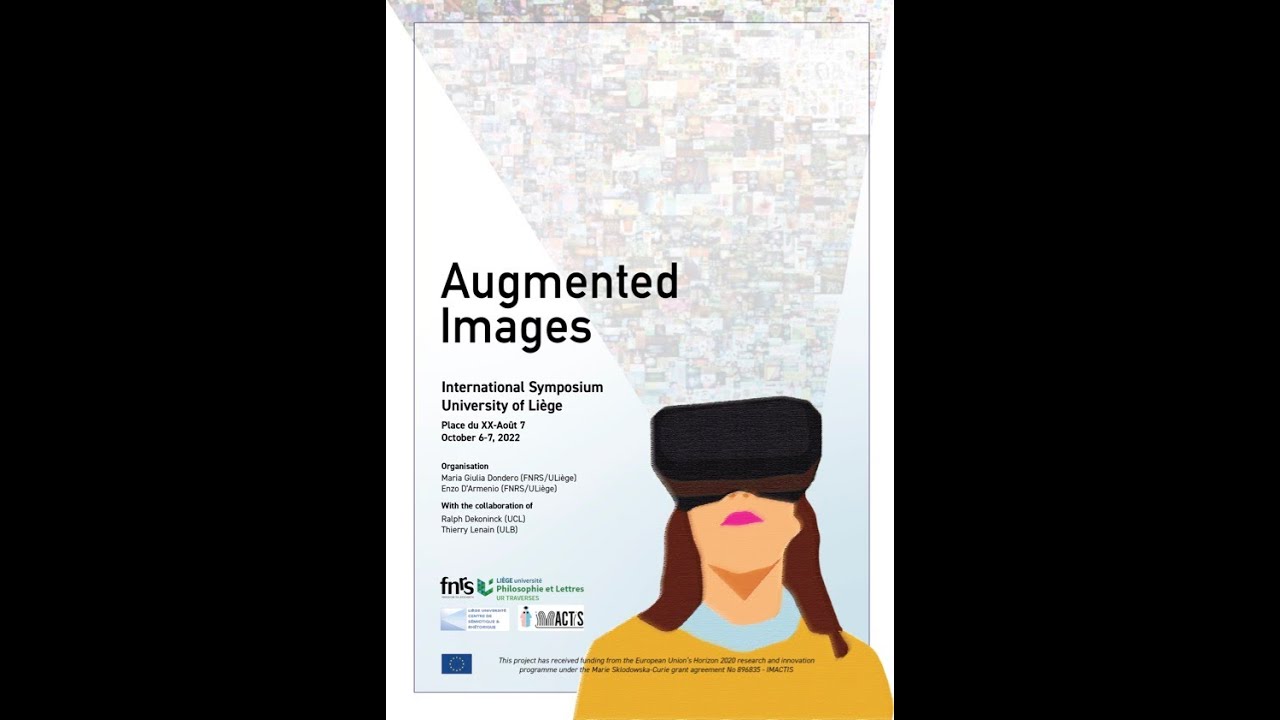
Johanna Drucker — Augmented Images (ULiège)
Keywords
Summary
240 words
Critical Evaluation
Value of the Information & Strength of the Argument
The lecture provides a compelling and original synthesis of concepts from visual studies, media theory, and science and technology studies. Drucker’s argument is well-structured: she moves from concrete examples (James Webb images, x-ray, sonar) to theoretical implications, consistently linking technical processes to cultural and historical frameworks. She effectively challenges the naive realism often associated with scientific imagery, showing how data are always mediated by conventions and expectations. Her use of diverse examples—from ancient mythology to modern astronomy—strengthens the argument and makes it accessible. The reasoning is sound; she acknowledges that some renderings are explicitly fictitious (spirit photography) while others are accepted as valid, and she interrogates the line between them. The value lies in prompting critical reflection on the constructed nature of visual evidence in the digital age.
Scientific Rigor, Source Quality, Title Accuracy
Drucker references a range of sources, including her own publications and other scholars, but provides few explicit citations in the talk. She mentions Percival Lowell, Charles Gilmore, and the Thought Forms of Besant and Leadbeater, but does not give specific bibliographic details. The title is well-matched: the talk indeed focuses on ‘Images after Optics’ and ‘Augmentation Technologies beyond the Visible Spectrum.’ However, the lecture is more of an interpretive essay than a rigorous citation-based review. The overall reliability is high due to the speaker’s expertise, but the lack of direct references limits verification. The description provides no external links, but the context of the international symposium adds credibility. There are no public comments to analyze, so no audience feedback is available.
264 words
Title / Content Match
The title accurately reflects the content: the talk discusses how images are augmented through algorithmic processing and cultural expectations, particularly beyond the visible spectrum.
Quality & Reliability
8/10
The speaker is a distinguished professor in information studies with a strong publication record. The talk is scholarly, well-structured, and draws on multiple examples and references. While it is an opinion/lecture rather than primary research, the argumentation is rigorous and consistent.
Key Moments
Markers derived by PSI from the transcript: the creator did not define chapters.
- Introduction of Johanna Drucker by the moderator.
- Drucker quotes the conference poster, framing the algorithmics as mediators between computer operations and cultural production.
- Discussion of James Webb Telescope images: processing of non-visible infrared signals, pixel value scales, and color assignment.
- Distinction between non-visible (infrared) and non-visual (e.g., logic, emotions), with historical examples like the winged bull and Sephirot.
- Examples of non-visual data renderings: magnetic fields, prize-winning novel networks, and 'Thought Forms' by Besant.
- Overview of the electromagnetic spectrum and non-optical telescopes: Arecibo and the Very Large Array, showing how radio signals become images.
- Comparison of X-ray and optical images of the Orion Nebula; discussion of capturing X-rays with Chandra telescope.
- Neutrinos and species-specific perception; trichromatic vs. dichromatic vision, and animal vision like bees seeing ultraviolet.
- Imaging technologies beyond photons: sonar, thermal imaging, and corona discharge photography; question of which renderings are deemed legitimate.
- Comparison of James Webb images with spiritualist photographs; discussion of belief systems and credibility.
- Mona Lisa copy and the historicity of visual features; examples of dinosaur reconstructions and Percival Lowell's Martian canals; concluding reflections.
Cited Sources
- Thought Forms (book) — Mentioned as a source for images of emotions, by Annie Besant and Charles Leadbeater.
- Percival Lowell's Mars maps — Referenced as an example of belief-driven imaging of canals on Mars.
- Charles Gilmore's dinosaur illustrations — Cited as an example of changing paleontological visualization.
Contribution & Novelties
Drucker’s talk offers a critical framework for understanding how images are augmented through algorithmic processing, emphasizing the role of cultural expectations and the ’technological imaginary.’ She brings together disparate examples—from scientific imaging to spirit photography—to question the authority attributed to certain types of imagery. Her approach is original in its broad interdisciplinary sweep, connecting media theory, art history, and the philosophy of science. The talk encourages scholars to question the naturalized status of computational images and to consider the historicity of perception.
Pour aller plus loin :
- Sociotechnical system — Relevant to the concept of the technological imaginary and how technologies and social practices co-evolve.
- Data visualization — Directly related to the rendering of non-visual data into visual forms, a central theme of the talk.
- Infrared astronomy — Explains the science behind James Webb images, a key example in the lecture.
141 words
Radar Profile
The radar profile shows high scores in quality of information and fiabilité, with slightly lower marks for quantity and technical depth. This reflects a lecture that is conceptually rich and persuasive, but not extremely dense in factual content or technical detail, focusing instead on interpretive and critical perspectives.