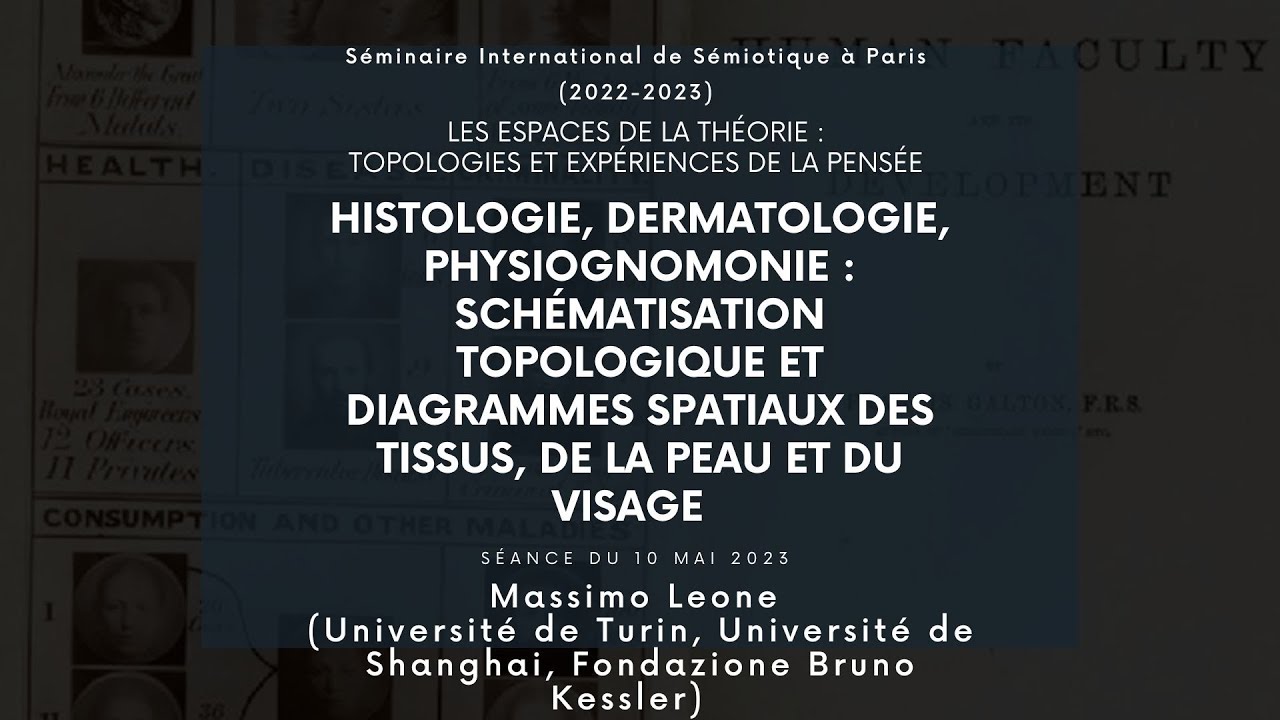
Massimo Leone (Univ. de Turin, Univ. de Shanghai) — Séminaire de Sémiotique à Paris (10/05/2023)
Massimo Leone (Univ. of Turin, Univ. of Shanghai) — Semiotics Seminar in Paris (10/05/2023)
Keywords
Summary
180 words
Critical Evaluation
Value of the Information & Strength of the Argument
The lecture provides high value by weaving together detailed historical research with semiotic theory. Leone’s argument is well-structured, moving from specific examples (street names, medical treatises) to broader conclusions about the function of diagrams as rhetorical devices. He convincingly demonstrates that the classification of diseases was not merely scientific but also served to assert a rationalized, yet spiritual, worldview. The argumentation is solid, supported by numerous specific references and examples, though the density of information might require careful attention from the listener.
Scientific Rigor, Source Quality, Title Accuracy
The scientific rigor is high, as Leone references primary sources (Bichat, Alibert, Alciat) and situates them historically. However, the lecture is not a systematic literature review but rather a personal exploration, which limits its generalization. The title accurately indicates the seminar context and the speaker’s affiliation. The content fully matches the promise of discussing topological diagrams and their application to skin and face. There are no obvious discrepancies between title and delivered material.
170 words
Title / Content Match
The title accurately reflects the content: a semiotics seminar focused on topological diagrams and the historical classification of tissues, skin, and face.
Quality & Reliability
8/10
Academic lecture with detailed historical references and clear argumentation, though the transcript is machine-generated and may contain minor inaccuracies. The speaker is a recognized expert in semiotics.
Key Moments
Markers derived by PSI from the transcript: the creator did not define chapters.
- Announcements and introduction by the seminar organizers.
- Presentation of Massimo Leone's academic career and the lecture topic.
- Start of the lecture: personal anecdote about Rue Bichat and toponymy.
- Discussion on Xavier Bichat and the foundation of histology.
- Exploration of Jean-Louis Alibert and the birth of dermatology.
- Analysis of medical diagrams and their connection to broader philosophical debates.
- Comparison with emblem books and the genealogy of visual cataloging.
- Conclusion on the role of images in semiotic theory and final remarks.
Cited Sources
- L'art du diagramme: littérature, sciences, arts — Mentioned by the speaker as a recent publication by Laurence Guedda (presented in the opening announcements).
- Description des maladies de la peau observées à l'hôpital Saint-Louis — Alibert's major work, referenced for its visual plates and classification system.
- Traité des membranes — Bichat's foundational text on tissue classification, cited in relation to histology.
- Emblemata — André Alciat's work on emblems, discussed as an early example of visual cataloging.
Contribution & Novelties
The lecture offers an original perspective by connecting the genealogy of scientific diagrams to broader semiotic and cultural history, showing how medical classification was both a scientific and rhetorical achievement. It bridges the gap between historical practices and contemporary semiotic theory, particularly in the concept of the ‘interstitial’ as an interface. The speaker’s personal narrative and historical detail enrich the understanding of how diagrams impose order on biological multiplicity.
Pour aller plus loin :
- Semiotics — Provides foundational concepts of sign theory, relevant to Leone’s framework.
- Histology — Scientific background on tissue study, contextualizing Bichat’s contributions.
- Physiognomy — Historical practice of reading character from faces, connected to Leone’s discussion of facial diagrams.
112 words
Radar Profile
The radar profile shows high scores across all dimensions, with a slight emphasis on information quality and quantity over technical level. This indicates a well-balanced lecture offering deep insight and solid argumentation, albeit presented at a high conceptual level.