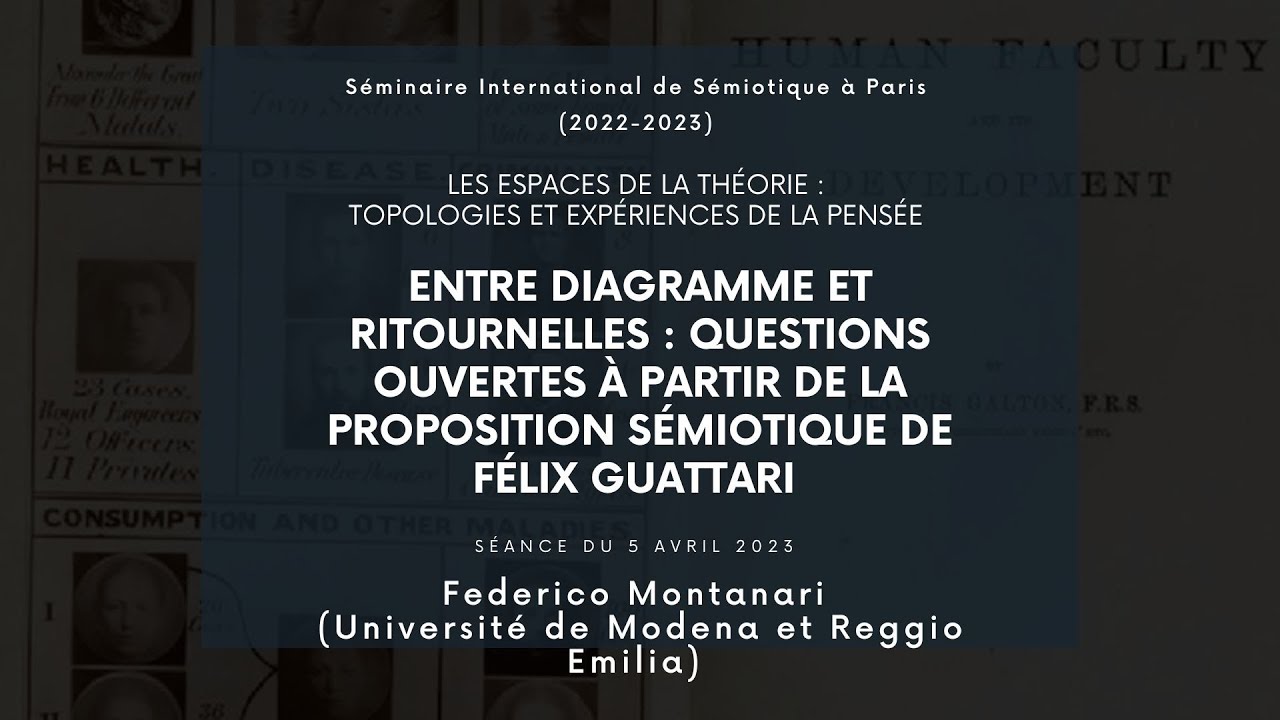
Federico Montanari (Un. Modena et Reggio Emilia) — Séminaire de Sémiotique à Paris (05/04/2023)
Federico Montanari (Un. Modena and Reggio Emilia) — Semiotics Seminar in Paris (05/04/2023)
Keywords
Summary
175 words
Critical Evaluation
Value of the Information & Strength of the Argument
The value of this exposition lies in its ability to re-articulate Guattari’s abstract concepts into a coherent map linking diagrammatics to the affective and territorial functions of the refrain. The argumentation is dense but logically structured: it moves from a precise dissection of the diagram as a processual and dynamic force, through its material implications for expression and content, to the ritournelle as an operator of territorialization and subjectivity. Montanari skillfully anchors these theoretical points with concrete examples—ranging from classical and popular music to television seriality and industrial metallurgy—thereby reinforcing the practical applicability of the concepts. The argument demonstrates a strong internal coherence, especially in showing how the diagram and the refrain interpenetrate within Guattari’s framework, and it effectively highlights the non-representational, machinic dimension of semiosis, offering a valuable contribution to the understanding of radical semiotic theory.
Scientific Rigor, Source Quality, Title Accuracy
The scientific rigor is grounded in direct references to ‘Mille Plateaux’, C.S. Peirce’s diagrammatic icon, and mentions of Maturana and Varela’s autopoiesis, indicating a solid engagement with primary and foundational texts. The quality of the sources appears high, although the presentation does not provide explicit citations in the video description beyond the seminar series itself, which limits external cross-verification. The title precisely matches the content delivered: it announces Guattari’s semiotic propositions with a focus on diagram and refrain, and the lecture adheres strictly to this promise. No significant discrepancy between the explicit title and the actual content was observed, making the title a reliable indicator of the lecture’s substance.
261 words
Title / Content Match
The title accurately reflects the content: a specialized seminar on Guattari's diagram and ritournelle concepts, staying strictly within the announced thematic scope.
Quality & Reliability
7/10
The presentation relies on primary sources (Deleuze & Guattari, Peirce) and offers a coherent scholarly argument, but the transcript is severely degraded due to auto-captioning and the video offers no external link to the speaker's publications, limiting independent verification of specific claims.
Key Moments
Markers derived by PSI from the transcript: the creator did not define chapters.
- Introduction of the seminar session and the speaker, Federico Montanari, with the topic on Guattari's propositions.
- Definition of the diagram in Guattari's terms as a dynamic set of variables, forces, and conditions of effectuation.
- Discussion on autopoietic machines, expression, and the connection to Maturana and Varela's theories.
- Introduction of the ritournelle (refrain) as a mechanism of territorialization and production of subjectivity.
- Exploration of the refrain in musical contexts (Blues, classical, popular) and its role in media seriality.
- Synthesis on stratification, the interplay of diagram and refrain, and concluding open questions on expression and political dimensions.
Cited Sources
- Séminaire International de Sémiotique à Paris - 'Les Espaces de la théorie' — The video itself, which is the eighth session of the seminar series, directed by Maria Giulia Dondero and Juan Alonso.
- A Thousand Plateaus (Mille Plateaux) — Central theoretical reference discussed throughout the lecture, particularly for the concepts of diagram and ritournelle.
- Anti-Oedipus (L'Anti-Œdipe) — Another foundational work by Deleuze and Guattari that frames the broader philosophical context of the talk.
Contribution & Novelties
The talk offers a novel synthetic reading that bridges Guattari’s diagrammatics with the territorial and affective functions of the refrain, demonstrating how these two concepts mutually constitute a process-based semiotics. It brings fresh applied perspectives by grounding abstract theory in musicology, media seriality, and crafts, thus making the concepts more tangible for interdisciplinary use. The explicit articulation of the diagram’s non-representational, machinic nature is a valuable clarification that goes beyond common visual analogies.
Pour aller plus loin :
- A Thousand Plateaus — Primary source for the concepts of diagram and ritournelle, essential for verifying the claims made.
- Félix Guattari — Contextualizes the philosopher and his broader contributions to schizoanalysis and ecosophy.
- Charles Sanders Peirce — Origin of the diagram/icon typology that Guattari reinterprets in his own framework.
- Autopoiesis — Core theory of Maturana and Varela, directly relevant to the discussion of self-organizing machines in the lecture.
146 words
Radar Profile
The radar profile shows a high technical level and solid theoretical rigor, but with moderate accessibility and a limited verifiable source base (relying on internal conceptual exposition). This suggests a sophisticated but niche academic contribution, likely to highly benefit specialized audiences while remaining opaque to generalists.