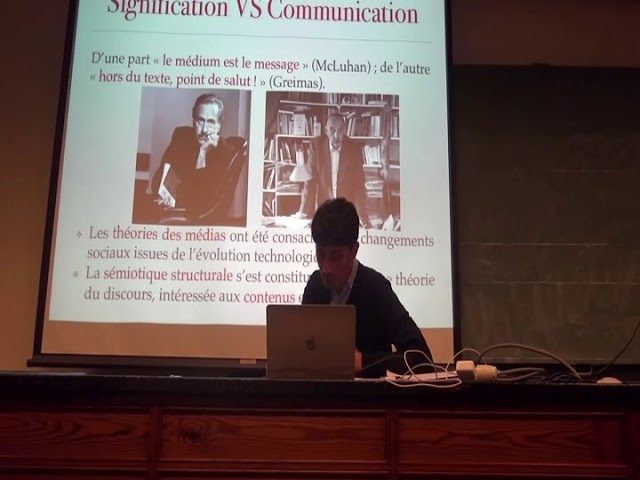
Conférence Enzo D’Armenio (19/10/2019)
Conference Enzo D’Armenio (19/10/2019)
Keywords
Summary
162 words
Critical Evaluation
Value of the Information & Strength of the Argument
The lecture offers a rich theoretical exploration of how digital devices function as ‘prostheses’ extending human capabilities. It builds on a solid base of semiotic theory (Greimas, Lotman) and media theory (McLuhan) to propose a nuanced analysis. The argumentation is structured, though the poor transcription makes it hard to follow every nuance. The speaker likely supports his claims with examples from media examples and philosophical references, but the argument’s strength is best assessed with a better audio/visual record.
Scientific Rigor, Source Quality, Title Accuracy
No explicit sources are listed in the video description, and the transcription does not clearly mention specific citations or publications. The title correctly identifies the event, but the lack of accessible references reduces the verifiability of the content. The speaker’s academic affiliation (via the channel) implies a certain rigor, but the absence of transparent sourcing is a limitation. There is a good match between title and content; no misleading elements are apparent.
165 words
Title / Content Match
The title is perfectly descriptive: it indicates a lecture by Enzo D'Armenio with the date, matching the content.
Quality & Reliability
6/10
The lecture appears academically grounded, but the automatic transcription is very poor, and no explicit sources are cited. The content likely follows a coherent semiotic/media-theoretical framework, but verification is limited by the transcription quality.
Key Moments
Markers derived by PSI from the transcript: the creator did not define chapters.
- Introduction: presentation of the conference and the semiotic framework.
- Discussion on digital devices as prosthetic extensions, referencing McLuhan.
- Analysis of Black Mirror episodes to illustrate the transformation of perception and memory.
- Conclusion: implications for semiotic theory and social communication.
Contribution & Novelties
The main contribution is the application of semiotic and phenomenological analysis to contemporary digital prostheses, bridging McLuhan’s media theory with modern practices. It offers a fresh perspective on how portable media reshape human experience and social interaction.
Pour aller plus loin :
- Marshall McLuhan — Directly relevant for the concept of media as extensions of the self.
- Semiotics — Foundational for the semiotic framework used in the lecture.
- Black Mirror — The TV series serves as a key illustrative example throughout the talk.
83 words
Radar Profile
The scores show a moderate balance, with quantity of information higher than technical level, suggesting the content is conceptually rich but not heavily technical. Fiabilité is decent, reflecting the academic context, but limited by lack of explicit sources.