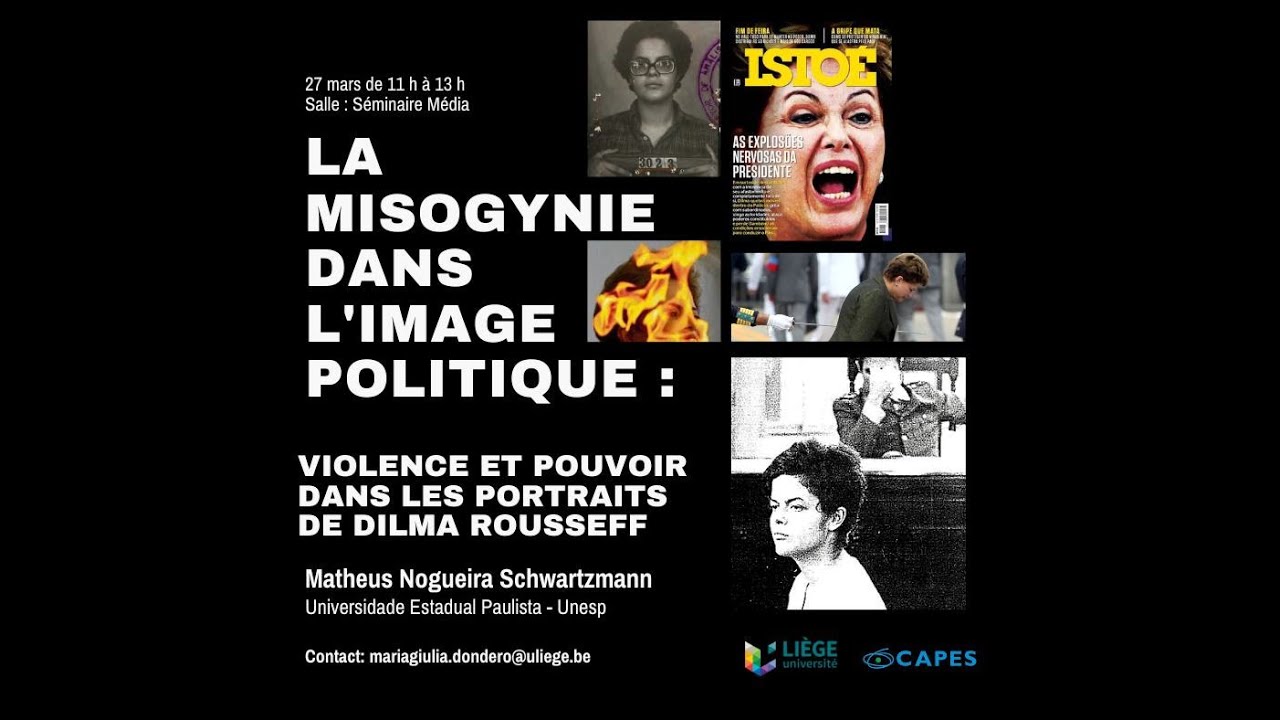
Conférence de Matheus Schwartzmann (Université de l’État de São Paulo – UNESP) — ULiège (27/03/2023)
Conference by Matheus Schwartzmann (São Paulo State University – UNESP) — ULiège (27/03/2023)
Keywords
Summary
122 words
Critical Evaluation
Value of the Information & Strength of the Argument
The value of this lecture lies in its interdisciplinary approach, combining semiotics, media studies, and gender politics. It offers a detailed case study that illustrates how visual imagery can be weaponized against female politicians. The argumentation is solid, as the speaker grounds his analysis in established semiotic theories (e.g., Fontanille, Dondero) and supports his claims with concrete examples from Brazilian press coverage. However, some claims are based on subjective interpretation, and the lecture does not provide quantifiable evidence for the impact of these images. Overall, it is a thought-provoking and well-structured presentation.
Scientific Rigor, Source Quality, Title Accuracy
The lecture demonstrates scientific rigor through its systematic use of semiotic methodology and reference to academic literature. While the speaker cites theorists like Fontanille, he does not provide a formal bibliography, relying on the audience’s familiarity. The title is highly accurate, precisely describing the content’s focus on misogyny in political portraits of Dilma Rousseff. The lecture is well-suited for an academic audience, though it may be dense for general viewers.
177 words
Title / Content Match
The title accurately reflects the content, which specifically addresses misogyny in media portraits of Dilma Rousseff.
Quality & Reliability
8/10
The speaker is a university professor and the lecture is based on his academic research, using established semiotic theories. However, sources are not formally cited within the talk, relying on the audience's familiarity with key theorists.
Key Moments
Markers derived by PSI from the transcript: the creator did not define chapters.
- Introduction and presentation of the speaker by Maria Giulia Dondero.
- Discussion of theoretical and methodological challenges in analyzing media portraits.
- Exploration of portraits as semiotic devices that extract subjects from their environment.
- Background on Dilma Rousseff, including her political career and media attacks.
- Analysis of four media narratives used to portray Rousseff in a negative light.
- Conclusion on the role of media in shaping public opinion and the implications for gender politics.
Contribution & Novelties
This lecture offers a fresh perspective on the intersection of semiotics and political communication, specifically demonstrating how the genre of portraits can be used to propagate misogynistic narratives. The innovative aspect is the systematic analysis of a series of images across Brazilian media, rather than a single text.
Pour aller plus loin :
- Semiotics — Provides foundational concepts for understanding the analysis.
- Dilma Rousseff — Background on the political figure and her impeachment.
- Misogyny — Definition and context of gender-based discrimination.
- Visual rhetoric — Relevant to the analysis of images.
90 words
Radar Profile
The radar profile shows high scores in information quality and technical level, indicating a scholarly presentation. The quantity of information is moderate, reflecting the conceptual focus. Overall, the lecture is robust in content but may require prior knowledge of semiotics.