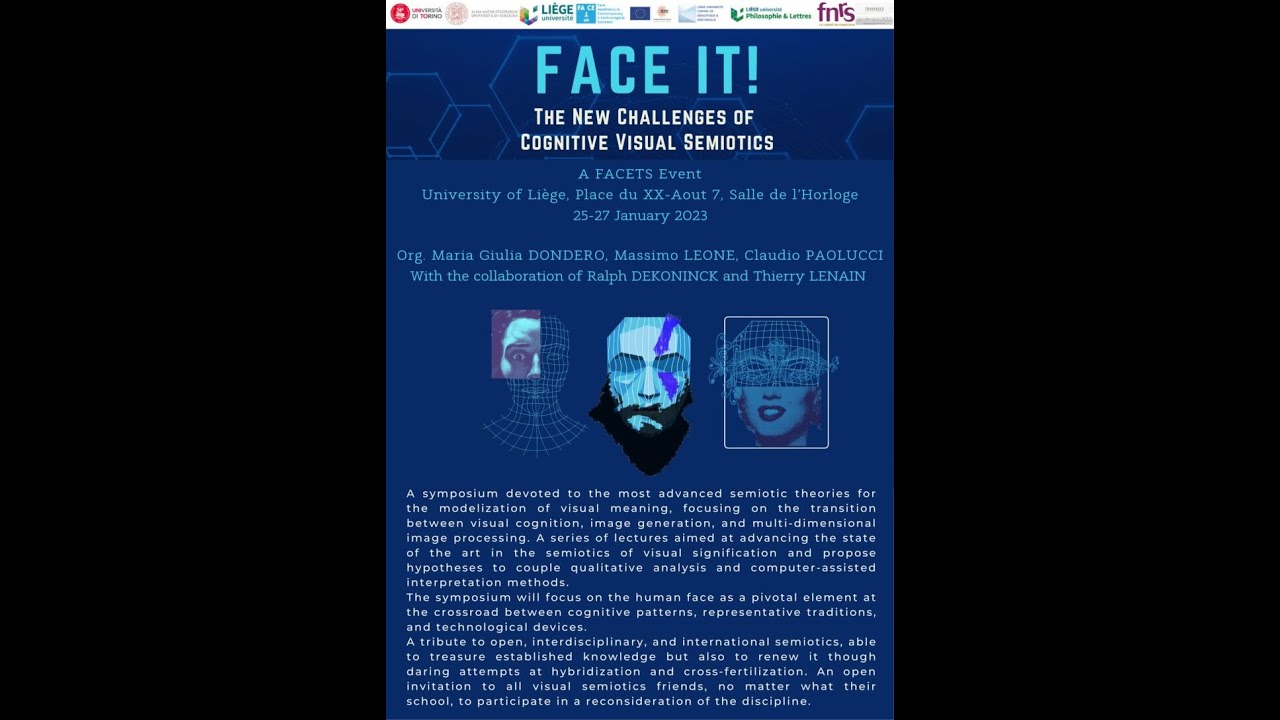
Claudio Paolucci — Face It! (ULiège)
Keywords
Summary
126 words
Critical Evaluation
Value of the Information & Strength of the Argument
The talk offers a valuable synthesis of enactivist philosophy and semiotics, proposing a novel ‘material semiotics’ that emphasizes the role of material culture in shaping cognition. The argument is solidly structured: it starts with a concrete example (face perception) to illustrate theoretical points, then uses historical cases (the shift from truth as integrity to truth as correspondence, the Boyle-Hobbes debate) to support the claim that material technologies alter the concept of truth. The argumentation is nuanced, avoiding naive constructivism while acknowledging the constructive role of machines. However, some steps rely on personal authority (e.g., citing his own work) and the logical connection between digital images and the return to a trust-based notion of truth could be more systematically developed.
Scientific Rigor, Source Quality, Title Accuracy
The speaker references several works, including a book by Richard Green on the history of truth and Shapin and Schaffer’s ‘Leviathan and the Air-Pump’, though without explicit URLs. These references lend historical credibility, but the talk does not provide systematic citations, typical of a keynote. The title ‘Face It!’ is catchy and relates to the face perception example, but the actual content is broader, covering semiotics and truth. The title-adéquation is acceptable, with a minor mismatch in scope.
212 words
Title / Content Match
The title 'Face It!' is somewhat cryptic but reflects the focus on faces as a key example of cognitive scaffolding, matching the content.
Quality & Reliability
7/10
The talk is an academic keynote by a senior scholar in semiotics, drawing on established theories (enactivism, material culture) and historical examples (Boyle vs Hobbes). The argument is coherent but relies on personal interpretation and selected references without systematic peer review. The scientific quality is high for a conference keynote, but the absence of explicit citations in the video and the subjectivity of philosophical claims moderate the score.
Key Moments
Markers derived by PSI from the transcript: the creator did not define chapters.
- Introduction: praise for young scholars and the purpose of the conference.
- Definition of cognitive semiotics as asking how we know the world.
- Discussion of narrative universes and the role of signs.
- Argument for material semiotics: artifacts scaffold cognition.
- Example of newborns' face preference and perceptual narrowing.
- Critical periods in language acquisition and experience-dependent brain shaping.
- Historical shift in meaning of 'truth' from integrity to conformity via documents.
- Boyle vs Hobbes: machines produce reality, not documents.
- Modern digital machines produce fakes and metadata, affecting truth and trust.
Cited Sources
- Green, Richard: Book on the history of truth (title not specified) — Mentioned in the talk regarding the shift in meaning of 'truth'.
- Shapin, S. & Schaffer, S. Leviathan and the Air-Pump — Referenced in the discussion of Boyle vs Hobbes and machine-produced reality.
Contribution & Novelties
The talk contributes a distinctive ‘material semiotics’ perspective, bridging enactive cognition and semiotics, and applies it to digital images. It highlights the under-explored role of material culture in shaping cognitive processes, offering a counterpoint to both social constructivism and naive realism.
Pour aller plus loin :
- Enactivism — Key theoretical basis for the claim that cognition arises from interaction with environment.
- Material culture — Central concept for understanding how artifacts scaffold cognition.
- Cognitive semiotics — The field the talk seeks to redefine.
- Critical period — Relevant to the discussion of language acquisition and perceptual narrowing.
95 words
Radar Profile
The profile shows strong scores in qualitative information and technical level, with slightly lower quantitative information, reflecting a conceptual keynote rather than a data-rich presentation. The reliability is solid but not maximal due to the absence of explicit citations.