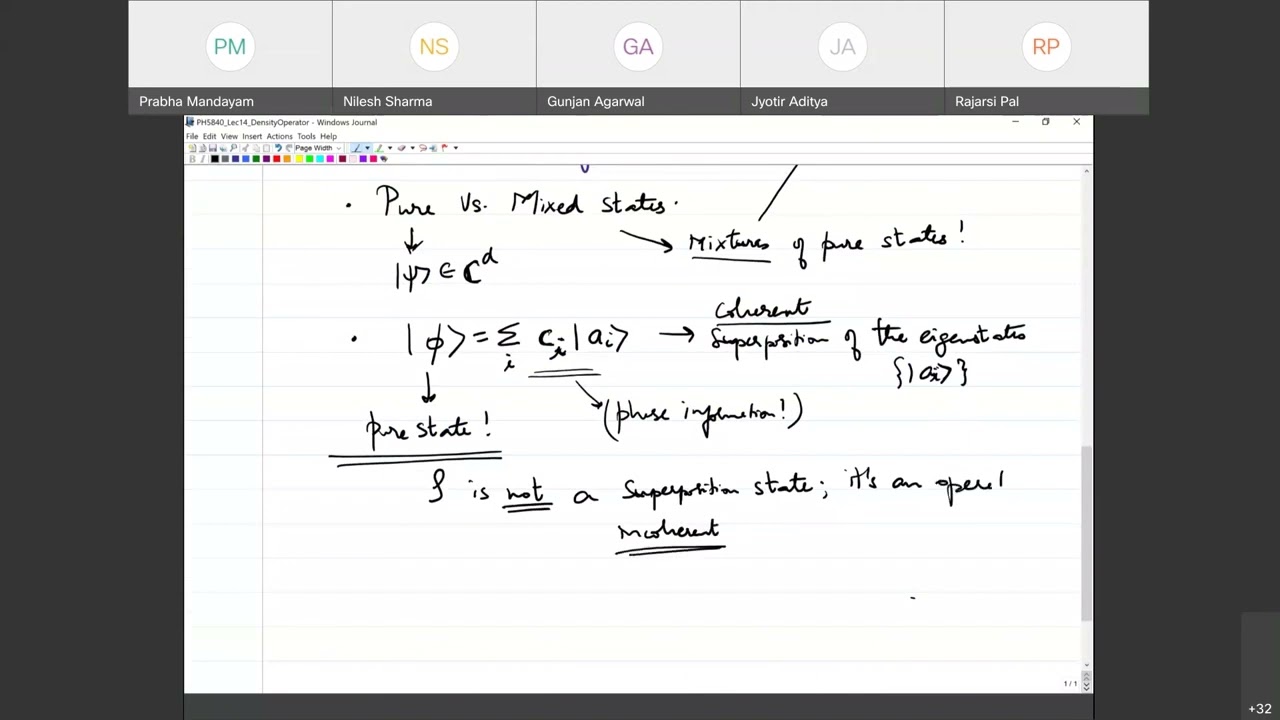
Quantum Computation and Quantum Information: Lecture 14 (The density operator I)
Keywords
Summary
191 words
Critical Evaluation
Value of the Information & Strength of the Argument
The lecture offers substantial value by filling a critical gap in the standard quantum mechanics curriculum: the formal description of mixed states and statistical ensembles. The argumentation is rigorous and systematic. The instructor first motivates the need for a new formalism by highlighting the inadequacy of pure state vectors in describing measurement outcomes, then builds the density operator definition from the ground up, proving each required property. The proof that density operators are positive semi-definite and trace-one is carefully executed via bra-ket algebra, and the converse (any such operator corresponds to an ensemble) is established via spectral decomposition. The clarity of the exposition is enhanced by frequent comparisons between pure and mixed states, and by the use of concrete examples such as the two-state communication scenario. The argumentation is deductive and mathematically sound, making it a valuable resource for learners and a solid reference for practitioners.
Scientific Rigor, Source Quality, Title Accuracy
The scientific rigor is high, as the content is based on the canonical textbook by Nielsen and Chuang (Section 2.4). The instructor acknowledges prior knowledge and builds upon established formalism. The sources are authoritative and the presentation is consistent with standard quantum information theory. The title accurately describes the content: it is the 14th lecture in a dedicated course on quantum computation and information, focusing specifically on the density operator. The lecture is self-contained within the broader course structure, and the mathematical derivations are complete and correct. No external claims are made without justification, and the reasoning is transparent. Overall, the source quality is exemplary for an academic lecture.
270 words
Title / Content Match
The title accurately reflects the content: the lecture focuses exclusively on the density operator formalism and its foundational role in describing quantum states, as indicated by 'Lecture 14 (The density operator I)'.
Quality & Reliability
9/10
Academic lecture delivered as part of a formal course at IIT Madras, based on the standard textbook Nielsen & Chuang. The presentation is mathematically rigorous, with clear definitions and proofs of properties. The instructor is an experienced academic, and the content aligns with established quantum information theory.
Key Moments
Markers derived by PSI from the transcript: the creator did not define chapters.
- Introduction: review of previous lectures and announcement of the topic (density operator).
- Motivation: why pure state vectors are insufficient; measurement leads to ensembles.
- Definition of density operator as a convex sum of projectors onto pure states.
- Properties of density operators: Hermitian, positive semi-definite, trace one; proofs given.
- Spectral decomposition and converse: any positive semi-definite trace-one operator is a density operator.
- Measurement transformation on density operators: map defined using projective operators.
- Example: measuring a pure state and deriving the post-measurement ensemble.
Cited Sources
- Quantum Computation and Quantum Information (Section 2.4) — The lecture explicitly references Nielsen and Chuang's textbook, Section 2.4, which covers the density operator formalism. The Wikipedia article provides an overview of the book, but the actual content is from the textbook itself.
Concurring Sources
- Nielsen, M. A., & Chuang, I. L. (2010). Quantum Computation and Quantum Information (10th ed.). Cambridge University Press. — The lecture follows Section 2.4 of this standard textbook, which is the canonical reference for quantum information. No URL is provided, but the book is widely available.
Contribution & Novelties
This lecture provides a comprehensive and pedagogically clear introduction to the density operator formalism, a fundamental tool in quantum information. Its original contribution lies in the structured derivation of density operator properties from measurement scenarios, making the abstract concept intuitive. The lecture successfully bridges the gap between pure state physics and statistical mixtures, a crucial stepping stone for understanding quantum noise, decoherence, and open quantum systems.
Pour aller plus loin :
- Density matrix (Wikipedia) — Overview of density matrices, including mathematical definitions and applications.
- Quantum decoherence (Wikipedia) — Concept of decoherence, which naturally arises from mixed states and density operators.
- POVM (Wikipedia) — Positive operator-valued measures, an extension of projective measurements discussed in the lecture.
115 words
Radar Profile
The radar profile shows high scores across all dimensions: information quantity (8), quality (9), technical level (9), and reliability (9). The lecture is dense in content, technically advanced, and authoritative. The low variance indicates a well-balanced presentation that is both informative and rigorous, catering to an audience with strong prerequisites in linear algebra and quantum mechanics.