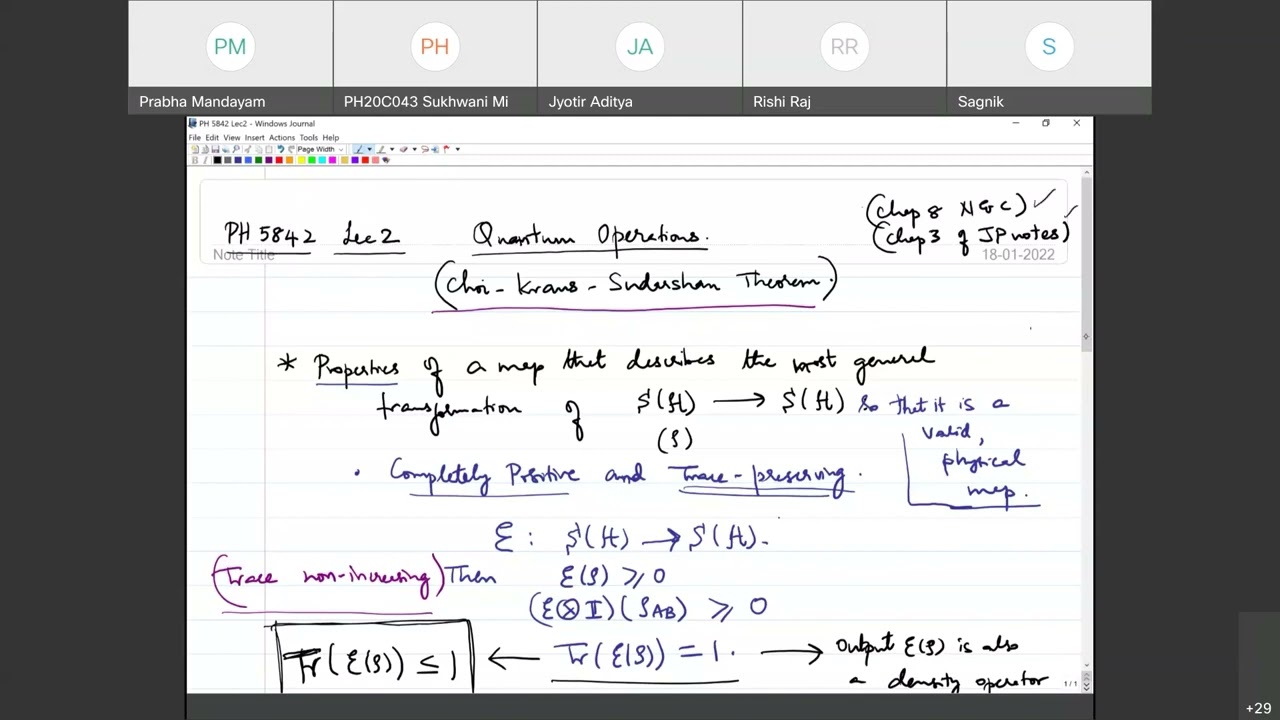
QEC and Quantum Information Theory: Lecture 2 Quantum Operations - II
Keywords
Summary
169 words
Critical Evaluation
Value of the Information & Strength of the Argument
The lecture provides a comprehensive and rigorous exposition of the operator sum representation for quantum operations. The argumentation is solid, with step-by-step proofs of the key theorems. The instructor carefully explains the physical motivations behind the mathematical constraints, such as trace preservation ensuring probability conservation and complete positivity ensuring valid evolution of entangled states. The use of the transpose map as an example of a positive but not completely positive map effectively illustrates the subtlety. The lecture also connects the material to previous knowledge (POVMs) and to practical applications like quantum error correction.
Scientific Rigor, Source Quality, Title Accuracy
The lecture is based on well-established references: Nielsen and Chuang’s ‘Quantum Computation and Quantum Information’ (Chapter 8) and John Preskill’s lecture notes (Chapter 3). The instructor also credits E.C. George Sudarshan for his independent contribution to the theorem. The presentation is mathematically rigorous, with all necessary assumptions stated. The title accurately reflects the content, as it is indeed the second lecture on quantum operations. The lecture maintains a high level of scientific rigor throughout.
182 words
Title / Content Match
The title accurately reflects the content: a lecture on quantum operations, specifically the second lecture in the series, focusing on operator sum representation and CPTP maps.
Quality & Reliability
9/10
Rigorous mathematical presentation of advanced quantum information concepts, based on standard textbook and lecture notes. The lecture is well-structured, with clear proofs and examples, and includes pedagogical interactions.
Key Moments
Markers derived by PSI from the transcript: the creator did not define chapters.
- Introduction and review of quantum operations properties
- Discussion of trace non-increasing maps and normalization
- Introduction of the Choi-Kraus-Sudarshan theorem and operator sum representation
- Proof of the converse: operator sum decomposition implies CPTP
- Normalization of trace non-increasing maps by adding a Kraus operator
- Explanation of complete positivity and the transpose map example
Cited Sources
- Nielsen & Chuang, Quantum Computation and Quantum Information — Main reference for the course, particularly Chapter 8 on quantum operations.
- John Preskill, Lecture Notes on Quantum Computation — Additional reference, Chapter 3 discusses measurement and evolution, including CPTP maps.
Contribution & Novelties
This lecture provides a thorough pedagogical exploration of the operator sum representation, which is fundamental to quantum information theory. It clarifies the distinction between positive and completely positive maps, and the role of trace preservation. The ‘Pour aller plus loin’ section includes relevant concepts for further study.
Pour aller plus loin :
- Kraus operator - Standard reference for operator sum representation.
- Quantum channel - General framework for CPTP maps.
- POVM - Measurement formalism closely related to operator sum decomposition.
79 words
Radar Profile
The radar shows high scores across all dimensions, with particularly high technical level and reliability, indicating a dense, advanced lecture suitable for graduate students.