Quantum Computation and Quantum Information: Lecture 18 (Entanglement and Bell States)
Keywords
Summary
167 words
Critical Evaluation
Value of the Information & Strength of the Argument
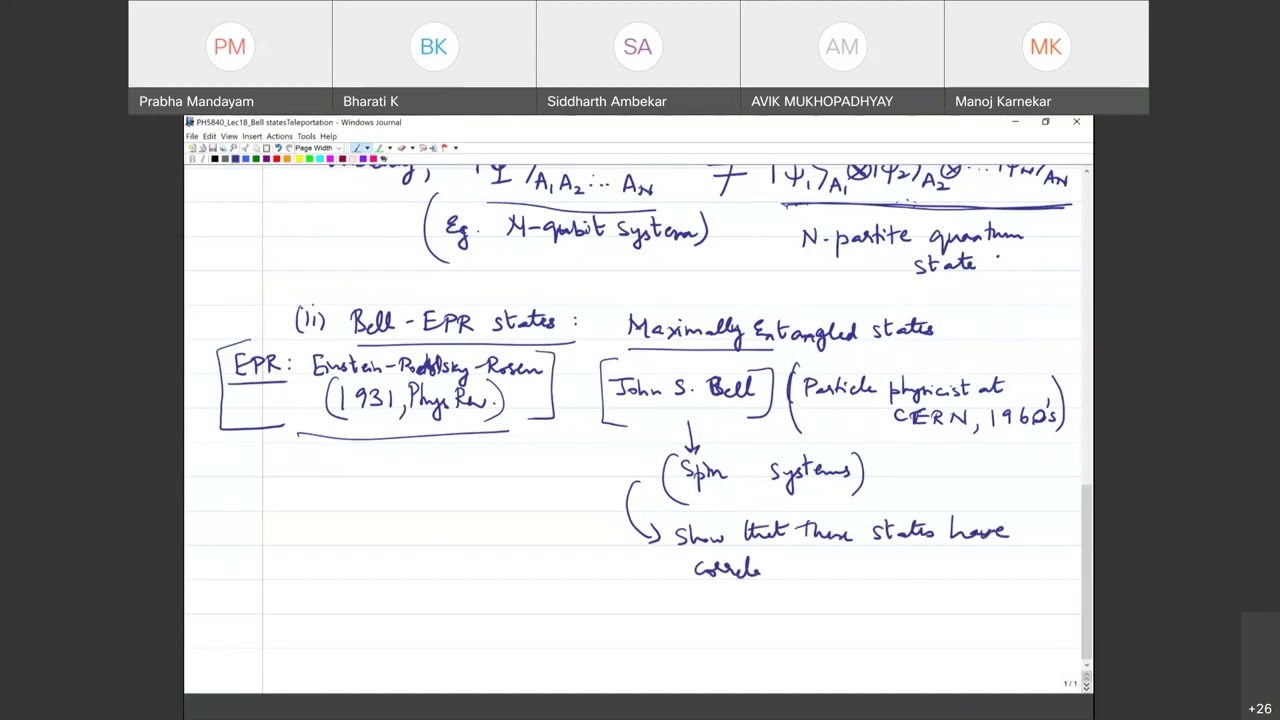
The lecture provides a solid introduction to entanglement and Bell states, building from first principles. The argumentation is clear and logical: the instructor carefully defines product states, introduces the notion of entangled states as non-factorizable, and then demonstrates the consequences for measurement outcomes. The use of examples (maximally entangled, non-maximally entangled, and product states) effectively illustrates the concept of correlation. The discussion of the EPR paper and Bell’s work gives historical depth, though the instructor misstates the year of the EPR paper (saying 1931 instead of 1935). The motivation for teleportation is well laid out, connecting the theoretical framework to practical applications. The pedagogical approach is strong, engaging students with questions and clarifying misconceptions.
Scientific Rigor, Source Quality, Title Accuracy
The content is scientifically rigorous, consistent with standard quantum information theory. No primary sources are cited in the video description, but the instructor references the EPR paper and John Bell’s contributions by name. The title is fully appropriate: it accurately reflects the lecture’s focus on entanglement and Bell states. The lecturer’s expertise and the institutional context (IIT Madras) lend credibility. No external references are provided, but the formal treatment is mathematically sound. The only minor issue is the incorrect year given for the EPR paper, which could mislead viewers if not corrected.
221 words
Title / Content Match
The title accurately describes the lecture content on entanglement and Bell states.
Quality & Reliability
8/10
Lecture from an IIT Madras course delivered by a professor, covering standard quantum information concepts. No external references provided in the description, but the content is aligned with established textbooks and the formal reasoning is sound.
Key Moments
Markers derived by PSI from the transcript: the creator did not define chapters.
- Introduction and recap of the Bell state preparation circuit (Hadamard + CNOT).
- Definition of entangled states as those that cannot be factorized into local product states.
- Discussion of the EPR paper and the maximally entangled nature of Bell states.
- Measurement correlations in Bell states: allowed outcomes and probabilities for |Φ+>.
- Examples of non-maximally entangled and product states, contrasting correlation with entanglement.
Cited Sources
- Einstein, Podolsky, Rosen - Can Quantum-Mechanical Description of Physical Reality Be Considered Complete? (Physical Review) — Mentioned in the lecture as the 1931 paper (actually published in 1935) proposing entangled states and the incompleteness argument.
Contribution & Novelties
The lecture provides a clear pedagogical explanation of Bell states and entanglement, emphasizing the distinction between entanglement and correlation through concrete examples. It bridges historical context (EPR, Bell) with the practical application of teleportation, making the topic accessible to advanced students. The lecturer’s interactive questioning reinforces understanding of key concepts.
Pour aller plus loin :
- EPR paradox — The original argument for quantum incompleteness and the concept of entanglement.
- Bell’s theorem — John Bell’s inequality and its implications for local hidden variables.
- Quantum entanglement — Overview of the phenomenon and its role in quantum information.
- Quantum teleportation — The protocol described in the lecture, using Bell states to transfer quantum information.
111 words
Radar Profile
The scores indicate a balanced lecture with high quality of information and technical depth, but slightly lower quantitative volume and no external sources. The profile suggests a solid academic presentation suitable for an advanced audience, with room for additional references.