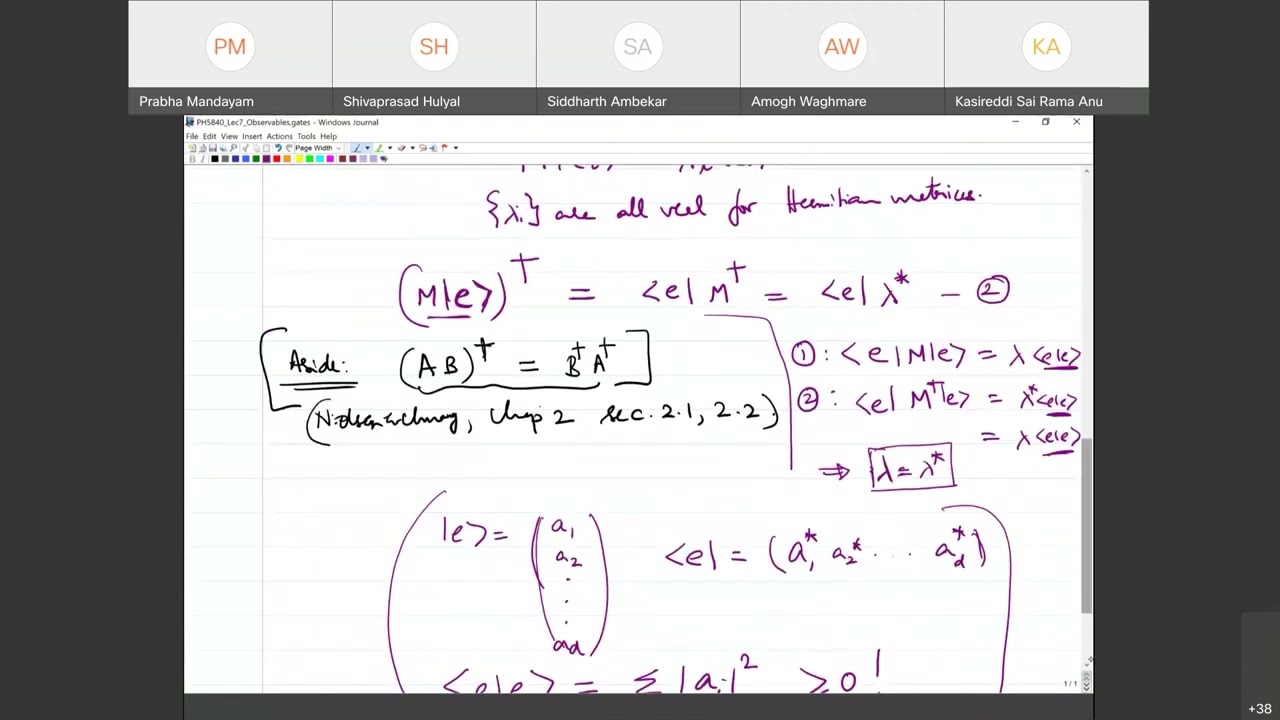
Quantum Computation and Quantum Information: Lecture 7 (Outer Product)
Keywords
Summary
132 words
Critical Evaluation
Value of the Information & Strength of the Argument
The lecture provides significant educational value by offering clear, step-by-step derivations of key quantum mechanics concepts. The instructor uses a logical progression: starting with the definition of Hermitian operators, proving the reality of eigenvalues, establishing orthogonality of eigenvectors, and then showing how these lead to a natural matrix representation. The argumentation is solid and rigorous, with proofs built on fundamental linear algebra operations. The use of concrete examples (Pauli matrices) reinforces abstract ideas, making the material accessible to students. The discussion of outer products and diagonalization is particularly helpful for understanding quantum measurements and state evolution. The presentation is coherent and maintains a consistent focus on the underlying mathematical structures.
Scientific Rigor, Source Quality, Title Accuracy
The scientific rigor is high: the content is standard quantum mechanics and linear algebra, presented accurately and without oversimplification. The instructor references Nielsen and Chuang’s textbook for further details, which is a canonical source in quantum computation. The title appropriately reflects the main topic, and the lecture covers additional related material coherently. The course is part of an academic program at IIT Madras, adding institutional credibility. No external sources are cited in the description, but the internal references are reliable. The argumentation is logically sound and supported by formal proofs where necessary.
217 words
Title / Content Match
The title accurately reflects the lecture's focus on outer products and matrix representations; it also covers related topics such as eigenvalues and eigenvectors.
Quality & Reliability
9/10
The lecture is well-structured, covers fundamental concepts of quantum mechanics and linear algebra with proofs, and refers to standard textbooks. The content is accurate and pedagogically sound.
Key Moments
Markers derived by PSI from the transcript: the creator did not define chapters.
Cited Sources
- Quantum Computation and Quantum Information — The lecturer refers to this textbook (Nielsen & Chuang) for proofs and additional details on linear algebra and quantum mechanics.
Contribution & Novelties
The lecture offers a clear pedagogical exposition of the outer product formalism, linking it to the representation of quantum observables. It emphasizes the diagonalization of Hermitian operators and how this relates to measurement outcomes. The original contribution lies in the step-by-step derivation of matrix elements and the demonstration that any operator can be represented in a chosen basis via outer products.
Pour aller plus loin :
- Dirac notation - Wikipedia — Essential for understanding the bracket notation used throughout the lecture.
- Hermitian matrix - Wikipedia — Provides background on the properties of Hermitian operators, including real eigenvalues.
- Outer product - Wikipedia — Explains the mathematical concept central to this lecture.
110 words
Radar Profile
The radar profile shows high scores in quality and reliability, with a slightly lower but still solid quantity of information. This indicates a comprehensive and accurate lecture that balances depth of content with technical accessibility.