Quantum Computation and Quantum Information: Lecture 39 (Phase estimation and Order finding)
Keywords
Summary
192 words
Critical Evaluation
Value of the Information & Strength of the Argument
The lecture provides a rigorous, step-by-step derivation of phase estimation and order finding, building on prior knowledge of QFT. The argumentation is solid: the circuit is analyzed mathematically, the state evolution is shown explicitly, and the error analysis is summarized with clear statements of necessary qubit counts. The value lies in its comprehensive explanation of why phase estimation works and how it connects to order finding, making complex quantum algorithmic ideas accessible to students with a background in linear algebra and quantum mechanics. The example of order finding illustrates the concept effectively. The lecturer openly acknowledges skipping detailed proofs for time, but points to authoritative references, maintaining intellectual honesty.
Scientific Rigor, Source Quality, Title Accuracy
The lecture adheres to high scientific rigor, following the notation and treatment of Nielsen & Chuang (the standard quantum computing textbook). The lecturer explicitly references Chapter 5 and Box 5.2 for circuit complexity and error analysis, indicating reliance on peer-reviewed scholarship. The title is precise: the lecture indeed covers phase estimation and order finding, as announced. No external sources are cited beyond the textbook, which is appropriate for a course lecture. The arguments are internally consistent, and the lecturer correctly handles technical nuances, such as the role of ancilla qubits and the probability of estimation error. Overall, the content is reliable and well-sourced.
227 words
Title / Content Match
The title accurately reflects the lecture content: phase estimation and order finding within quantum computation.
Quality & Reliability
9/10
Academic lecture by IIT Madras professor, based on standard textbook Nielsen & Chuang, rigorous derivation and clear logical flow.
Key Moments
Markers derived by PSI from the transcript: the creator did not define chapters.
- Introduction of phase estimation problem and definition of φ as fractional binary expansion.
- Circuit for phase estimation: t data qubits initialized to |0>, Hadamard gates, and controlled U^(2^j) operations.
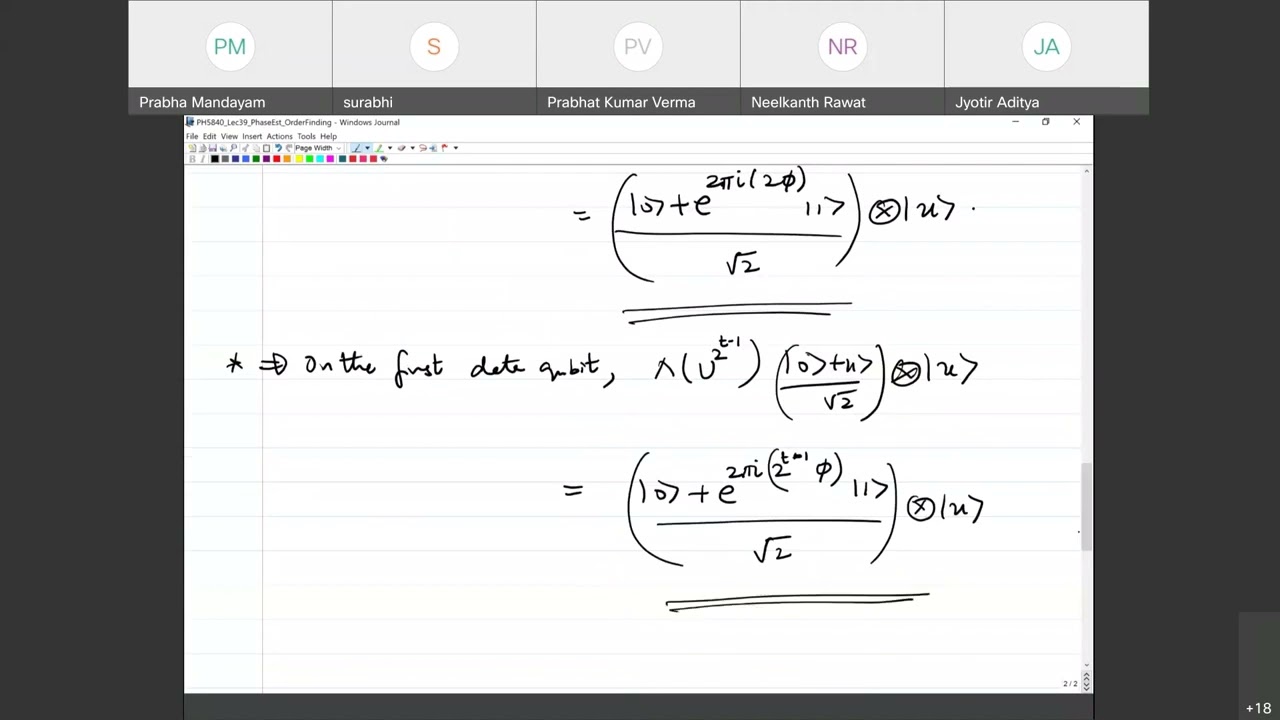
- Derivation of the data qubits' state after control unitaries, showing it equals QFT transformation of the binary string of φ.
- Discussion of error analysis: required number of qubits t = n + ceil(log(2 + 1/(2ε))) for n-bit accuracy with failure probability ε.
- Introduction to order finding: definition of modular arithmetic and order of x mod N, with connection to factoring.
- Worked example: order of 4 mod 7 is 3, illustrating periodic behavior.
- Wrap-up and pointer to Nielsen & Chuang for further details on modular exponentiation and factorization algorithms.
Cited Sources
- Nielsen & Chuang, Quantum Computation and Quantum Information — Referenced for phase estimation performance analysis and modular exponentiation circuit (Chapter 5, Box 5.2).
Contribution & Novelties
This lecture provides a clear, self-contained explanation of phase estimation and order finding, building intuition through circuit analysis and a concrete example. It fills a pedagogical niche by connecting theoretical concepts to their implementation, while openly directing students to authoritative resources for deeper proofs. The original contribution lies in the lecturer’s ability to distill complex material without oversimplifying.
Pour aller plus loin :
- Shor’s algorithm — Central application of order finding; explains how these concepts enable integer factorization on a quantum computer.
- Quantum Fourier transform — Core building block used in phase estimation; provides mathematical background and circuit implementation.
- Quantum phase estimation algorithm — Directly related algorithm; offers additional context on error analysis and variants.
115 words
Radar Profile
The radar profile shows high scores across all dimensions, with particularly strong quality, reliability, and technical depth. The lecture excels in providing accurate, well-reasoned content, though the information quantity is slightly lower due to the focused scope of the two topics covered.