QEC and Quantum Information Theory: Lecture 16 Stabilizer Codes (3)
Keywords
Summary
228 words
Critical Evaluation
Value of the Information & Strength of the Argument
The lecture provides high-value information by clearly explaining the concept of logical operators in stabilizer codes, a crucial topic for quantum error correction. The argumentation is solid: the instructor builds from abstract definitions to concrete examples, ensuring that the audience understands the motivation and construction of logical operators. The distinction between the code space defined by stabilizers and the specific logical states defined by logical operators is well articulated. The use of the three-qubit and Shor codes as examples effectively demonstrates the abstract concepts. The instructor also highlights the importance of logical operators for implementing logical gates, connecting error correction to quantum computation. The reasoning is logical and step-by-step, with occasional checks for student understanding.
Scientific Rigor, Source Quality, Title Accuracy
The lecture is scientifically rigorous, adhering to standard definitions and theorems in quantum error correction. No external sources are cited, which is typical for a lecture, but the material is consistent with established literature. The title accurately reflects the content: it is the third lecture on stabilizer codes, focusing on logical operators and examples. The title does not overpromise; it precisely indicates the topic. The absence of citations does not undermine the rigor, as the content is foundational and well-established.
210 words
Title / Content Match
The title accurately reflects the content: the lecture is the third part of a series on stabilizer codes, focusing on logical operators and examples. The title is precise and not misleading.
Quality & Reliability
9/10
The lecture is delivered by a recognized academic (IIT Madras) and is part of a structured course. The content is mathematically rigorous, with clear definitions and examples. No external sources are cited, but the material is standard textbook knowledge in quantum error correction. The absence of citations is typical for a lecture and does not detract from reliability.
Key Moments
Markers derived by PSI from the transcript: the creator did not define chapters.
- Introduction to the concluding lectures on error correction and fault tolerance.
- Review of [[N,K,D]] stabilizer codes and their error-correcting capabilities.
- Introduction to logical operators as an efficient description of the code space.
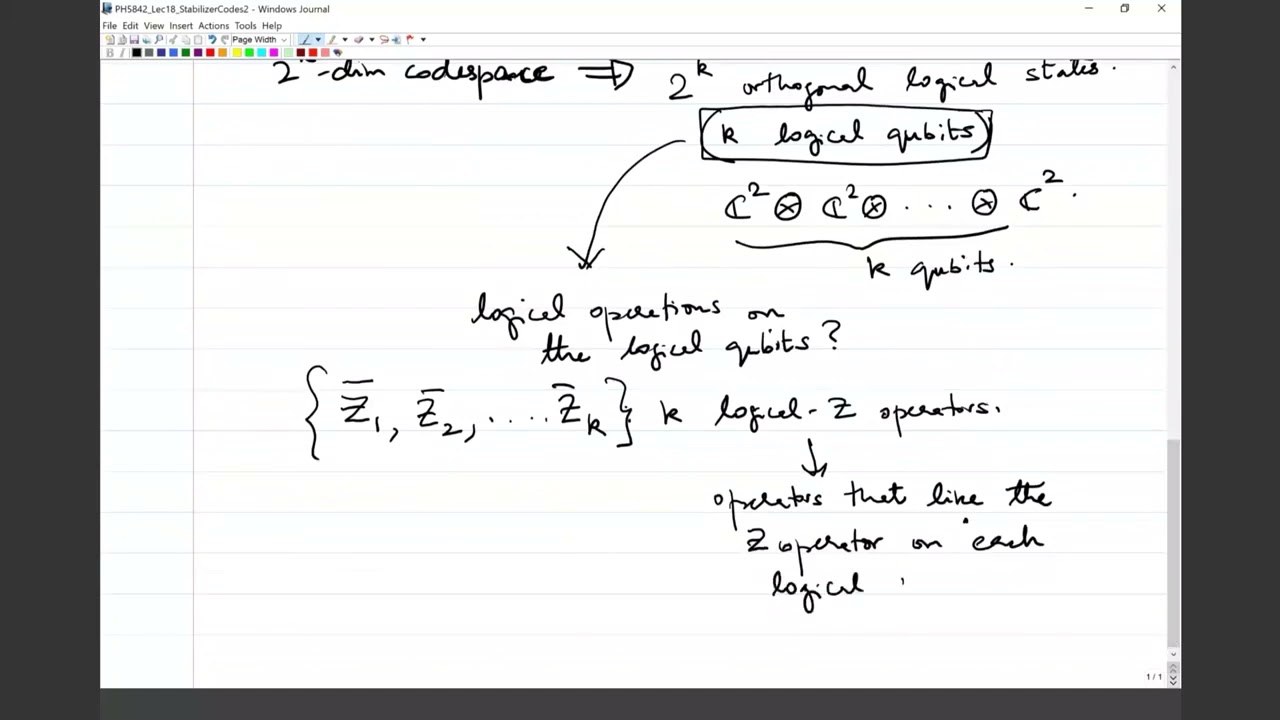
- Definition of logical Z operators and their properties.
- Definition of logical X operators via anti-commutation with logical Z.
- Example: logical operators for the three-qubit bit-flip code.
- Example: logical operators for the nine-qubit Shor code.
- Discussion on the role of logical operators in defining logical states and performing logical gates.
- Explanation of logical errors and their severity.
Contribution & Novelties
The lecture does not present new research but provides a clear pedagogical explanation of logical operators in stabilizer codes, a topic often found in advanced textbooks. The original aspect is the detailed walkthrough of identifying logical operators for the Shor code, which can be challenging for students. The instructor’s emphasis on the distinction between physical and logical operators and the role of logical operators in quantum computation adds practical insight.
Pour aller plus loin :
- Stabilizer code — Wikipedia article providing an overview of stabilizer codes and logical operators.
- Quantum error correction — General introduction to quantum error correction, including the Shor code.
- Logical operator — Not a standard Wikipedia page; instead, refer to the concept in the context of stabilizer codes as described in Nielsen & Chuang’s “Quantum Computation and Quantum Information”.
133 words
Radar Profile
The radar profile shows high scores in information quantity, quality, technical level, and overall reliability, indicating a dense, rigorous, and advanced lecture. The balance across dimensions suggests a well-structured presentation with strong theoretical foundations and practical examples.