Quantum Computation and Quantum Information: Lecture 33 (Deutsch-Jozsa, Quantum search)
Keywords
Summary
171 words
Critical Evaluation
Value of the Information & Strength of the Argument
The value of the lecture lies in its clear, step-by-step mathematical derivation of the Deutsch-Jozsa algorithm, making the abstract concept of quantum speedup tangible. The argumentation is solid: the instructor explicitly evaluates the amplitude for the all-zero string in both constant and balanced cases, showing the constructive and destructive interference effects. The transition from the single-bit Deutsch problem to the n-bit case is natural, and the instructor highlights the exponential advantage over classical queries. The introduction to Grover’s search is presented with practical motivations, though the full algorithm is left for subsequent lectures. The use of examples (traveling salesman, prime factorization) underscores the real-world relevance, and the historical note about Lov Grover adds context. Overall, the reasoning is rigorous and pedagogically effective.
Scientific Rigor, Source Quality, Title Accuracy
The lecture is a well-structured academic presentation, relying on established concepts of quantum computing (e.g., Hadamard transform, oracle formulation) without citing external sources directly, but consistent with standard textbooks like Nielsen & Chuang. The scientific rigor is high: the derivation is self-contained, and the instructor pauses to answer questions, ensuring clarity. The title accurately specifies the content, and the content matches the promises of covering the Deutsch-Jozsa algorithm and beginning quantum search. No references are provided in the description, so no external sources are cited, but the lecture itself is a reliable primary source from an academic institution.
235 words
Title / Content Match
The title accurately describes the content: the lecture covers the Deutsch-Jozsa algorithm and introduces Grover's quantum search algorithm. The title matches the delivered material perfectly.
Quality & Reliability
9/10
Lecture delivered by a professor at IIT Madras as part of a formal course. The content is mathematically rigorous, well-structured, and consistent with standard textbook explanations of quantum algorithms. No obvious errors or unsupported claims.
Key Moments
Markers derived by PSI from the transcript: the creator did not define chapters.
- Introduction and review of Deutsch algorithm, setting the stage for n-bit generalization.
- Definition of Deutsch-Jozsa problem and promise of constant or balanced function; oracle construction.
- Step-by-step development of the quantum algorithm: initialization, uniform superposition via Hadamard gates, ancilla preparation.
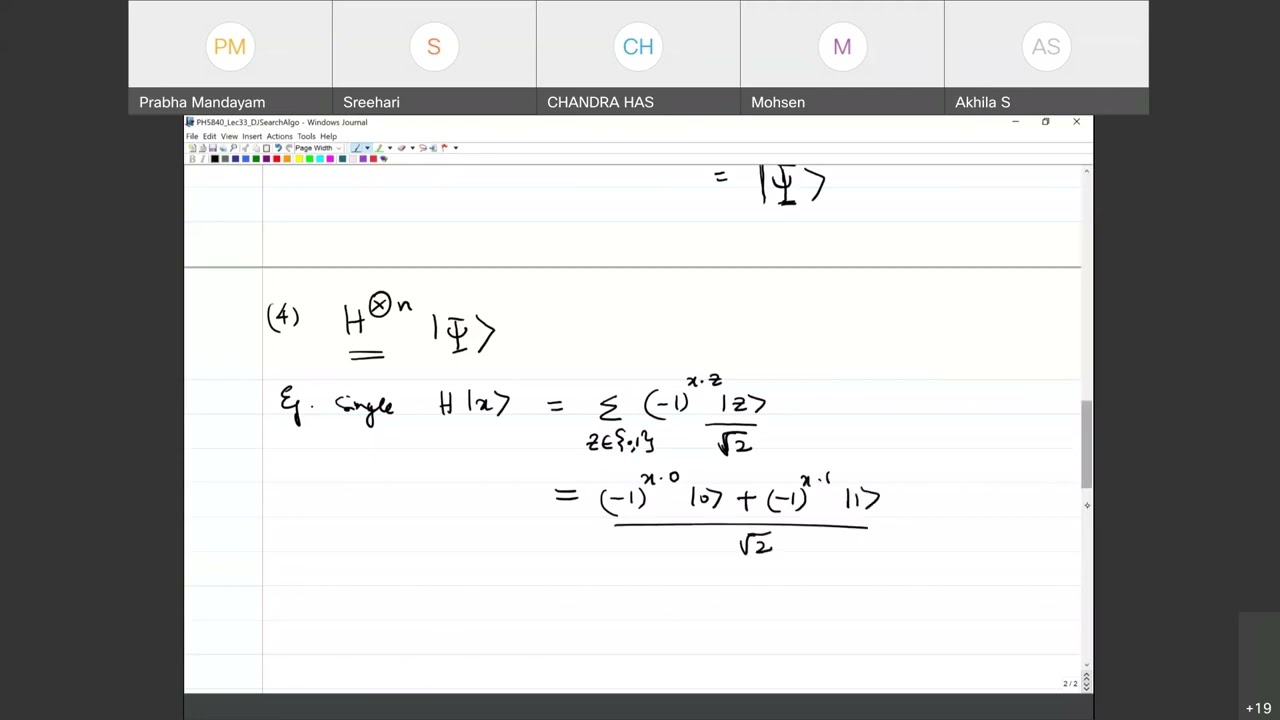
- Analysis of final Hadamard transform and interference; evaluation of amplitudes for constant versus balanced cases.
- Conclusion of Deutsch-Jozsa and transition to Grover's search algorithm; motivation and examples.
Contribution & Novelties
This lecture provides a thorough, self-contained explanation of the Deutsch-Jozsa algorithm and its exponential speedup over classical queries, with explicit derivations and circuit intuition. It also serves as an entry point to Grover’s search, highlighting practical applications. The pedagogical approach of walking through the full mathematics and addressing common questions adds value for learners.
Pour aller plus loin :
- Deutsch–Jozsa algorithm - Wikipedia — Official article with historical context and formal definition.
- Grover’s algorithm - Wikipedia — Comprehensive description of the quantum search algorithm, including applications.
- Quantum computation and quantum information (Nielsen & Chuang) — Standard textbook reference, covering both algorithms and broader quantum computing principles.
106 words
Radar Profile
The radar profile shows high scores across all dimensions: information quantity (9), information quality (9), technical level (9), and overall reliability (9), reflecting a dense, accurate, and technically demanding lecture. The balanced high scores indicate a content-rich presentation suitable for an advanced audience.