Quantum Computation and Quantum Information: Lecture 24 (The Bell-CHSH inequality)
Keywords
Summary
264 words
Critical Evaluation
Value of the Information & Strength of the Argument
The value of the information is high: it provides a self-contained derivation of a pivotal result in quantum foundations, with clear logical steps from basic probability theory to quantum mechanical expectations. The argumentation is solid: the instructor explicitly states all assumptions, carefully defines the mathematical framework, and demonstrates each calculation. The use of Bell states and Pauli operators is well-chosen, and the comparison between classical and quantum bounds is compelling. The discussion of the maximal violation (2√2) and its connection to entanglement measures is particularly insightful. The lecture also places the CHSH inequality in historical context (Bell, Clauser et al.) and explains its practical applications, making it valuable for both theory and experiment.
Scientific Rigor, Source Quality, Title Accuracy
The scientific rigor is exemplary: the derivation is mathematically precise, with no steps skipped, and the instructor explicitly notes when assumptions are made. The sources are not formally cited in the video description, but the lecture directly references the original Bell inequality framework and the 1969 CHSH paper. The title accurately reflects the content, which is strictly focused on the Bell-CHSH inequality. No commercial or promotional content is present. The lecture is part of a university course, which ensures a structured and reliable presentation. The mathematical notation is consistent, and the instructor takes care to highlight subtleties (e.g., the non-commutativity of observables, the sign conventions).
233 words
Title / Content Match
The title perfectly matches the content: the entire lecture is devoted to the Bell-CHSH inequality, its derivation, and its quantum violation.
Quality & Reliability
9/10
The lecture is a rigorous, formal derivation of the Bell-CHSH inequality, with clear assumptions, mathematical steps, and contextual background. Perfectly suited for a graduate-level physics course, and the presentation is logically sound.
Key Moments
Markers derived by PSI from the transcript: the creator did not define chapters.
- Introduction: setup of the lecture, general physical theory, and the four binary observables P, Q, R, S.
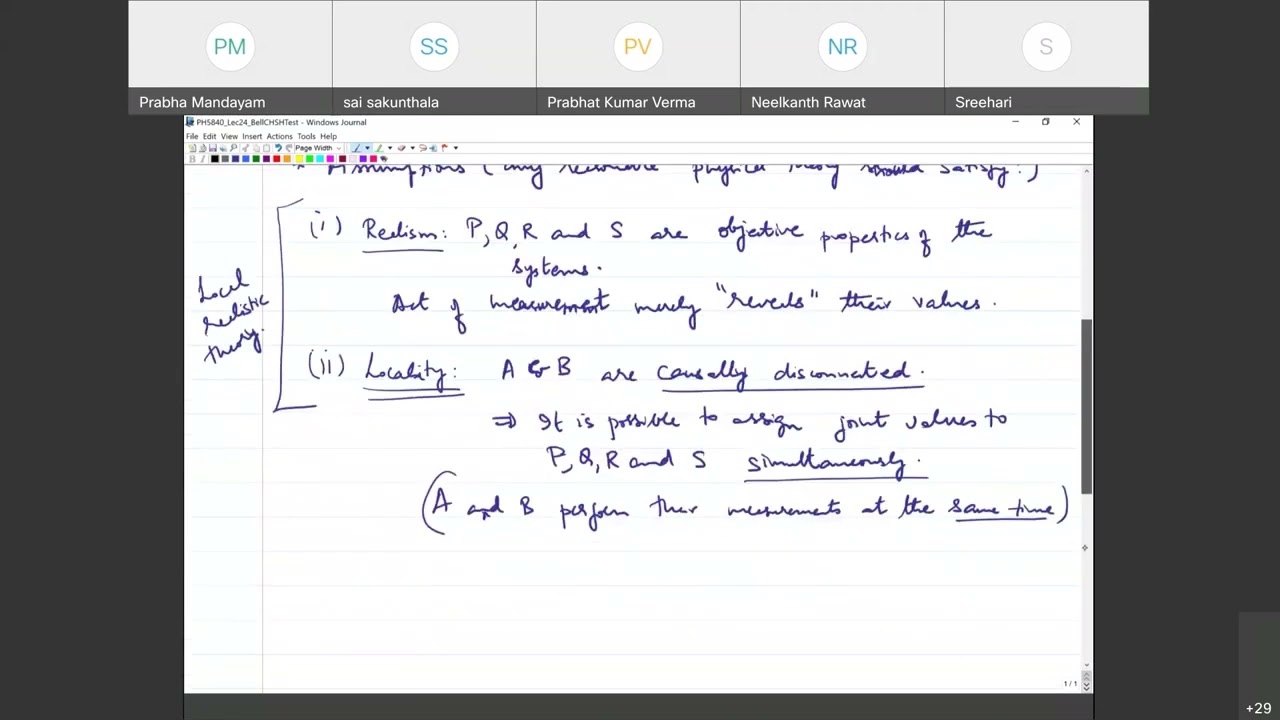
- Assumptions of realism and locality stated, with reference to the Einstein–Abaraham Pais moon dialogue.
- Definition of the observable M = PR + QR - PS + QS, and derivation of the bound |E[M]| ≤ 2.
- Introduction of Bell state β₁₁ and the specific choices of Pauli observables for the quantum violation.
- Step-by-step calculation of expectation values, showing each term equals 1/√2, leading to E[M] = 2√2.
- Discussion of the CHSH inequality as a Bell inequality, its history (Clauser, Horne, Shimony, Holt), and its use as an entanglement witness.
- Applications: verification of entanglement, entanglement quantification, and role in quantum cryptography.
- Reflection on which assumptions (realism/locality) are abandoned in quantum mechanics, and summary of the significance.
Contribution & Novelties
The lecture provides a clear, pedagogically structured derivation of the Bell-CHSH inequality and its quantum violation, making a complex topic accessible to a graduate-level audience. The original contribution is the explicit computation of the violation using the Bell state, which highlights the role of both entangled states and non-commuting observables. The interpretation of the violation as a measure of non-locality and a tool for device-independent entanglement verification underscores its practical relevance.
Pour aller plus loin :
- CHSH inequality - Wikipedia — Background, derivation, and modern context of the inequality.
- Bell’s theorem - Wikipedia — Original theorem and its implications for local realism.
- Einstein–Podolsky–Rosen paradox - Wikipedia — The foundational thought experiment leading to the concept of entanglement.
- Quantum entanglement - Wikipedia — General overview of entangled states and their properties.
130 words
Radar Profile
The radar profile shows a uniformly high score across all dimensions (quantity, quality, technical level, reliability), reflecting a well-balanced and rigorous lecture. The emphasis on technical depth and accuracy is slightly higher than on raw information volume, but all scores are excellent.