Quantum Computation and Quantum Information: Lecture 20 (Partial trace and reduced density operator)
Keywords
Summary
119 words
Critical Evaluation
Value of the Information & Strength of the Argument
The lecture provides a solid, self-contained derivation of key quantum information concepts. The proof of the no-cloning theorem is elegant and accessible, using an inner product argument that clearly shows the constraint unitarity imposes. The partial trace is introduced with clear formal definitions and multiple worked examples, reinforcing the operator-level calculations. The argumentation is rigorous, step-by-step, and pedagogically effective, connecting abstract formalism to concrete matrix representations. The analogy with probability marginals helps intuition. No unsupported claims are made; all results follow from standard quantum mechanics.
Scientific Rigor, Source Quality, Title Accuracy
The content is based on well-established quantum information theory (e.g., Nielsen & Chuang textbook). The instructor mentions the original no-cloning paper by Wootters and Zurek (1982) but does not provide URLs; the course uses Moodle for readings. The presentation is mathematically precise, with careful derivations. The title accurately reflects the content. There is no reference to external sources beyond the course materials, but the lecture itself is a primary educational resource with high technical rigor.
175 words
Title / Content Match
The title exactly matches the content: lecture 20 on partial trace and reduced density operator in quantum computation and information.
Quality & Reliability
8/10
Lecture by a professor at IIT Madras, based on standard textbook material (Nielsen & Chuang) and rigorous mathematical derivations. The content is technically accurate and well-structured, though it relies on prior knowledge and does not provide external references beyond the course.
Key Moments
Markers derived by PSI from the transcript: the creator did not define chapters.
- Introduction to no-cloning theorem, historical context.
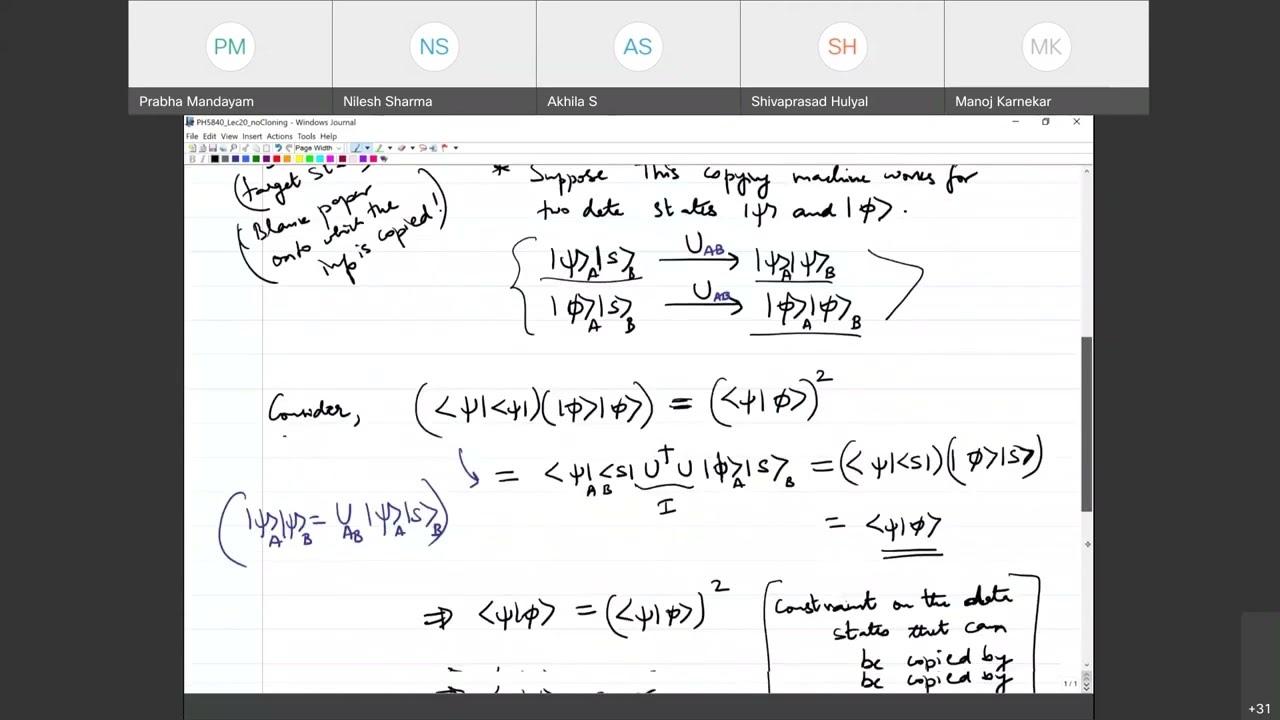
- Proof of no-cloning theorem: unitary constraint and inner product argument.
- Discussion of orthogonal states as classical limit, start of reduced density operator.
- Definition of bipartite density operator and matrix representation.
- Example: Bell state beta0 vector and density matrix.
- Example: incoherent mixture of product states, contrast with coherent superposition.
- Introduction of partial trace operation and formal definition.
- Analogy with probability marginals, examples with product states.
- Example: reduced states of entangled Bell state, resulting maximally mixed state.
Cited Sources
- No cloning theorem (Wootters and Zurek, Nature 1982) — Mentioned in lecture as origin of the theorem, but no URL provided.
Concurring Sources
- Nielsen & Chuang, Quantum Computation and Quantum Information — Standard textbook covering the same material, used implicitly in the course.
Contribution & Novelties
The lecture provides a clear and systematic pedagogical treatment of two fundamental topics, but does not present new original research. Its value lies in the explicit computations and the intuitive presentation of the partial trace as an operator analogue of marginalization. For deeper exploration, see the following:
Pour aller plus loin :
- Density matrix — Background on density operators.
- Partial trace — Formal definition and properties.
- Quantum entanglement — Context for reduced states.
- No-cloning theorem (concept, without URL) — Relevant to quantum cryptography.
83 words
Radar Profile
The radar profile shows high scores in information quality, technical level, and reliability, with slightly lower quantity, reflecting a focused lecture with deep mathematical content rather than broad coverage.