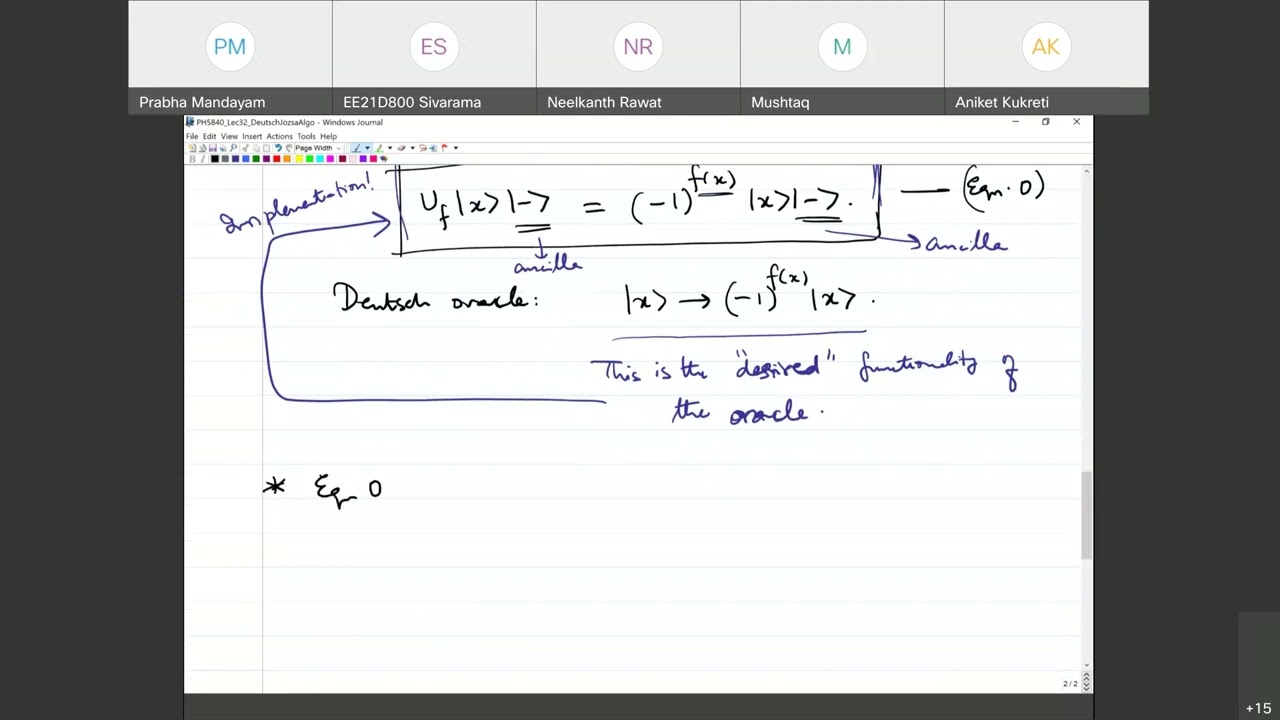
Quantum Computation and Quantum Information: Lecture 32 (The Deutsch-Jozsa Algorithm)
Keywords
Summary
154 words
Critical Evaluation
Value of the Information & Strength of the Argument
The lecture offers a valuable pedagogical walkthrough of a canonical quantum algorithm, bridging abstract theory with circuit-level implementation. The argumentation is logically sound: the instructor first analyzes the single-bit case intuitively, then generalizes to n bits, clearly demonstrating the exponential speedup. The explanation of how the oracle extracts phase information and how superposition enables parallelism is particularly effective. The emphasis on practical details, such as the need for a Hadamard before measurement, reinforces the correct reasoning. No claims are made beyond what is standard in quantum computing, and the mathematical derivations are consistent.
Scientific Rigor, Source Quality, Title Accuracy
The content is mathematically rigorous and follows standard references like Nielsen and Chuang, though no explicit citations are given in the video. The instructor relies on established knowledge and derives everything from first principles. The title is precise and matches the content exactly. The description confirms this is part of an academic course, adding credibility. The video does not include any external sources or citations, which is typical for a lecture, but the reliability of the information is high due to the fundamentals involved.
192 words
Title / Content Match
The title accurately describes the content, which is a dedicated lecture on the Deutsch-Jozsa algorithm within a quantum computation course.
Quality & Reliability
8/10
The lecture provides a rigorous and clear explanation of the Deutsch-Jozsa algorithm, with correct mathematical derivations and circuit analysis. The instructor is a professor at IIT Madras, and the content is well-structured. However, no external sources are cited, and the video is a pedagogical lecture rather than a peer-reviewed presentation.
Key Moments
Markers derived by PSI from the transcript: the creator did not define chapters.
- Introduction and recap of Deutsch's problem for single-bit functions.
- Classical oracle and XOR-based comparison for constant vs balanced functions.
- Definition and functionality of the quantum oracle, including phase encoding.
- Circuit for Deutsch algorithm, including Hadamard gates and measurement basis.
- Extension to n-bit functions: Deutsch-Jozsa algorithm and promise of constant or balanced.
- Complexity analysis: exponential speedup and summary of key steps.
Contribution & Novelties
This lecture provides a clear and systematic exposition of the Deutsch-Jozsa algorithm, making it accessible to students with a basic background in quantum computing. It stands out for its detailed explanation of the oracle’s phase-kickback mechanism and the importance of measurement basis, which are often glossed over. The step-by-step circuit construction and the discussion of practical issues (e.g., initialization, measurement) add pedagogical value. While the algorithm itself is well-known, the lecture’s ability to build intuition through examples and emphasis on pitfalls is a noteworthy contribution.
Pour aller plus loin :
- Deutsch–Jozsa algorithm (Wikipedia) — Comprehensive overview and history of the algorithm.
- Quantum oracle (Wikipedia) — Detailed explanation of oracles in quantum computing, including phase oracles.
- Hadamard transform (Wikipedia) — The unitary transformation used to create superpositions and interference patterns, central to the algorithm.
- Nielsen, M. A., & Chuang, I. L. (2010). Quantum Computation and Quantum Information. Cambridge University Press. — The canonical textbook covering this algorithm in depth (no URL).
160 words
Radar Profile
The radar profile shows high scores across all dimensions, with particularly strong performance in 'qualite_information' and 'fiabilite_globale'. This indicates a well-explained and reliable educational content, though the lack of external citations slightly reduces the overall reliability score.