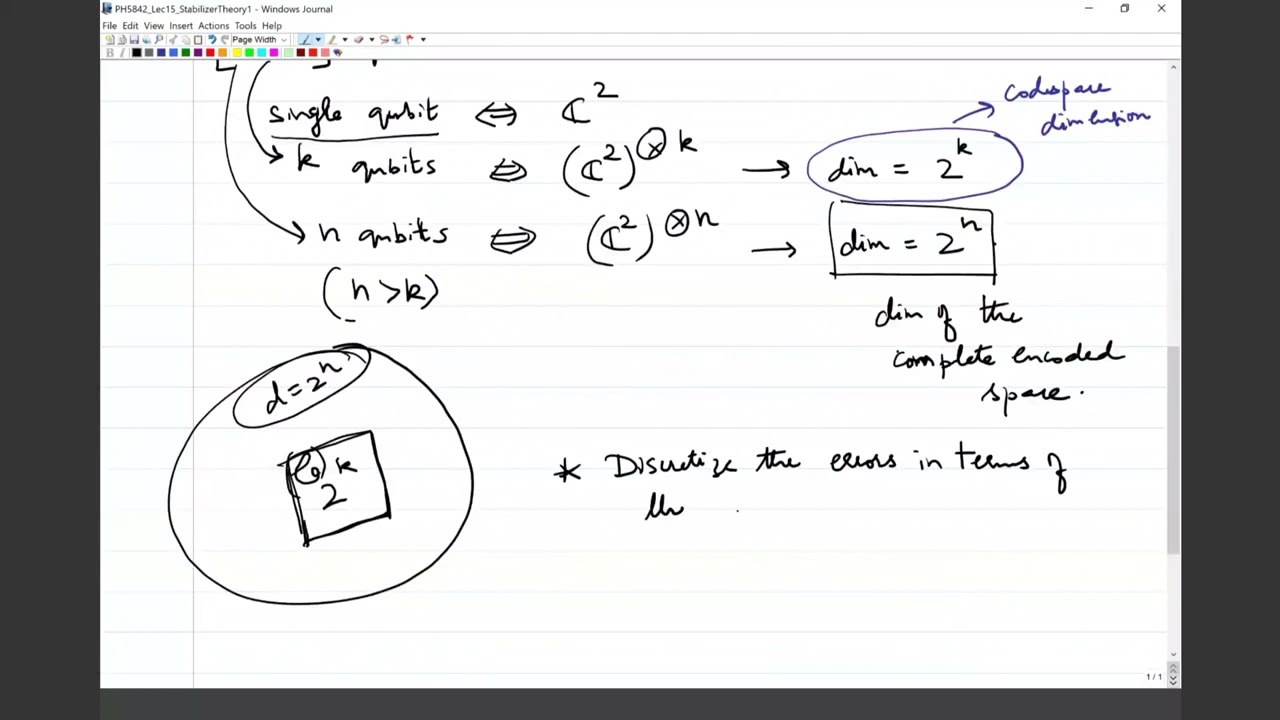
QEC and Quantum Information Theory: Lecture 13 The Stabilizer Formalism
Keywords
Summary
158 words
Critical Evaluation
Value of the Information & Strength of the Argument
The lecture is valuable for its clear exposition of the stabilizer formalism, emphasizing the shift from state-based to operator-based descriptions of quantum codes. The argumentation is solid: it systematically builds from code parameters and the Hamming bound to the necessity of the stabilizer framework. The instructor provides concrete examples and invites audience interaction, reinforcing understanding. The reasoning is logical, and the connection between Pauli error discretization and the distance parameter is well articulated.
Scientific Rigor, Source Quality, Title Accuracy
The lecture adheres to established textbook material, explicitly referencing Nielsen and Chuang (Section 10.5). The presentation is rigorous, with correct mathematical definitions and derivations. The title accurately reflects the content, as the lecture indeed covers the stabilizer formalism within quantum error correction and quantum information. No inconsistencies or unsupported claims were detected.
140 words
Title / Content Match
The title accurately describes the lecture's focus on the stabilizer formalism within the context of quantum error correction and quantum information theory.
Quality & Reliability
9/10
This lecture is delivered by a professor at IIT Madras, covering standard material from Nielsen and Chuang. The presentation is rigorous, mathematically precise, and aligned with established textbook content. While it does not cite primary research, the material is fundamental and accurately presented.
Key Moments
Markers derived by PSI from the transcript: the creator did not define chapters.
- Introduction: revisiting code parameters (n, k, d) and the quantum Hamming bound.
- Explanation of distance d and its relation to the number of correctable errors t.
- Derivation of the quantum Hamming bound and the existence of the [[5,1,3]] code.
- Introduction of the stabilizer idea using the Bell state and X1X2, Z1Z2.
- Example of the three-qubit bit-flip code and its stabilizer generators.
Cited Sources
- Nielsen & Chuang, Quantum Computation and Quantum Information (Section 10.5) — Referenced as the basis for the stabilizer formalism discussion.
- Advanced Topics in Quantum Computation and Quantum Information (PH 5842), IIT Madras — The course for which this lecture is given.
Concurring Sources
- Nielsen & Chuang, Quantum Computation and Quantum Information — The standard textbook covering the same material in greater depth and with additional context.
- Preskill's Lecture Notes on Quantum Computation — Another widely used resource that discusses the stabilizer formalism and quantum error correction similarly.
Contribution & Novelties
This lecture provides a pedagogical bridge from the abstract quantum error correction conditions to a practical, operator-based framework. Its originality lies in the clarity of presentation and the systematic progression from code parameters to the stabilizer formalism, making the material accessible to graduate students.
Pour aller plus loin :
- Stabilizer code (Wikipedia) — Provides an overview of the stabilizer codes and their properties.
- Quantum error correction (Wikipedia) — General survey of QEC, including stabilizer codes.
- Calderbank–Shor–Steane code (Wikipedia) — A specific family of stabilizer codes with an efficient construction.
89 words
Radar Profile
The radar profile shows very high scores in quantity, quality, and reliability, with slightly lower technical level indicating the lecture is accessible yet still rigorous. A balanced and strong profile consistent with a high-quality academic lecture.