Quantum Computation and Quantum Information: Lecture 5 (Bloch Sphere)
Keywords
Summary
161 words
Critical Evaluation
Value of the Information & Strength of the Argument
The lecture provides a solid, rigorous foundation for understanding quantum states, which is essential for quantum computation. The value lies in its careful mathematical treatment of orthonormal bases and linear independence, supported by explicit calculations and proofs. The argumentation is logical and incremental, building from abstract definitions to concrete examples and exercises. The instructor effectively uses questioning to clarify common misunderstandings, such as why only two orthogonal states exist in a 2D space and the correct normalization factor. The presentation is pedagogical, with step-by-step derivations, making complex topics accessible to a physics or mathematics audience.
Scientific Rigor, Source Quality, Title Accuracy
The lecture demonstrates strong scientific rigor, with precise definitions and formal proofs. The instructor frequently references prerequisite knowledge (linear algebra, quantum mechanics) and builds on it systematically. No external sources are cited in the description or transcript, but the content aligns with standard quantum mechanics textbooks (e.g., Nielsen & Chuang). The title specifically mentions the Bloch sphere, yet the lecture covers much broader groundwork, and the Bloch sphere is only introduced at the very end, making the title somewhat misleading regarding the focus of the lecture. The course context at IIT Madras suggests a high level of academic reliability.
209 words
Title / Content Match
The title focuses on the Bloch sphere, but the lecture primarily reviews basics of linear algebra, quantum states, and two-level systems, only beginning the Bloch sphere at the end. The content is broader than the title suggests.
Quality & Reliability
9/10
Academic lecture from IIT Madras, part of a structured course, covering foundational quantum mechanics with mathematical rigor. The content is accurate and well-presented, though some advanced topics are introduced without full derivation.
Key Moments
Markers derived by PSI from the transcript: the creator did not define chapters.
- Introduction and review of linear algebra, inner products, and the first postulate of quantum mechanics.
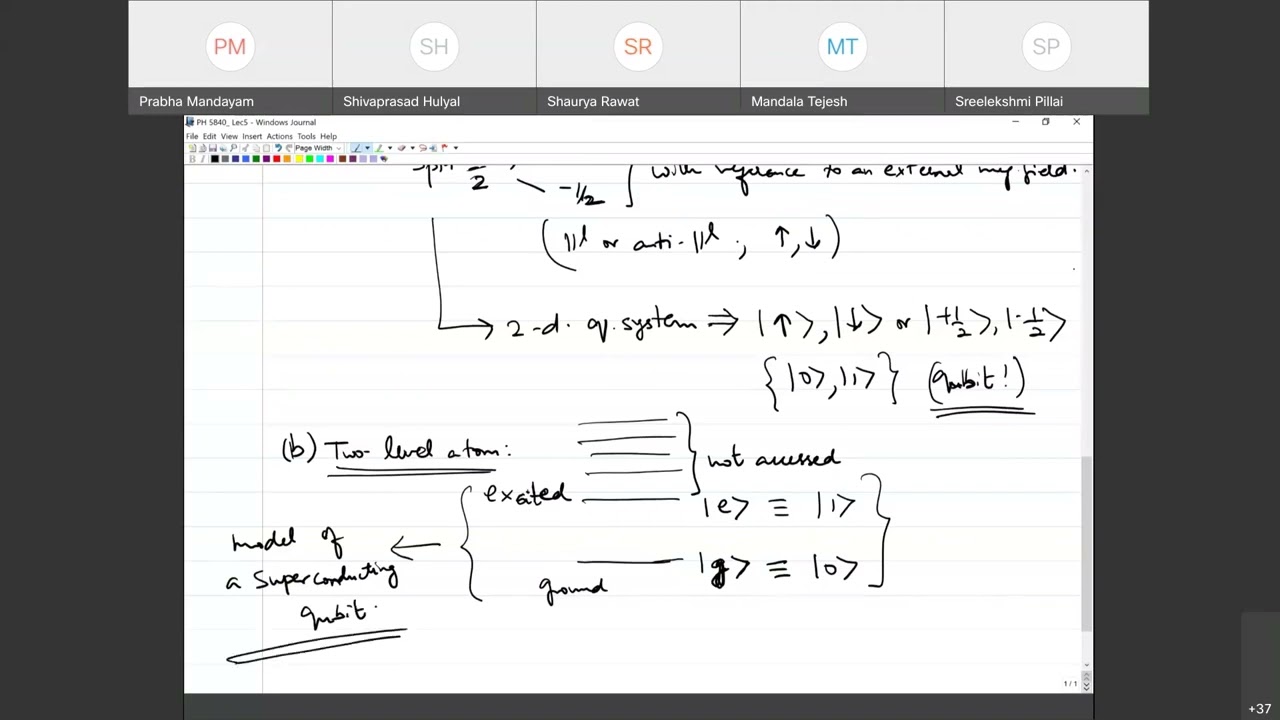
- Discussion of spin-1/2 particles as two-level quantum systems, quantization of spin, and relation to qubits.
- Introduction of two-level atoms and superconducting qubits as additional physical realizations of a qubit.
- Detailed derivation of orthonormal bases, proof that |0⟩ and |1⟩ form an orthonormal basis, and exercise on the |+⟩, |−⟩ basis.
- Explanation of normalization, phase freedom, and the proof that orthogonal vectors are linearly independent, leading to the start of the Bloch sphere discussion.
Contribution & Novelties
The lecture’s contribution is primarily pedagogical, offering a clear and thorough exposition of fundamental concepts in quantum computation. It bridges abstract linear algebra with physical qubit implementations, providing a solid basis for further study. The interactive question-and-answer segments enhance understanding of subtle points like orthogonality and normalization.
Pour aller plus loin :
- Stern-Gerlach Experiment — Historically demonstrates quantization of spin, providing physical intuition for two-level systems.
- Bloch Sphere — The geometric representation of a qubit state, central to quantum information (see e.g., Wikipedia).
- No-Cloning Theorem — A fundamental consequence of quantum mechanics often discussed alongside qubit properties.
97 words
Radar Profile
The profile shows high scores in technical level and reliability, with slightly lower but still strong scores in quantity and quality of information. The lecture is mathematically dense and authoritative, though it could be criticized for not fully addressing the advertised Bloch sphere topic.