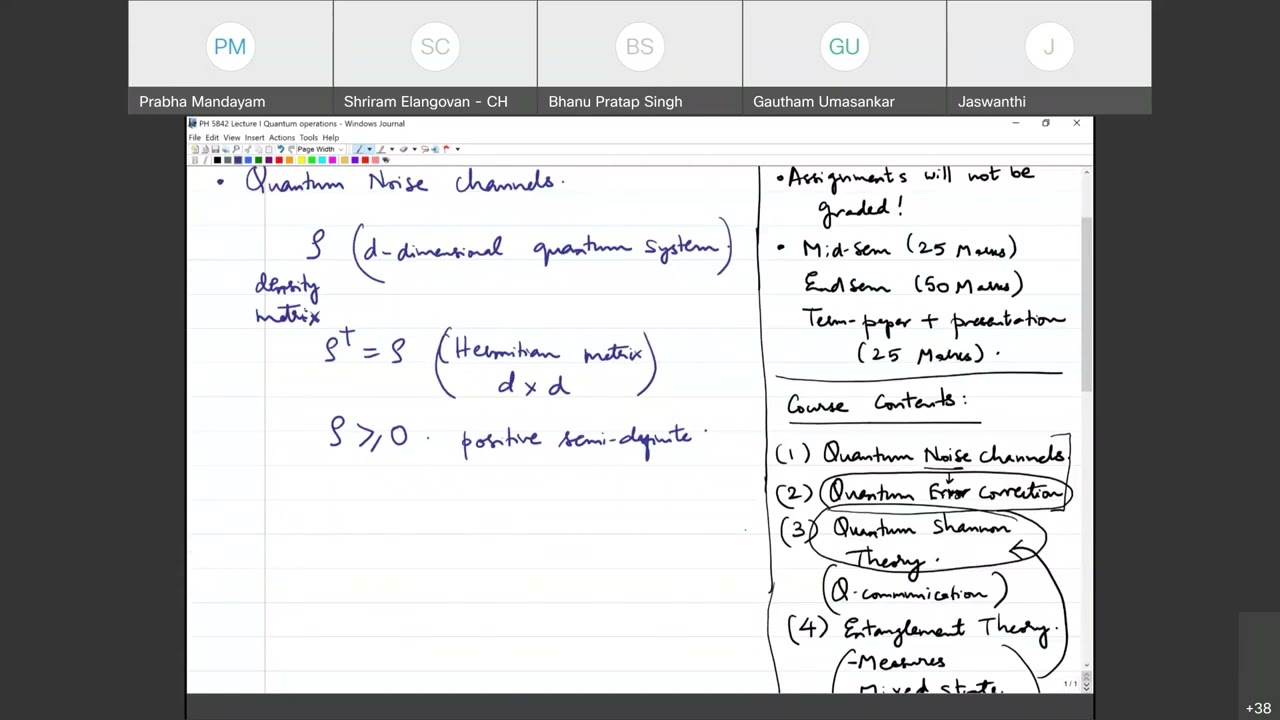
QEC and Quantum Information Theory: Lecture 1 Quantum Operations - I
Keywords
Summary
141 words
Critical Evaluation
Value of the Information & Strength of the Argument
The value of the information is high: the lecture provides a solid mathematical foundation for understanding quantum operations, which are essential for quantum error correction and quantum communication. The argumentation is rigorous, with clear definitions, formal proofs, and illustrative examples. The instructor carefully verifies that both unitary transformations and measurements satisfy the requirements of being positive and trace-preserving maps, establishing the formal framework that will be used throughout the course. The presentation is coherent and builds logically from basic quantum state representations to the abstract concept of quantum operations.
Scientific Rigor, Source Quality, Title Accuracy
The scientific rigor is excellent. The instructor adheres strictly to mathematical formalism, defining all terms and proving key properties. She references the prerequisite course material and advises students to revisit basic concepts if needed. The title accurately matches the content, as this is indeed the first lecture on quantum operations within a broader course on quantum error correction and quantum information theory. No external sources are cited in the lecture itself, but the course structure indicates reliance on standard textbooks like Nielsen and Chuang. The absence of citations does not detract from the internal rigor, as the content is self-contained and logically derived.
207 words
Title / Content Match
The title accurately reflects the content: it is the first lecture on quantum operations within a course on quantum error correction and quantum information theory.
Quality & Reliability
9/10
The lecture is a rigorous academic presentation by a professor at IIT Madras, systematically building concepts from basics to advanced topics, with clear definitions and mathematical proofs. The content is well-structured and consistent with established quantum information theory.
Key Moments
Markers derived by PSI from the transcript: the creator did not define chapters.
- Introduction to the course logistics, TA introductions, and evaluation scheme.
- Overview of course modules: quantum noise channels, error correction, quantum Shannon theory, and entanglement.
- Review of density operators: definition, properties (Hermitian, positive semidefinite, trace one).
- Discussion on positive operators and equivalent characterizations (expectation values, eigenvalues, decomposition as M M†).
- Measurement as a quantum operation: mapping pure states to mixed states via convex combination of eigenstates.
- Unitary transformation acting on density matrices by conjugation, preserving trace and positivity.
- Summary of properties of quantum operations: positive and trace-preserving maps, setting stage for further study.
Contribution & Novelties
This lecture provides a rigorous introduction to quantum operations, establishing the mathematical framework necessary for analyzing noise and error correction. The instructor’s pedagogical approach emphasizes verification of properties from first principles, which is valuable for students. To go further:
- Quantum operation (Wikipedia) — A comprehensive overview of the formalism of quantum operations, including Kraus representation and applications.
- Density matrix (Wikipedia) — Detailed explanation of density matrices, their properties and use in quantum mechanics.
- Quantum error correction (Wikipedia) — The natural next topic after understanding noise channels, as discussed in the course overview.
- Nielsen & Chuang, Quantum Computation and Quantum Information — Standard textbook reference for quantum information theory, including quantum operations.
111 words
Radar Profile
The radar profile shows consistently high scores across all dimensions, with particularly strong quality and technical rigor. The balance between information quantity and reliability is excellent, indicating a well-structured and authoritative lecture suitable for advanced students.