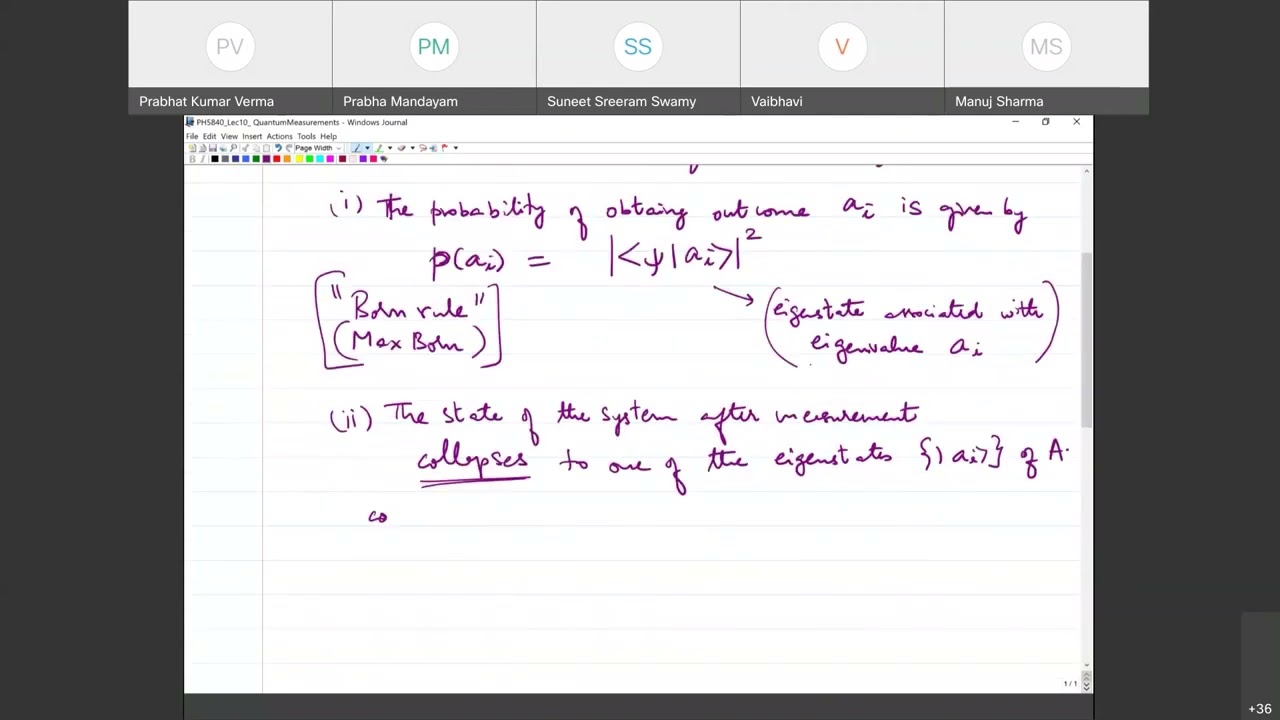
Quantum Computation and Quantum Information: Lecture 10 (Quantum Measurements)
Keywords
Summary
194 words
Critical Evaluation
Value of the Information & Strength of the Argument
The lecture provides a solid and comprehensive introduction to the quantum measurement postulate, essential for understanding quantum circuits and algorithms. The argumentation is clear and systematic: it starts with the conceptual differences from classical physics, introduces the Born rule and collapse, then reformulates everything in the language of projections and trace, which is crucial for advanced quantum information theory. The speaker uses a pedagogical approach, anchoring each new concept in previous material and encouraging students to derive key identities. The discussion of normalization and probability amplitudes is particularly valuable, as it explicitly connects the mathematical formalism to the physical requirement of valid probability distributions. The argumentation is logically coherent, building step-by-step from simple postulates to a more general operator formalism.
Scientific Rigor, Source Quality, Title Accuracy
The lecture is rigorous, with careful definitions and derivations. The speaker does not cite external sources but relies on established quantum mechanics knowledge, which is standard in the field. The mathematical treatment is precise, using Dirac notation and operator algebra correctly. The title ‘Quantum Measurements’ accurately reflects the content, which focuses exclusively on the measurement postulate and its formalization. The lecture is well-structured, and the depth is appropriate for a specialized course. No external sources are provided in the description, so the quality assessment is based solely on the content and the lecturer’s expertise.
229 words
Title / Content Match
The title accurately reflects the content: it is a lecture on quantum measurements within a course on quantum computation and information.
Quality & Reliability
8/10
The lecture is a rigorous exposition of quantum measurement postulates, based on standard theoretical physics, with careful mathematical derivations and a clear pedagogy. However, it is a single lecture without external references or peer review, so the reliability is based on the lecturer's expertise.
Key Moments
Markers derived by PSI from the transcript: the creator did not define chapters.
- Introduction to the measurement postulate and its place in quantum theory.
- Statement of the Born rule and probability of outcomes.
- Discussion of the collapse postulate and destruction of superposition.
- Expansion of state in eigenbasis and identification of probability amplitudes.
- Formalization using projection operators and trace identities.
- Completeness of projectors and preview of next lecture on general measurement operations.
Contribution & Novelties
This lecture contributes a clear pedagogical exposition of quantum measurement, bridging fundamental postulates with the operator formalism essential for quantum computation. It emphasizes the probabilistic nature of measurement and the role of projections, providing a foundation for understanding more advanced topics like POVMs and quantum channels. The lecture uniquely ties the measurement postulate to the trace formalism, which is often underemphasized in introductory texts.
Pour aller plus loin :
- Born rule — Directly related to the probability rule introduced.
- Measurement in quantum mechanics — Broader context of the measurement problem and formalisms.
- Projection (linear algebra) — Mathematical basis for the projectors used.
- Trace (linear algebra) — The trace operation used in probability formulas.
113 words
Radar Profile
The radar profile shows high scores in technical level and information quality, indicating a deep and accurate lecture. Quantity of information is also high, but might be slightly lower than quality due to the focused scope. Fiabilité is strong, reflecting reliance on established theory. The lecture is clearly geared toward an advanced audience, with a balanced emphasis on conceptual understanding and mathematical rigor.