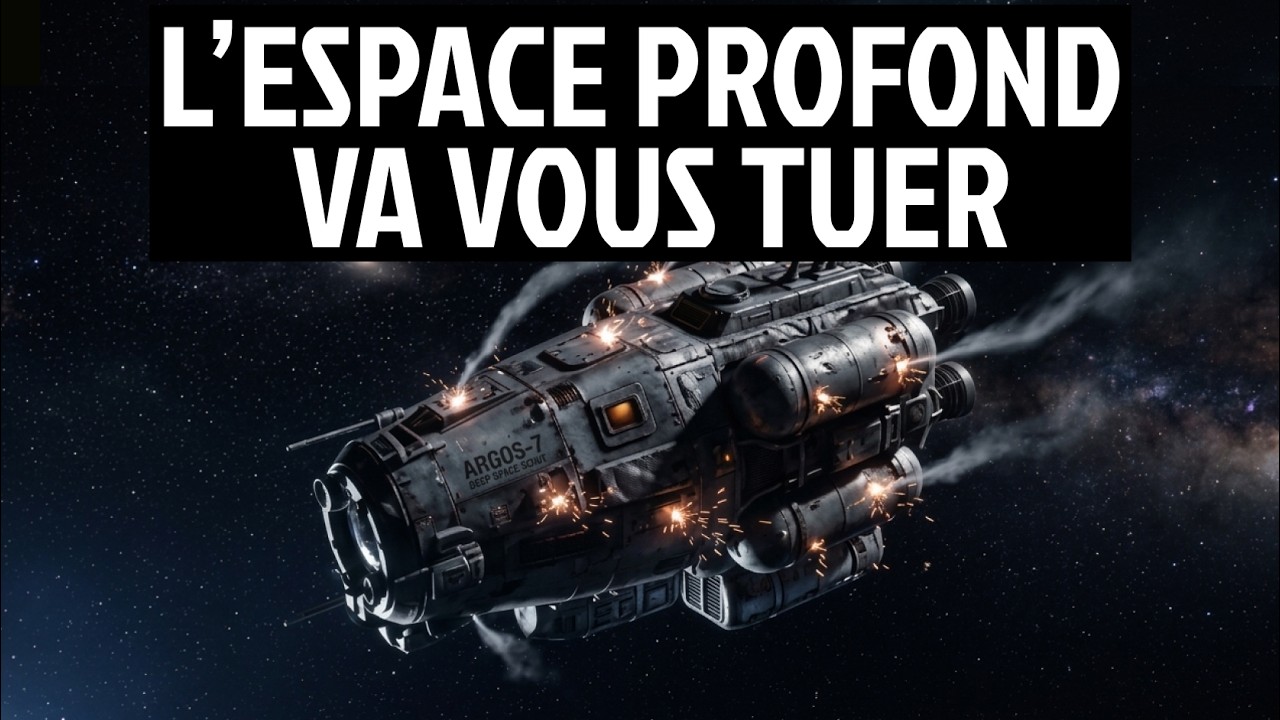
Pourquoi les Humains ne Peuvent pas Survivre dans l’Espace Profond
Why Humans Cannot Survive in Deep Space
Keywords
Summary
177 words
Critical Evaluation
Value of the Information & Strength of the Argument
The video provides substantial value in consolidating many documented challenges of deep space exploration into one coherent narrative. It effectively uses concrete cases and data to support its claims, and the argumentation is solid, relying on established physics and biology. However, it occasionally merges distinct issues without always quantifying cumulative risks, and some extrapolations (e.g., bone loss over years) are presented as straightforward when actual rates may vary. Still, the overall message is well-reasoned and persuasive.
Scientific Rigor, Source Quality, Title Accuracy
The video demonstrates a good grasp of the scientific literature, referencing real missions, studies, and physical principles. It does not cite direct sources in the description, which limits verifiability, but the content aligns with known facts. The title is accurate and appropriately reflects the theme. There is no evident bias or sensationalism; rather, the tone is measured and educational.
150 words
Title / Content Match
The title accurately reflects the content, focusing on the scientific challenges of deep space survival.
Quality & Reliability
8/10
The video presents well-referenced scientific facts about space exploration and human physiology, with accurate descriptions of known phenomena. It is generally reliable but lacks direct citations to primary sources.
Key Moments
Markers derived by PSI from the transcript: the creator did not define chapters.
- ISS Canadarm impact by tiny debris in 2021
- Feynman's quote on nature not being fooled
- Inverse-square law and solar energy limitations
- Voyager RTG decay and power constraints
- Distance to Alpha Centauri and travel time at Parker speed
- ISS water recycling reaching 98%
- Tsiolkovsky rocket equation explanation
- Biosphere 2 oxygen drop and lessons
- Debris statistics from NASA OIG 2021 report
- Radiation exposure and shielding challenges
- NASA Twins Study telomere findings
- Bone density loss and exercise countermeasures
- Fluid shift and visual impairment syndrome
- Psychological stress and isolation research
- Valeri Polyakov 437-day record and conclusion
Cited Sources
- NASA Twins Study — Discussion of telomere changes in Scott Kelly vs Mark Kelly during 340-day mission.
- Biosphere 2 — Ground-based closed ecosystem experiment that experienced oxygen depletion due to soil microbes and concrete absorption.
- Konstantin Tsiolkovsky — Author of the rocket equation, foundational to spaceflight mass and propulsion calculations.
Concurring Sources
- NASA OIG Report on Orbital Debris (2021) — Statistics on debris sizes and impact potential mentioned in the video.
- NASA Human Research Program — Provides context on physiological effects of long-duration spaceflight and radiation limits.
Contribution & Novelties
The video synthesizes widely known challenges of deep space travel into a coherent, accessible narrative, emphasizing that current technological milestones (e.g., 98% water recycling, Voyager longevity) still fall short of what interstellar missions require. It draws compelling parallels between historical incidents (ISS debris hits, Biosphere 2 failure) and future risks, offering a realistic counterpoint to optimistic colonization narratives.
Pour aller plus loin :
- Alpha Centauri — The nearest stellar system, illustrating the immense distances involved in interstellar travel.
- Inverse-square law — The physical principle governing solar energy attenuation with distance.
- Tsiolkovsky rocket equation — Essential for understanding the mass-fuel trade-off in space missions.
103 words
Radar Profile
The profile shows high scores in quality and quantity of information, with moderate technical depth and high global reliability, reflecting a well-researched documentary that prioritizes accuracy over sensationalism.