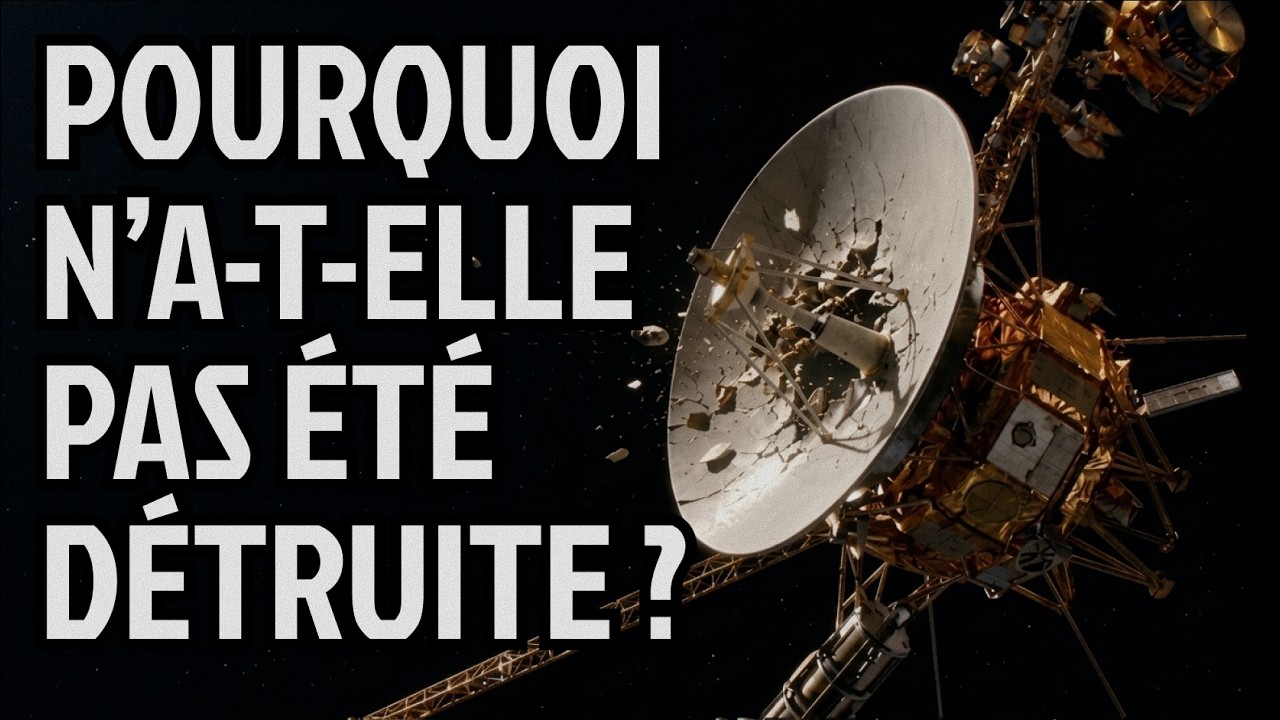
Pourquoi la Voyager 1 n’a-t-elle Encore Rien Percuté Après 49 Ans dans l’Espace ?
Why Hasn't Voyager 1 Broken Through Anything Yet After 49 Years in Space?
Keywords
Summary
141 words
Critical Evaluation
Value of the Information & Strength of the Argument
The video’s value lies in its ability to translate complex astronomical concepts into intuitive, vivid analogies, such as the scaled model where the Sun is a meter-wide ball and Voyager 1 is a nanometer-sized speck. The argumentation is coherent and fact-based, systematically building the case that space is overwhelmingly empty. It draws on concrete mission data—particle densities, distances, and impact statistics—to support its claims. The narrative is engaging and avoids over-simplification, making a strong case for the empirical reality of interplanetary and interstellar voids.
Scientific Rigor, Source Quality, Title Accuracy
The video demonstrates strong scientific rigor in its factual content, accurately describing known mission events and discoveries. However, it does not provide direct source citations or links in the description, relying instead on the authoritative nature of the mission’s history. The title is well-matched to the content, posing a question that the video thoroughly resolves. The absence of explicit references is a minor weakness, but the overall reliability is high given the familiarity of the mission’s achievements.
176 words
Title / Content Match
The title directly addresses the central question, and the video thoroughly answers it while expanding into broader cosmic scale concepts. The match is strong.
Quality & Reliability
7/10
The video presents a scientifically accurate and well-structured overview of the Voyager 1 mission and the extreme emptiness of the solar system, based on established facts. However, it lacks explicit citations or links to primary sources, and some narrative embellishments and analogies are introduced for educational impact.
Key Moments
Markers derived by PSI from the transcript: the creator did not define chapters.
- Launch of Voyager 1 on September 5, 1977, and the near-failure due to a fuel shortage in the Centaur upper stage.
- Description of the asteroid belt and the actual particle density, highlighting the lack of obstacles encountered.
- Jupiter flyby: discovery of its ring, the Great Red Spot's motion, and the volcanic activity on Io discovered by Linda Morabito.
- Europa's smooth icy surface and the inference of a subsurface ocean, now supported by later missions.
- Saturn encounter: thousands of rings and the surprising complexity of the F-ring, with braided structures.
Contribution & Novelties
The video effectively synthesizes the Voyager mission’s history and the scientific understanding of space’s emptiness, offering a fresh perspective that counters common misconceptions. Its originality lies in the emphasis on the empirical measurement of emptiness, using Voyager 1’s journey as a direct experiment. The narrative style is cinematic and immersive, making abstract scales tangible.
Pour aller plus loin :
- Voyager 1 - Wikipedia — Reliable foundational source for mission details and timeline.
- Interstellar Medium - Wikipedia — Explains the density and composition of gas in space, relevant to the video’s core argument.
- Scale of the Solar System — Provides visualizations and comparisons that complement the video’s scale analogy.
108 words
Radar Profile
The radar profile shows high scores in quantity and quality of information, moderate technical depth, and good global reliability. This indicates a well-researched documentary that is accessible to a general audience while retaining scientific accuracy.