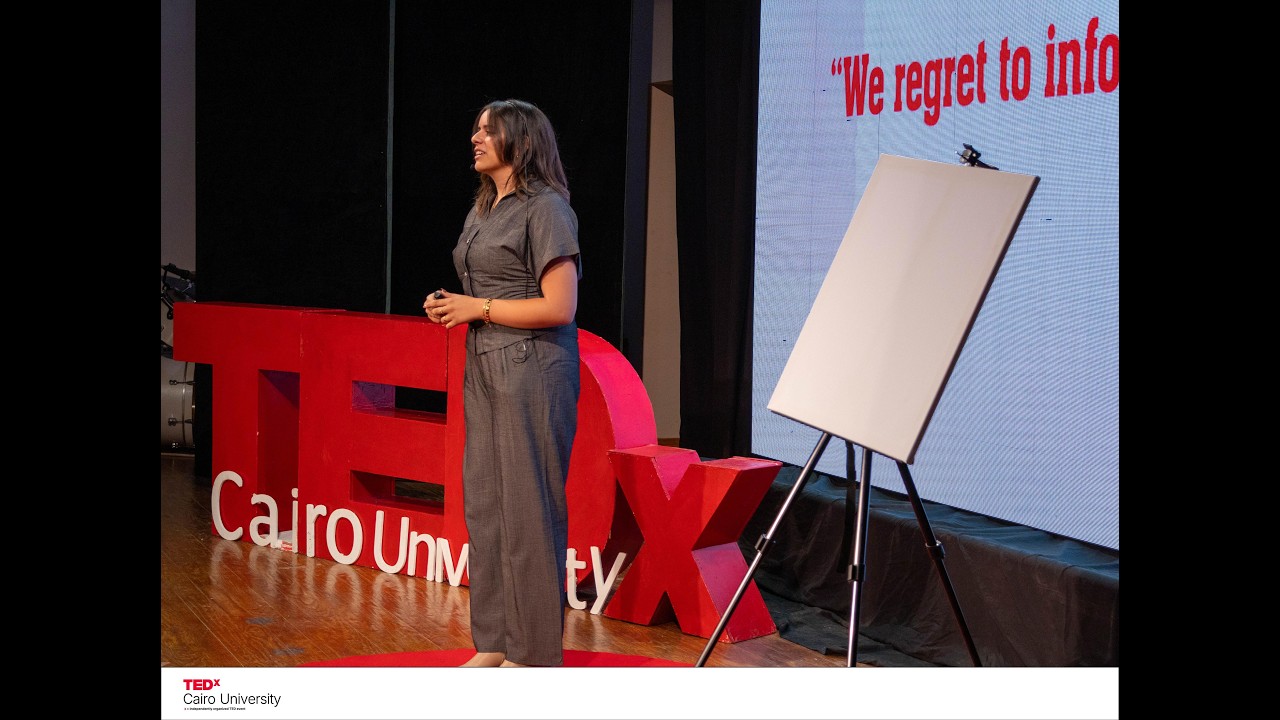
Proof Over Potential | Norhan Nada | TEDxCairo University
Keywords
Summary
210 words
Critical Evaluation
Value of the Information & Strength of the Argument
The talk’s value lies in its relatable reframing of potential as a hinderance rather than an asset. Nada’s argumentation is built on vivid personal stories and analogies (the empty board, the perfectionist preparer) that make the abstract concept accessible. However, the reasoning is anecdotal and lacks empirical support or references to psychological literature on procrastination or goal pursuit. The logical progression from identifying the problem to proposing a concrete solution is clear, and the final call to action is practical, but the absence of evidence or external validation weakens its persuasive force beyond personal testimony.
Scientific Rigor, Source Quality, Title Accuracy
The talk does not cite any academic sources, studies, or expert opinions. The only reference is to TEDx itself, which is not a scientific authority. The content is based on personal experience and subjective observation, aligning with a motivational genre rather than scientific discourse. The title is appropriate and directly reflects the message, and the presentation follows a coherent narrative structure. While the talk is intellectually stimulating, its scientific rigor is minimal; it does not offer verifiable data or replicable methodologies.
191 words
Title / Content Match
The title accurately captures the central thesis: instead of resting on perceived potential, one should seek concrete proof through action.
Quality & Reliability
4/10
The talk relies on personal anecdotes and motivational framing rather than verifiable data or peer-reviewed sources. The argument is coherent but not grounded in academic research, limiting its reliability as a scientific source.
Key Moments
Markers derived by PSI from the transcript: the creator did not define chapters.
- Introduction: being told since age nine that she would achieve great things, and the metaphor of a mental board with all plans.
- Realization that despite all planning, the board remains empty; potential becomes a hiding place.
- Three archetypes: the gifted student who stops raising her hand, the aspiring entrepreneur who only consumes knowledge, and the perpetual procrastinator who waits for next year.
- Fear of losing the untested image of genius; potential as an identity shield.
- Personal breakthrough: submitting a rough startup idea, winning in Egypt and Tokyo, traveling, creating content.
- Challenge to the audience: pick one unfinished thing and make an imperfect version this week.
Cited Sources
- TEDx Talks official page — The talk was delivered at a TEDx event organized by Cairo University; the page explains the TEDx format and context.
Contribution & Novelties
The talk offers a fresh, personal perspective on the common challenge of perfectionism and procrastination, framing ‘potential’ as a cognitive refuge that delays action. Its novelty lies in the vivid metaphor of the ‘board’ and the actionable suggestion to produce imperfect work quickly. While not scientifically novel, it synthesizes everyday insights in a memorable way.
Pour aller plus loin :
- Growth mindset (Wikipedia) — Relevant to how beliefs about abilities affect behavior, complementing the idea of potential as a mindset.
- Procrastination (Wikipedia) — Directly related to the talk’s core issue of delaying action despite intention.
- The IKEA effect (Wikipedia) — Explores why people value their own imperfect creations, supporting the talk’s encouragement to produce imperfect work.
116 words
Radar Profile
The radar profile is unbalanced, with low technical level and moderate information quantity. The talk scores higher on quality of information relative to quantity, indicating a focused but narrow message. Reliability is low, consistent with an anecdotal motivational talk rather than scientific exposition.