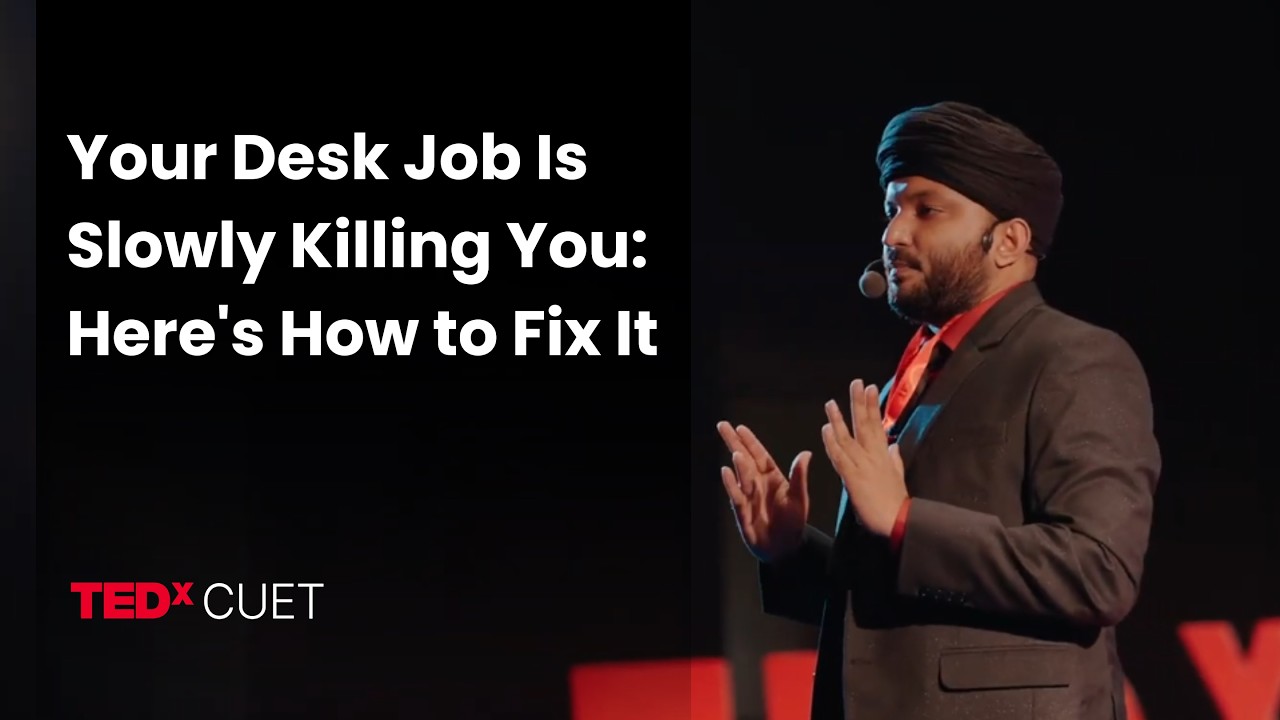
Building healthier habits and combating a sedentary lifestyle | Muhammad Sajal | TEDxCUET
Keywords
Summary
169 words
Critical Evaluation
Value of the Information & Strength of the Argument
The talk provides a structured overview of common health issues related to modern work environments, with practical advice that is accessible to a general audience. The argumentation relies heavily on anecdotal evidence and broad assertions, often presenting correlation as causation (e.g., linking prolonged sitting to specific cancers without citing robust meta-analyses). While the suggestions for healthy habits (e.g., nasal breathing, regular walking) are generally aligned with mainstream wellness guidance, the specific statistics and mechanisms are presented without references, undermining their credibility. The speaker’s enthusiasm and clear delivery help convey the message, but the lack of scientific evidence significantly weakens the value of the information as a reliable source of health advice.
Scientific Rigor, Source Quality, Title Accuracy
The talk cites a few studies (e.g., a 2021 study from an ‘international journal of health professionals’) but provides no specific citations, URLs, or author names, making verification impossible. The TED description itself warns viewers not to look to this talk for health advice, indicating that several claims lack sufficient scientific support. The title accurately matches the content, but the overall scientific rigor is low due to unsubstantiated statistics and oversimplified physiological explanations. The speaker’s credentials in nutrition and public health are presented, but they do not counteract the absence of evidence for many specific claims. The presentation is more motivational than evidence-based, and viewers should approach it with caution.
236 words
Title / Content Match
The title accurately reflects the content: the speaker discusses habits to improve health and combat sedentary lifestyle.
Quality & Reliability
2/10
The talk presents personal views and unsupported claims, as flagged by TED. Many statistics lack verifiable sources and some advice may not be scientifically validated. The speaker mixes anecdotal observations with broad statements without rigorous evidence.
Key Moments
Markers derived by PSI from the transcript: the creator did not define chapters.
- Introduction: focus on occupational health of engineers, chronic stress and prolonged sitting.
- Statistics on chronic stress: 70% of engineers affected, 2021 study, postural deformities like tech neck.
- Nasal breathing as stress management tool: links to parasympathetic nervous system.
- Nutrition advice: leafy greens, nuts, seeds, dark chocolate; avoid sugar and caffeine.
- Risks of prolonged sitting: diabetes, colon cancer, heart disease; importance of leg muscles.
- Exercise solutions: extension exercises, daily walking (60 min), strength training (3 hrs/week).
- Conclusion: recap of seven techniques to reverse enemies; closing statement.
Cited Sources
- TEDx Content Guidelines — Linked in description, provides context for TEDx content standards.
- TEDx Official Page — General TEDx information, referenced in description.
Dissenting Sources
- TED Disclaimer in Description — The video description contains a formal disclaimer stating that the talk should not be viewed as health advice and that several claims lack sufficient scientific support.
Contribution & Novelties
The talk compiles common wellness advice within a framework specifically targeting engineers and office workers, emphasizing the dual threats of stress and sedentary behavior. Its originality lies in the combination of breathing, nutrition, and exercise recommendations, but the content is largely derivative and lacks new scientific insights. The claimed statistics and causal links are not backed by accessible sources, limiting its contribution to the field.
Pour aller plus loin :
- Nasal breathing — Relevant to the proposed stress management technique, though benefits are not fully established.
- Sedentary lifestyle and health — Discusses general health impacts, aligning with the talk’s warnings.
- Strength training for health — Supports the recommendation for muscle preservation and metabolic benefits.
- Tech neck (text neck) — A term used in the talk, though not officially recognized as a medical condition.
133 words
Radar Profile
The radar profile shows low reliability and technical depth, moderate quantity of information, and low quality. The talk is accessible and broad, but the lack of rigorous evidence and superficial treatment of physiological mechanisms results in a weak scientific basis.