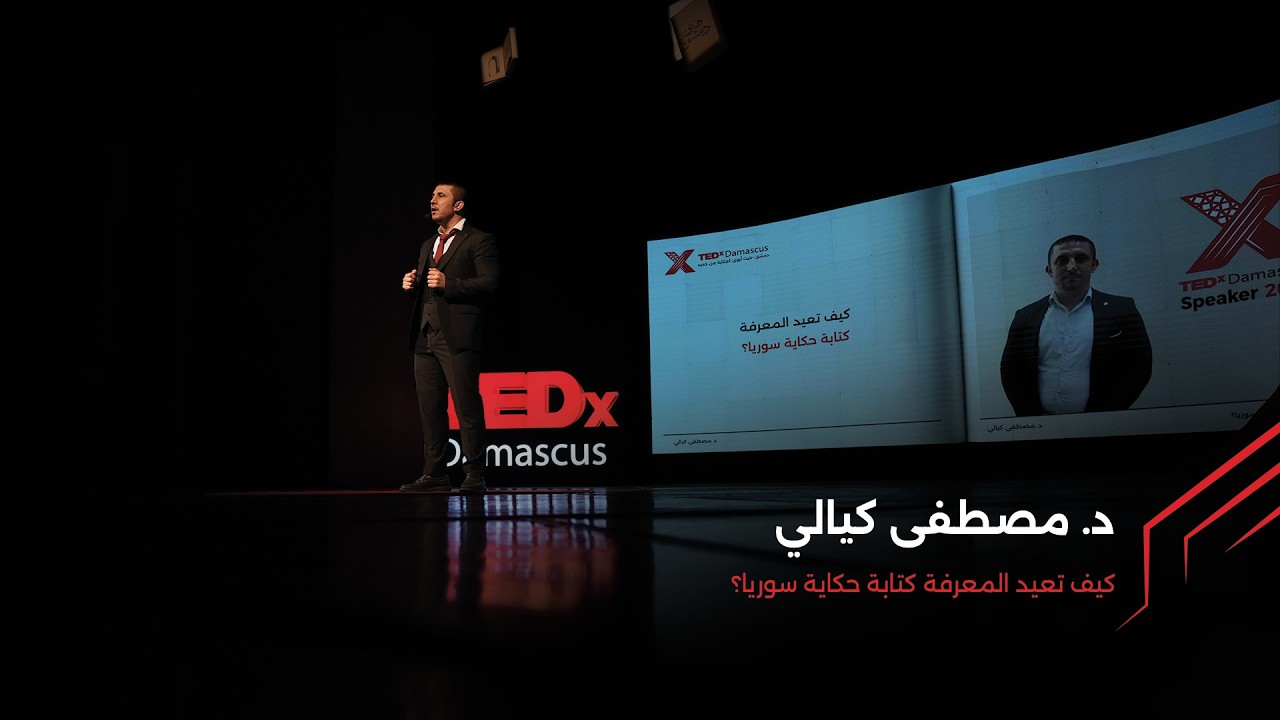
Invisible Infrastructure: How Knowledge Rewrites Syria's Story | Dr.Mustafa Kayyali | TEDxDamascus
Invisible Infrastructure: How Knowledge Rewrites Syria's Story | Dr. Mustafa Kayyali | TEDxDamascus
Keywords
Summary
116 words
Critical Evaluation
Value of the Information & Strength of the Argument
The talk offers a compelling and coherent argument that knowledge is a critical, often overlooked component of national reconstruction. The speaker contrasts physical rebuilding with intellectual renewal, using relatable examples (a bridge needs an educated engineer, a hospital needs a skilled doctor). The argumentation is logical and progresses from defining the problem to proposing a concrete five-step framework, then to individual agency. While the talk is not dense with external evidence, it is internally consistent and persuasive, drawing on the speaker’s personal credibility and experience.
Scientific Rigor, Source Quality, Title Accuracy
The talk is a personal opinion piece rather than a scientific presentation; it does not cite specific studies or data. The speaker references his own extensive publication record (over 30 books, 250 papers) as a basis for authority, but no external sources are mentioned beyond the TEDx platform itself. The title is accurate and well-matched to the content. The description provides additional context about the speaker’s background, which enhances trustworthiness, but the talk itself lacks formal citations.
177 words
Title / Content Match
The title accurately reflects the content: the talk defines invisible infrastructure as knowledge and explores how it can rewrite Syria's narrative through documentation and education.
Quality & Reliability
6/10
The talk is a reflective and motivational discourse by an experienced academic. It lacks empirical data but is grounded in the speaker's considerable expertise in higher education and research, offering a coherent conceptual framework rather than original scientific findings.
Key Moments
Markers derived by PSI from the transcript: the creator did not define chapters.
- Definition of invisible infrastructure as systems of knowledge and institutions
- Why Syria specifically needs to rebuild knowledge infrastructure due to interrupted education and migration
- Introduction of the five steps: documentation, understanding, translation, access, outcome
- Emphasis on individual contributions and the role of families and workers in preserving memory
- Call to action: start building with knowledge now, not waiting for large reconstruction projects
Cited Sources
- TEDx Program — The talk was given at a TEDx event, independently organized, and the official TEDx page is referenced in the description.
Contribution & Novelties
The talk contributes a clear framing of knowledge as ‘invisible infrastructure’ for post-conflict reconstruction, proposing a practical five-step pathway. It adds value by emphasizing the role of documentation and translation in preserving national memory, an angle often overlooked in physical rebuilding discussions.
Pour aller plus loin :
- Soft power — The concept of soft power, as introduced by Joseph Nye, aligns with the speaker’s idea of knowledge as a non-coercive influence; relevant for understanding how knowledge can rebuild Syria’s global standing.
- Knowledge economy — Reference to economic frameworks where knowledge is a key asset; helps situate the talk’s argument in a broader economic context.
- Institutional memory — The concept of preserving an organization’s history and knowledge, directly related to the talk’s emphasis on documentation to avoid rebuilding from scratch.
129 words
Radar Profile
The radar profile shows moderate scores in information quantity and quality, low technical level, and moderate reliability. This reflects a conceptual, non-technical talk that prioritizes rhetorical persuasion over empirical detail.