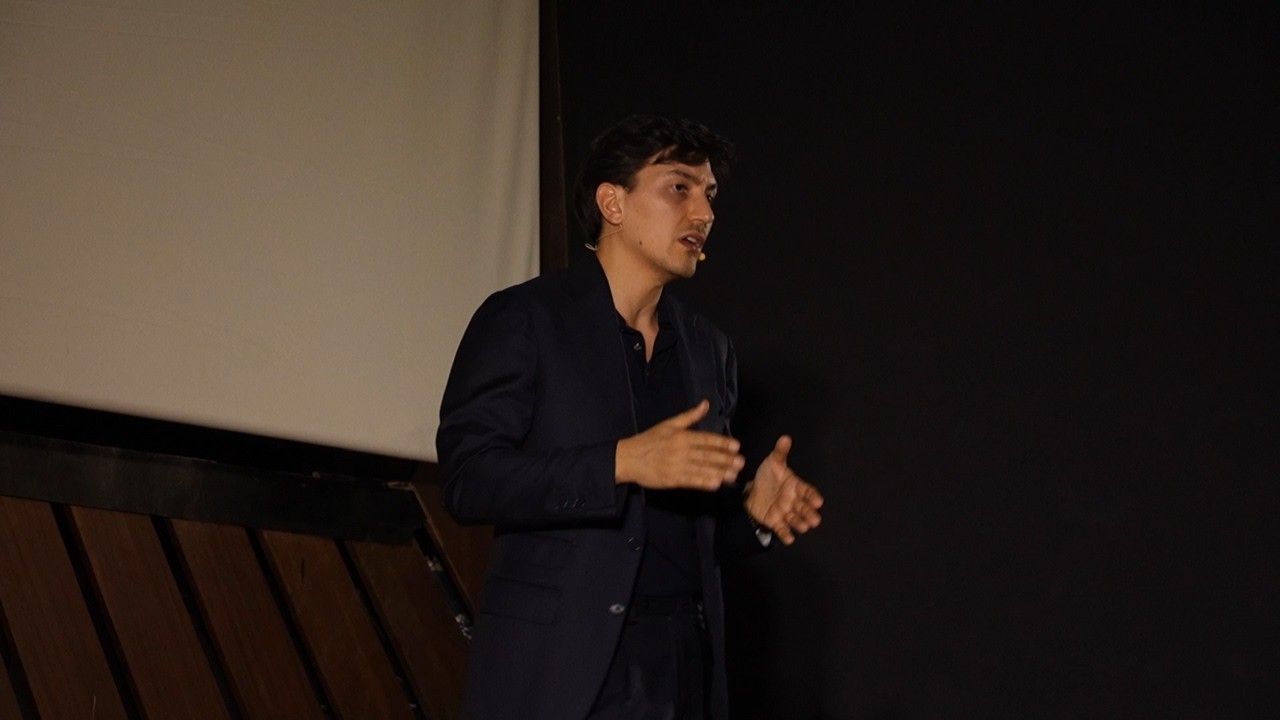
Abbiamo ottimizzato tutto. Tranne le nostre decisioni. | Federico Coccia | TEDxLatronico
We optimized everything. Except our decisions. | Federico Coccia | TEDxLatronico
Keywords
Summary
251 words
Critical Evaluation
Value of the Information & Strength of the Argument
The talk delivers genuine value through a practitioner’s insider perspective rarely accessible in academic contexts: the speaker transparently explains persuasion mechanisms he deploys professionally, including language choices on checkout buttons and how contextual details orient attention. The concrete case study — changing ‘Buy now’ to a softer continuation phrasing — illustrates convincingly that micro-choices in design alter perceived decision weight without changing price or product. The argumentation is structurally sound: it moves from personal anecdote to professional mechanism, then to AI amplification, and finally to a philosophical call for reclaiming friction as protective thinking space. The logical thread is coherent and the ‘pilot’ metaphor for AI literacy is memorable and effective. However, the argument rests heavily on experiential authority; causal claims (e.g., AI leading to more automation of decisions) are asserted rather than demonstrated, and the burnout statistic is presented without methodological context. The rhetorical strength relies on relatability and narrative, which works for a TEDx audience but limits its value as evidence-based analysis.
Scientific Rigor, Source Quality, Title Accuracy
The talk is notably light on citations: the only external reference is Google Trends (burnout searches), mentioned without precise time frame or verification. As a TEDx talk, it follows the convention of oral narrative over academic sourcing; the speaker’s authority derives from his professional track record rather than published research. The e-commerce case study is presented as a factual recollection without measurable conversion figures — interesting, but impossible to verify. The only link provided in the description is the general TEDx program page, offering no additional documentation. On its own terms, the talk is rigorous in its internal logic and honest about its premises, but it does not meet standards of empirical rigor. The title-content fit is excellent: the title announces a critique of optimization at the expense of decision-making, and the talk develops exactly that thesis with coherence and concrete illustrations.
321 words
Title / Content Match
The title fits the content perfectly: the speaker argues that we optimized every digital process except the preservation of genuine, reflective human decision-making, which is exactly what the talk develops with coherent examples and a clear thesis.
Quality & Reliability
6/10
Expert opinion grounded in 15+ years of professional digital marketing and AI experience, illustrated with a concrete client case study (changing a purchase button label). However, the talk relies primarily on personal authority and anecdotal evidence rather than peer-reviewed research; the only quantitative reference (100% rise in burnout searches on Google Trends) is imprecise, lacking time frame and methodological context.
Key Moments
Markers derived by PSI from the transcript: the creator did not define chapters.
- Intro: born in 1900, dial-up internet nostalgia and the promise of connectivity.
- Personal anecdote: 20 minutes on a shoe website without intending to buy — persuasion mechanisms at work on an expert.
- We react to contexts: details (image, text, review, box placement) build a direction; designers of persuasion.
- Friction as thinking moment: the pause that lets us ask 'do I really want this?' vs design's drive to remove friction.
- Introducing 'invisible direction': a frame of details that makes one choice feel more natural than another; AI personalizes per user.
- Case study: replacing 'Buy now' with 'Continue — you can review everything before paying' removes psychological pressure without changing the product.
- AI is deeply human; burnout searches doubled on Google Trends; the danger is thinking becoming optional.
- Pilot metaphor and conclusion: the future belongs to those who stay human — reflecting before acting.
Cited Sources
- TEDx program (TED.com) — Official TEDx program page mentioned in the video description, explaining the independently organized TED-style event format.
Contribution & Novelties
The original contribution lies in framing friction as a protective mechanism for decision autonomy — a counterpoint to the dominant UX paradigm of frictionless flows — and in adding a practitioner vocabulary (‘invisible direction’, ‘pilot literacy’) for describing AI-mediated persuasion. For professionals, the case study provides actionable insight; for the general public, it offers a pragmatic mental checklist for detecting manipulated contexts. The talk does not claim academic novelty but synthesizes known persuasion research into an accessible framework oriented toward AI-era challenges.
Pour aller plus loin :
- Choice architecture — The organizing concept by Thaler & Sunstein that directly underpins the talk’s ‘invisible direction’ thesis.
- Nudge theory — Core behavioral economics framework for how subtle cues alter decisions without mandates, supporting the speaker’s argument.
- Dark patterns — Documented UI manipulation techniques that complement and formalize the persuasion details described in the talk.
- Attention economy — The economic lens explaining why platforms optimize for attention capture, contextualizing the speaker’s commercial incentives.
- Recommender system — Technical overview of the personalization engines the speaker says decide ‘what to make us notice’.
178 words
Radar Profile
The radar profile shows a talk strong on qualitative, experiential knowledge (quality 6/10) but modest on technical depth (4/10) and external verifiability (reliability 5/10). The balanced rectangle shape reflects a practitioner's perspective: practical, narrative-driven insight with limited quantitative backing.