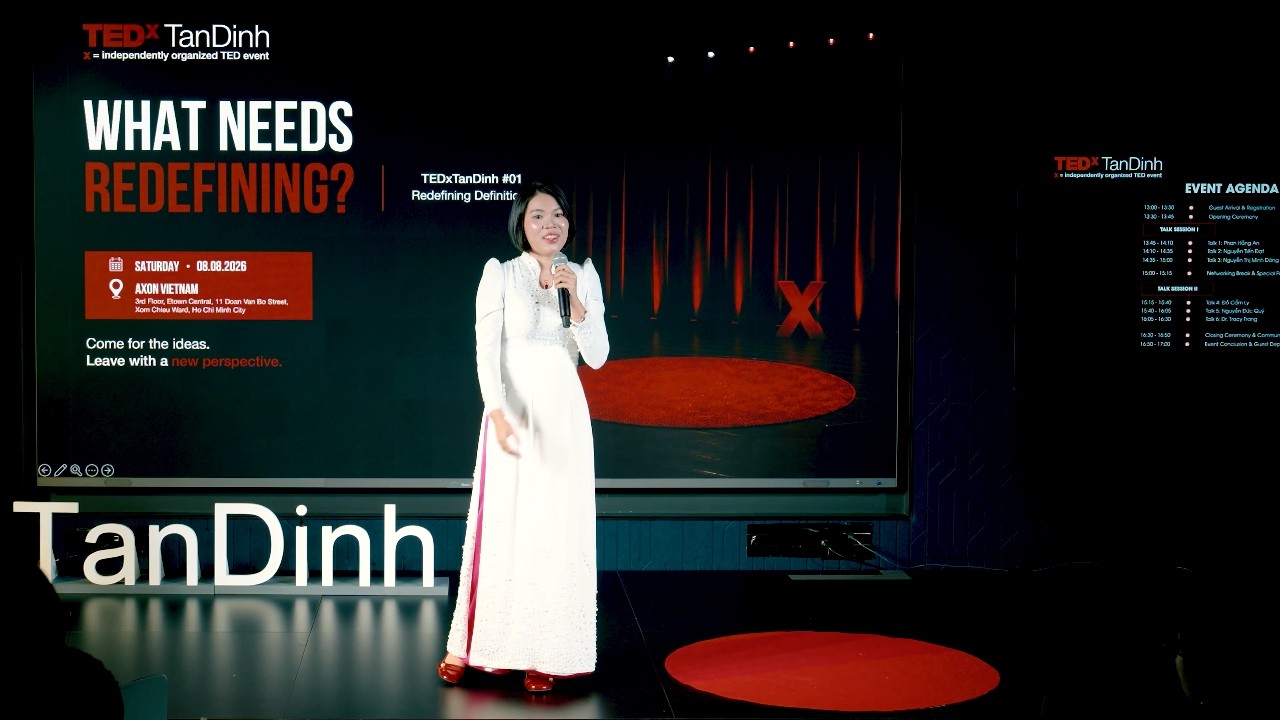
Raising Global Citizens, Not Global Competitors | Tracy Trang Tran | TEDxTan Dinh
Keywords
Summary
181 words
Critical Evaluation
Value of the Information & Strength of the Argument
The talk offers an inspiring and emotionally resonant perspective on parenting and education, emphasizing empathy, curiosity, and cultural rootedness. The argumentation is coherent, moving from personal anecdotes to a broader educational philosophy. However, it relies heavily on narrative rather than systematic evidence; the speaker’s credibility comes from professional experience rather than cited research. The emotional appeal is effective, but the logical structure is loose and would benefit from more concrete data to support its claims.
Scientific Rigor, Source Quality, Title Accuracy
The talk references UNESCO but does not provide specific documents or publications, limiting verifiability. No external sources are listed in the description beyond the standard TEDx link. The title accurately captures the theme, and the content stays on topic. The lack of formal citations and the subjective nature of the anecdotes reduce the scientific rigor, though the talk is clearly framed as a personal and motivational piece.
157 words
Title / Content Match
The title accurately reflects the talk's central contrast between raising global citizens and global competitors, a theme developed throughout.
Quality & Reliability
6/10
The talk draws on personal experiences and a brief reference to UNESCO, but lacks specific citations and empirical evidence. It is coherent and inspirational, yet the scientific rigor is limited to general principles.
Key Moments
Markers derived by PSI from the transcript: the creator did not define chapters.
- Introduction: invites audience on a metaphorical journey to childhood and asks what it means to raise a global citizen.
- Poses the central question and contrasts parental desires for success with the idea of global citizenship.
- Discusses common parental aspirations (ratings, English, studying abroad) and introduces the global citizen vs global competitor dichotomy.
- Cites UNESCO's definition of global citizenship, emphasizing continuous learning, critical thinking, empathy, and emotional intelligence.
- Presents three stories of students facing identity conflicts due to academic pressure or cultural disconnect.
- Reflects on becoming a 'global parent' and the importance of building a future with children, not just for them.
- Argues that English proficiency is not identity and academic excellence does not guarantee fulfillment; emphasizes cultural pride.
- Shares a student's message about carrying Vietnamese culture to the world and concludes with love and home as the foundation of education.
Cited Sources
- TEDx — Standard TEDx description link; the talk references UNESCO but no specific URL is provided in the transcript or description.
Contribution & Novelties
The talk offers a personal and culturally specific perspective on global citizenship, arguing that true global citizenship does not require abandoning one’s cultural identity. It challenges the common assumption that success lies in academic excellence and Western assimilation, proposing instead a holistic approach centered on empathy, emotional intelligence, and home-based learning. The speaker’s emphasis on the parent-child relationship as the primary educational site is a valuable contribution to the discourse on international education.
Pour aller plus loin :
- Global citizenship education — Provides an academic foundation for the concept highlighted in the talk.
- Emotional intelligence — Directly links to the speaker’s call for empathy and emotional skills in education.
- Growth mindset — Relevant to the idea of continuous learning and adaptability rather than fixed achievement.
125 words
Radar Profile
The profile shows a talk with moderate information quality and reliability but low technical depth, indicating a non-technical, inspirational presentation. The scores suggest a balanced appeal to general audiences rather than specialized researchers.