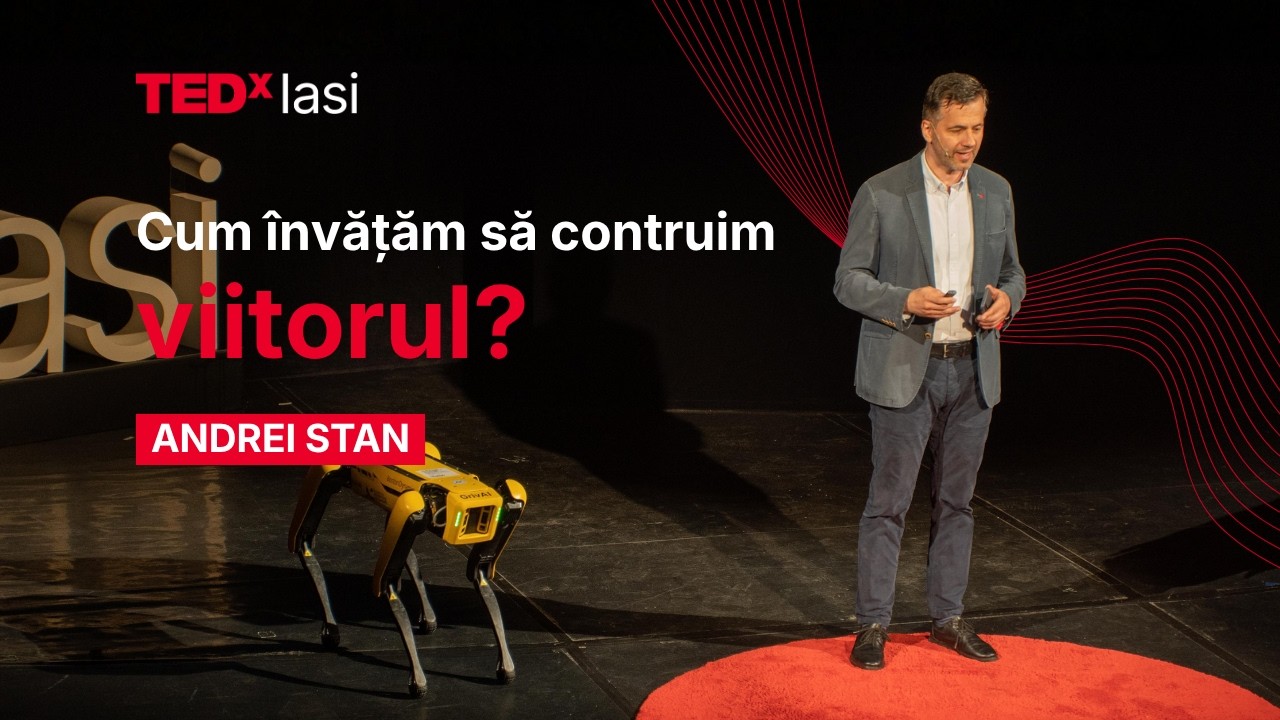
Cum învățăm să construim viitorul? | Andrei Stan | TEDxIasi
How do we learn to build the future? | Andrei Stan | TEDxIasi
Keywords
Summary
196 words
Critical Evaluation
Value of the Information & Strength of the Argument
The talk’s value lies in demystifying AI by highlighting the often-overlooked hardware foundation, and in linking technical concepts to concrete applications and pedagogical practices. The argumentation is clear and progressive: starting from the three-pillar analogy, it moves through historical context (creative destruction, Turing Award), a tangible example (GPU), a live demonstration (robot), and then to the author’s own research and student work, ultimately advocating for an integrated educational approach. The reasoning is sound and supported by recognized authorities and practical evidence, though the depth is limited by the talk format.
Scientific Rigor, Source Quality, Title Accuracy
The speaker demonstrates scientific rigour by correctly referencing Hennessy and Patterson’s Turing Award work on domain-specific architectures and Schumpeter’s concept of creative destruction. He also mentions the open-source RISC-V architecture and presents real student projects with preliminary results submitted to a conference. However, no explicit academic sources or papers are cited, and the only link provided is the general TEDx page. The title adequately reflects the content, and the talk stays on topic throughout.
179 words
Title / Content Match
The title directly reflects the content: the speaker argues that building the future requires understanding the hidden hardware pillar of AI and adapting education accordingly, and he illustrates this with examples from his own teaching and research.
Quality & Reliability
8/10
The talk provides accurate and well-structured information, referencing recognized authorities such as Hennessy and Patterson and Schumpeter, and grounds claims in concrete student projects. However, it remains a popular-science talk with no detailed citations, and the only source link is the generic TEDx page.
Key Moments
Markers derived by PSI from the transcript: the creator did not define chapters.
- Introduction to the three pillars of AI: algorithms, data, and hardware.
- Discussion of creative destruction and how smartphones replaced entire industries.
- Reference to Hennessy and Patterson's Turing Award and the concept of domain-specific architectures.
- Example of GPUs, originally for graphics, now powering AI due to parallel processing.
- Demonstration of the robot Grivai from the Spot family, showcasing hardware-software integration.
- Presentation of the speaker's research on a RISC-V extension and open-source validation tool.
Cited Sources
- TEDx official page — The video description provides this link as general information about TEDx events.
Contribution & Novelties
The talk brings a fresh perspective by focusing on the hardware pillar of AI, which is rarely discussed in popular science, and by connecting it to education and open-source hardware. It illustrates how universities in less central locations can contribute to cutting-edge R&D using open tools like RISC-V. The emphasis on teaching students to design specialized systems rather than just use existing ones is a valuable takeaway.
Pour aller plus loin :
- RISC-V — The open-standard instruction set architecture that the speaker and his students use for their research; central to the talk’s technical aspects.
- Graphics processing unit — The GPU as an example of a domain-specific architecture that found a new purpose in AI, as described in the talk.
- Turing Award — The prestigious award referenced to cite Hennessy and Patterson’s contribution to computer science.
- Creative destruction — Schumpeter’s concept invoked to explain technological paradigm shifts.
147 words
Radar Profile
The radar profile suggests a talk with moderate information density and technical depth, but high informational quality and good overall reliability. It is stronger on qualitative aspects and argumentation than on quantitative content or formal complexity.