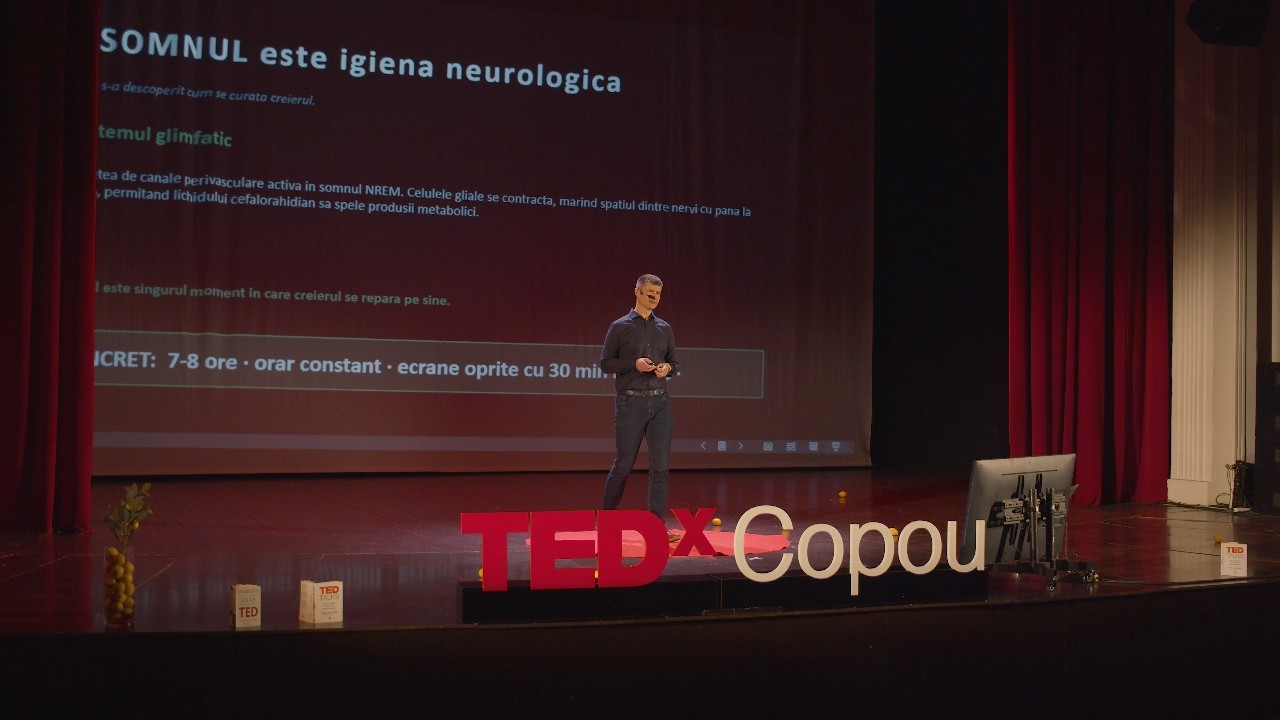
De ce sistemul tău nervos nu se mai liniștește? | Orest Bolbocean | TEDxCopou
Why Your Nervous System Won't Calm Down | Orest Bolbocean | TEDxCopou
Keywords
Summary
164 words
Critical Evaluation
Value of the Information & Strength of the Argument
The talk provides practical, actionable advice on nervous system regulation, supported by well-known scientific concepts such as the glymphatic system, default mode network, and neuroplasticity. The speaker uses a personal anecdote to engage the audience and illustrates each law with concrete examples. However, the argumentation is built on simplified analogies and personal clinical experience rather than systematic evidence. The claim that the brain forms responses up to 10 seconds before conscious awareness is presented without citation, and the four laws, while reasonable, are not derived from a single coherent framework. The motivational section introduces the ‘stimulus vs. motivation’ distinction effectively, but the explanation of dopamine as a ‘seeking hormone’ is accurate yet oversimplified. Overall, the talk is persuasive and accessible, but it lacks rigorous scientific nuance.
Scientific Rigor, Source Quality, Title Accuracy
The talk is a science communication piece rather than an original study. It cites only two major studies explicitly: the 2013 Science paper on the glymphatic system and the 80-year longitudinal study on relationships (likely the Harvard Study of Adult Development), but it does not provide specific references or methodological details. The absence of formal citations and the TED disclaimer indicating the talk falls outside content guidelines reduce its scientific rigor. The title accurately reflects the content, which offers practical guidance on calming the nervous system. The talk is not overly technical, and the speaker’s credentials as a neurologist add some authority, though the lack of precise sourcing and the broad generalizations prevent it from being highly rigorous.
259 words
Title / Content Match
The title asks why the nervous system cannot calm down, and the talk addresses that by explaining stress responses and offering four practical laws for nervous system regulation. The content matches the title well.
Quality & Reliability
5/10
The talk is based on personal clinical experience and simplified neuroscience. It references a landmark 2013 Science paper on the glymphatic system and a long-term study on relationships, but does not provide specific citations or methodological details. TED has flagged the talk for falling outside content guidelines, indicating potential overgeneralizations.
Key Moments
Markers derived by PSI from the transcript: the creator did not define chapters.
- Introduction with a plastic lemon; announcement that the talk will be about calming the nervous system.
- Personal story of a panic attack at 3 AM before signing a lease; explanation that the brain simulates the future during sleep.
- Four types of reactions to a threat: muscular, sympathetic/parasympathetic, metabolic, and cognitive interpretation.
- Contrast between a healthy person and an overloaded one, listing symptoms like interrupted sleep, fatigue, and generalized pain.
- First law: Sleep is mandatory, referencing the 2013 Science paper on the glymphatic system and brain cleaning.
- Second law: Active relaxation, introducing the default mode network discovered during MRI rest states.
- Third law: Attention as a finite biological resource; example of the 23-minute refocusing time.
- Fourth law: Energy from motivation instead of stimulus; four components of motivation, dopamine as a seeking hormone.
- Conclusion: Relationships as best predictor of health, neuroplasticity, and the importance of daily choices.
Cited Sources
- TEDx Content Guidelines — Referenced in the video description regarding TED's note about the talk's content.
- TEDx Program — Mentioned as the event format for independently organized TED-like talks.
Contribution & Novelties
The talk adds value by translating complex neuroscience into four practical, memorable laws for everyday life, illustrated with personal clinical examples. It emphasizes the often-overlooked role of the physical body in emotional regulation and promotes a holistic view of health. While not containing new scientific findings, it synthesizes existing research on sleep, attention, and motivation into actionable advice. Its novelty lies in the accessible presentation and the integration of P-DTR (a neurological technique) with broader lifestyle recommendations.
Pour aller plus loin :
- Glymphatic system — Relevant to the first law on sleep and brain cleaning.
- Default mode network — Supports the second law on active relaxation and mind-wandering.
- Neuroplasticity — Underlies the concluding message about the brain’s ability to change.
- Harvard Study of Adult Development — The 80-year study on relationships mentioned in the talk.
135 words
Radar Profile
The profile shows moderate information quantity and quality, with lower technical depth and reliability. This suggests a broadly accessible talk that sacrifices rigor for practical applicability. The scores indicate a need for caution regarding scientific accuracy, but the talk offers valuable behavioral insights.