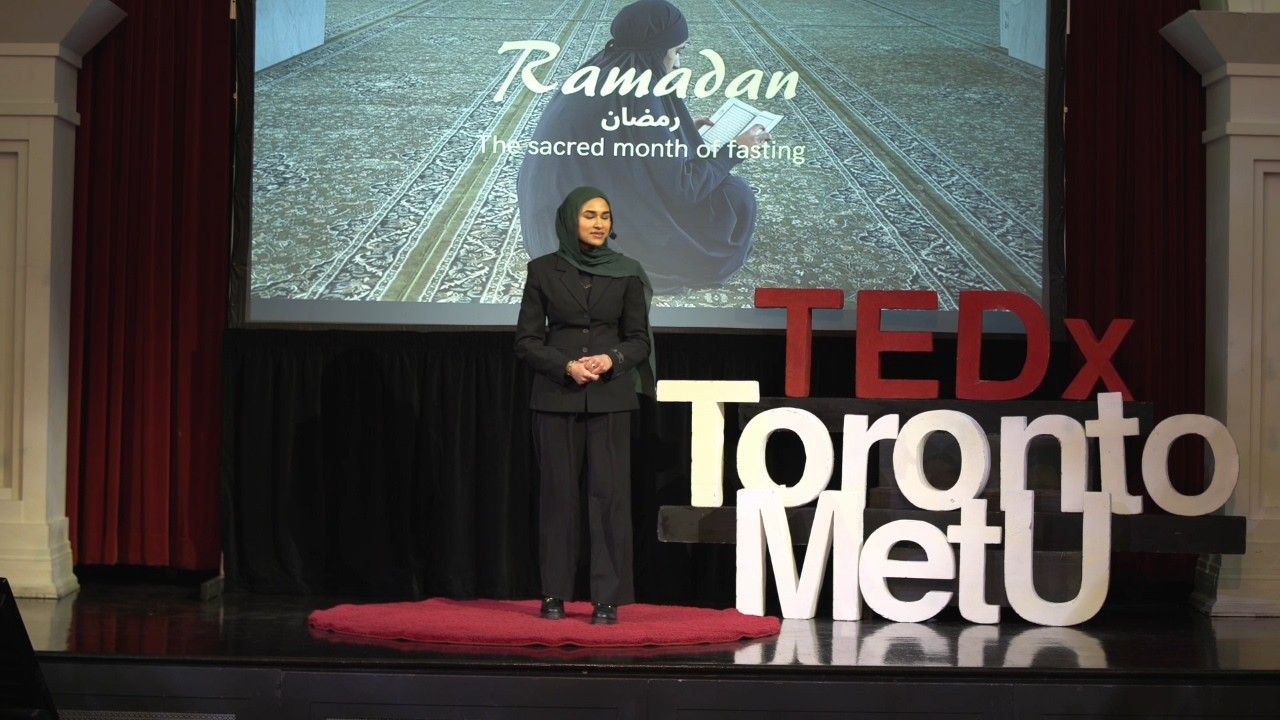
Run Back Home: Why Success Doesn't Require Self Erasure | Anam Biabani | TEDxTorontoMetU
Keywords
Summary
147 words
Critical Evaluation
Value of the Information & Strength of the Argument
The talk offers valuable insights into the psychological costs of toxic productivity and identity erasure, particularly for minority individuals navigating professional spaces. Its argumentative structure is coherent: it establishes the problem (busyness as identity), explores the physiological consequences (fight-or-flight, functional freeze), and presents a solution (rediscovering identity through faith and heritage). The speaker uses metaphor and personal testimony effectively, though the scientific explanations are simplified and serve primarily as supporting analogies rather than rigorous evidence. The argument that rest and reflection are not wastes of time but essential for sustainable success is well-presented and resonates with contemporary discussions on burnout and mindfulness. However, the reasoning is predominantly anecdotal and does not provide empirical support beyond the speaker’s experience.
Scientific Rigor, Source Quality, Title Accuracy
The talk demonstrates moderate scientific rigor: it correctly names the sympathetic nervous system and vagus nerve but oversimplifies their roles. The speaker does not cite specific studies or external sources in the talk itself, relying on her own narrative and general medical knowledge. The two links in the description are to TEDx guidelines and the TEDx homepage, which are irrelevant as supporting sources for the content. The title is highly accurate and matches the content precisely, encapsulating the central metaphor and message. There is no evidence of misinformation, but the work is clearly a personal perspective rather than a research-backed presentation.
234 words
Title / Content Match
The title perfectly matches the content: the speaker metaphorically 'runs' toward success, and the talk concludes that one must 'run back home' to one's roots rather than erase identity. The subtitle 'Why Success Doesn't Require Self Erasure' is directly addressed throughout.
Quality & Reliability
7/10
The talk is a personal narrative with references to established physiological concepts (sympathetic/parasympathetic nervous systems, cortisol, vagus nerve) presented accurately but simplified. The speaker explicitly positions it as her personal spiritual and experiential perspective, and the TEDx disclaimer reinforces that it is not peer-reviewed science. The core message about self-worth and identity is philosophically sound but lacks empirical grounding.
Key Moments
Markers derived by PSI from the transcript: the creator did not define chapters.
- Introduction: Speaker asks about pride in being busy, then recounts her own past identification with busyness.
- Discusses the pressure of university applications and the inability to answer 'Tell us about yourself' without accomplishments.
- Reveals her name and identity: Anam, a South Asian Muslim woman, and explains the expectations tied to being the eldest daughter.
- Explains the sympathetic nervous system's threat-based mode and how expectation replaced predator, leading to functional freeze.
- Describes her experience during Ramadan: slowing down, praying, and finally feeling rest without guilt.
- Shares how she used her heritage as a 'diagnostic tool', discussed her faith in medical school interviews, and succeeded by showing up whole.
Cited Sources
- TEDx Content Guidelines — Linked in the video description as the guidelines for TEDx organizers, noting that the talk represents the speaker's personal views.
- TEDx Official Page — Referenced in the description as the platform for independently organized TEDx events.
Contribution & Novelties
The talk provides a fresh perspective on the interplay between cultural identity, faith, and professional success, particularly for individuals from collectivist backgrounds navigating Western professional environments. It bridges personal storytelling with basic neuroscience to argue that overemphasis on productivity can trigger a chronic stress response, and that cultural and spiritual practices can serve as restorative counterbalances. While the message is not novel in self-help discourse, its specific framing within a South Asian Muslim context adds a valuable voice.
Pour aller plus loin :
- Vagus nerve — Relevance: The speaker mentions this nerve as the ‘brake pedal’ for the stress response; this page explains its role in parasympathetic activation.
- Sympathetic nervous system — Relevance: Discussed as the ‘gas pedal’ for fight-or-flight; this source details its function and effects.
- Burnout (occupational) — Relevance: The speaker’s functional freeze and exhaustion align with burnout; this page summarizes the syndrome, its causes, and prevention.
- Ramadan — Relevance: Central to the speaker’s turning point; this page describes the month’s practices and spiritual significance.
167 words
Radar Profile
The radar profile shows a moderate balance across dimensions, with quality of information and reliability scoring slightly higher than technical depth and quantity. This reflects the talk's focus on personal narrative and established but simplified concepts rather than dense scientific detail. The technical level is accessible, making the message broadly relatable, while the factual accuracy is sound within the scope of the speaker's claims.