How to Be Seen in a World Full of Content | Yier Luo | TEDxNYU Shanghai Salon
Keywords
Summary
174 words
Critical Evaluation
Value of the Information & Strength of the Argument
The talk offers valuable insights into the intersection of art history and modern digital culture, connecting the evolution of self-portraits to contemporary social media dynamics. Luo’s argumentation is persuasive through the use of vivid historical examples and personal stories, effectively illustrating how the human drive for recognition has shaped visual expression. However, the reasoning is largely anecdotal and opinion-based, lacking systematic evidence or alternative perspectives, which limits its scientific rigor. The four principles presented are practical but emerge from individual experience rather than empirical research.
Scientific Rigor, Source Quality, Title Accuracy
The talk demonstrates moderate scientific rigor: it draws on verifiable historical facts (e.g., Dürer’s biography, Warhol’s works) but does not cite specific scholarly sources or data. The quality of sources is acceptable for a popular audience, as the speaker is a curator with relevant expertise, though the reliance on personal anecdotes reduces objectivity. The title accurately reflects the content: it promises a discussion on being noticed amidst abundant content, which the talk delivers through historical and contemporary lenses. The visual structure and engaging delivery compensate for the lack of formal citations.
191 words
Title / Content Match
The title accurately captures the central theme of gaining visibility in a saturated content landscape, aligning with the talk's focus on attention and self-representation.
Quality & Reliability
7/10
The talk is grounded in well-known art historical references and personal industry experience, but lacks direct citations or verifiable data, relying instead on anecdotal evidence and broad cultural observations.
Key Moments
Markers derived by PSI from the transcript: the creator did not define chapters.
- Introduction: nervousness, art is dead, Warhol and Murakami examples.
- Anecdote about grandpa watching TikTok; video overload.
- History of self-portraits: medieval churches, Suger, Dürer's evolution and branding.
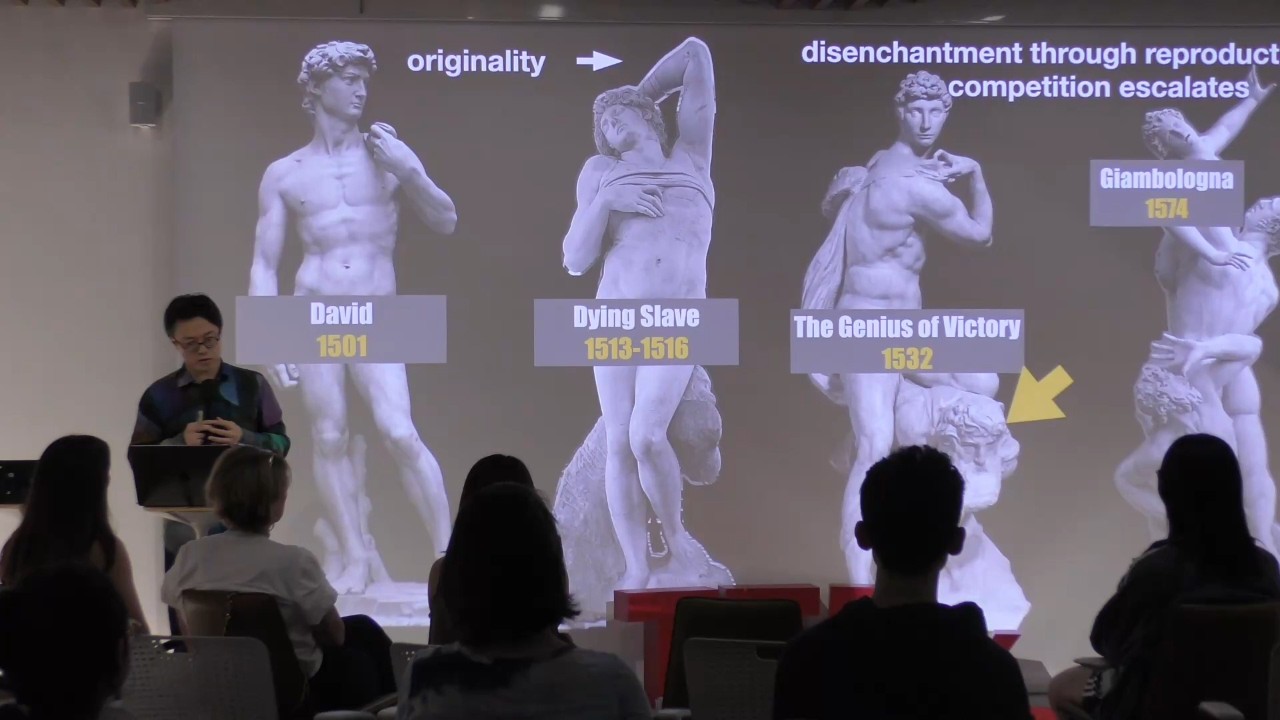
- Michelangelo's David, competition, growth of image complexity.
- Rembrandt and storytelling, photography, selfie culture.
- Four principles to be seen: ride the trend, repeat success, package importance, keep creating, embrace technology.
- Conclusion: comedy script story, call to action to make art and get seen.
Cited Sources
- TEDx program — Official TEDx description link; indication of the talk format.
Contribution & Novelties
The talk provides a fresh perspective by linking historical self-portrait conventions to modern content creation, proposing that the attention economy has parallels across centuries. It contributes practical advice drawn from the speaker’s cross-cultural career, notably the ‘four principles’ for visibility. The narrative style makes complex ideas accessible.
Pour aller plus loin :
- Attention economy — Relevant to the core theme of competing for visibility.
- Self-portrait — Historical context of the talk’s main subject.
- Andy Warhol — Central figure in the discussion of brand and repetition.
85 words
Radar Profile
The radar shows a balanced profile with moderate scores across information quantity, quality, and reliability, but lower technical depth. This reflects the talk's accessible, narrative-driven approach with strong engagement but limited empirical rigor.