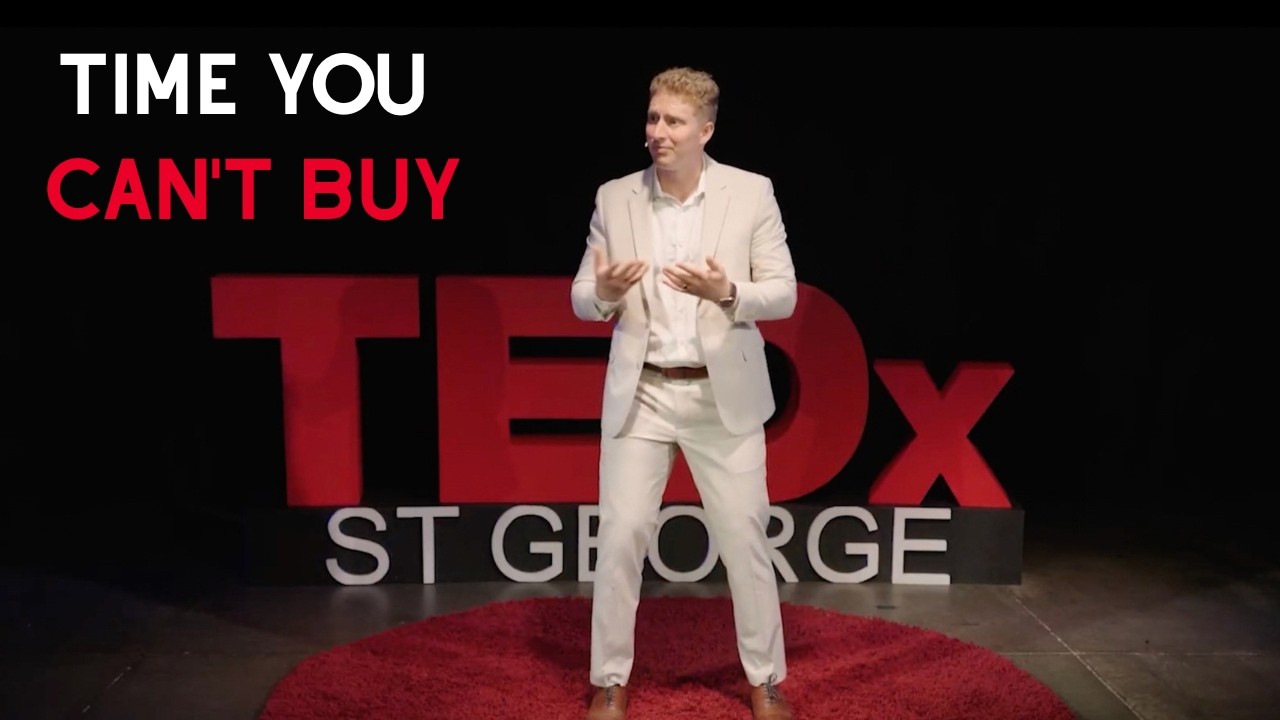
Are You Truly Living? | Nathan Barkocy | TEDxStGeorge
Keywords
Summary
176 words
Critical Evaluation
Value of the Information & Strength of the Argument
The talk delivers a compelling personal narrative that humanizes abstract concepts of success and wealth. Its argumentative strength lies in contrasting two common life strategies and proposing a third that integrates financial achievement with deeper purpose. However, the argumentation relies heavily on anecdote and rhetorical appeal rather than systematic evidence or logical proof. The pillars are presented as universal truths but lack empirical backing or practical validation beyond the speaker’s own businesses. The wealth transfer statistic is mentioned without citation, and the causal link between choosing ‘True Wealth’ and better outcomes is asserted, not demonstrated. The motivational value is high, but the intellectual rigor is limited.
Scientific Rigor, Source Quality, Title Accuracy
The talk is light on verifiable sources; the only direct reference is to the book ‘Rich Dad Poor Dad,’ mentioned without a specific citation. The description provides a link to TEDx Talks but no external references. The $124 trillion figure appears in some economic reports, but the speaker offers no source. The title aligns well with the content, as the question ‘Are You Truly Living?’ is directly addressed throughout. The quality of sources is low for scientific rigor, but the talk is positioned as an inspirational experience rather than an academic lecture.
213 words
Title / Content Match
The title 'Are You Truly Living?' accurately reflects the central question posed by the speaker and the exploration of meaningful vs. busy life. It is well-aligned with the content.
Quality & Reliability
5/10
The talk is primarily anecdotal and motivational, relying on personal experience and a self-developed framework rather than peer-reviewed evidence. It references general concepts like 'Rich Dad Poor Dad' and a wealth transfer figure, but lacks verifiable sources or statistical backing. The framework of 'True Wealth' is presented as an opinion with no empirical validation.
Key Moments
Markers derived by PSI from the transcript: the creator did not define chapters.
- Introduction and setting the stage: being a 16-year-old competitive cyclist, feeling on track.
- The accident: hit by a distracted driver at 60 mph, impact reported as fatal, waking up paralyzed two weeks later.
- The central question: 'Was I truly living or just busy?' and its relevance to others facing crises.
- Introducing the two flawed models: Old Wealth (accumulate, wait for retirement) and New Wealth (hustle, never enough).
- Defining True Wealth: measured by what you multiply for others, not what you keep; combining financial success with meaning.
- The four pillars: T (Time), R (Relationships), U (Understanding), E (Expression) – explained with personal examples.
- The $124 trillion wealth transfer and the importance of passing on the right definition of wealth.
- Conclusion: revisiting the question 'Are you just busy or truly living?' and call to act deliberately.
Cited Sources
- TEDx Talks — Talk given at a TEDx event; the official TEDx page is the link provided in the description.
Contribution & Novelties
The talk offers a personalized framework (‘True Wealth’) that attempts to unite financial success with meaningful living, but it does not introduce novel scientific data or original research. Its contribution is conceptual and motivational, providing a vocabulary for critiquing common success models. The four pillars are a synthesis of existing personal development ideas rather than a breakthrough. However, the personal story adds engaging context and makes the message relatable.
Pour aller plus loin :
- Rich Dad Poor Dad — The book that influenced the speaker’s early money mindset; central to the talk’s critique of accumulation.
- Wealth transfer — The concept of intergenerational wealth transfer, referencing the $124 trillion figure often discussed in economics.
- Purpose-driven life — A related motivational framework focusing on meaning, though not directly cited, it parallels the talk’s emphasis on purpose.
- Success ethics — Discussion of cultural models of success and hard work, relevant to the ‘old wealth’ critique.
152 words
Radar Profile
The radar profile shows moderate scores across information quantity and quality, with a low technical level and moderate reliability. This suggests a talk that is engaging and conceptually rich but lacks empirical depth and technical rigor. The strengths lie in narrative and practical advice rather than evidence-based science.