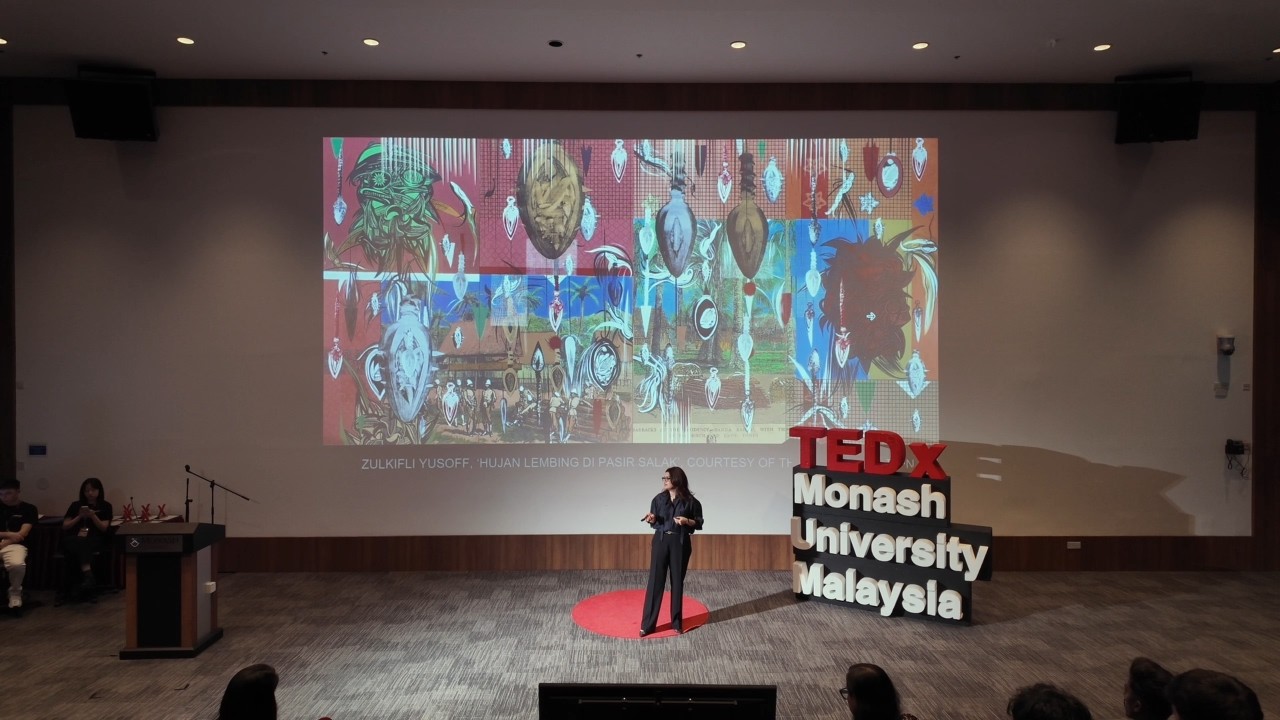
Drawing Conclusions | Zena Khan | TEDxMonash University Malaysia
Keywords
Summary
218 words
Critical Evaluation
Value of the Information & Strength of the Argument
The talk offers a compelling and well-argued perspective on the value of art. Khan’s argument is built on grounded personal experience, from her drawing classes to her curatorial practice, which lends authenticity. She effectively demonstrates that attentive looking can lead to deeper understanding of complex subjects, such as a nation’s identity. The reasoning is clear and logical: observing art trains critical thinking, which is essential for navigating today’s information-saturated world. Her examples, particularly the analysis of Zulkifli Yusof’s artwork, are illustrative and substantive. The talk could benefit from more rigorous engagement with cognitive science or educational research, but as an experiential and professional testimony, it is convincing and thought-provoking.
Scientific Rigor, Source Quality, Title Accuracy
The talk is presented as a personal and professional reflection rather than a scientific study. Khan does not cite external academic sources or data, relying instead on her expertise and specific case studies. The only source referenced in the description is the generic TEDx link; no scholarly references are provided. This limits the overall scientific rigor, but within the context of a TEDx talk, it is acceptable. The title ‘Drawing Conclusions’ aptly captures the talk’s dual focus on drawing as both literal act and metaphor for forming conclusions. The content matches the title well, as Khan weaves the theme of attention and conclusion-forming throughout.
228 words
Title / Content Match
The title 'Drawing Conclusions' cleverly ties the act of drawing to critical thinking, which is precisely the talk's central theme.
Quality & Reliability
7/10
The speaker is a professional curator with deep expertise in Malaysian contemporary art. She shares personal experiences and insights from her curatorial practice, without making unverifiable claims. The argument is coherent and grounded in her own work, but relies on anecdotal evidence rather than systematic studies.
Key Moments
Markers derived by PSI from the transcript: the creator did not define chapters.
- Khan invites the audience to spend 15 seconds looking at a table of objects as a visual memory exercise.
- She explains that drawing teaches observation, and observation leads to critical thinking.
- Khan introduces her role as curator and the exhibition 'To Know Malaysia Is To Love Malaysia' in Abu Dhabi.
- She presents Zulkifli Yusof's artwork 'Hujan Lembing di Pasir Salak' and analyzes its meaning and context.
- Khan discusses how the artworks reflect Malaysia's social-political history and rapid transformation.
- She reflects on the value of art in practicing critical reading of media and information.
- She concludes by urging the audience to see, not just look, and to draw their own conclusions.
Cited Sources
- TEDx Program — General information about independently organized TED-like events.
Contribution & Novelties
The talk offers an original perspective on art as a practical tool for developing critical thinking skills, rooted in the curator’s personal experience. It connects the act of detailed observation—often taught in art schools—to broader cognitive and emotional habits like empathy and open-mindedness. The wealth of concrete examples from Malaysian contemporary art provides a fresh lens, especially for audiences unfamiliar with this art scene.
Pour aller plus loin :
- Critical thinking — Wikipedia article that defines and contextualizes the concept central to Khan’s argument.
- Visual literacy — Related to the ability to interpret and make meaning from visual images, complementing her points about seeing and understanding art.
- Malaysian art — Background on the history and forms of Malaysian art, relevant to her discussion of contemporary Malaysian works.
127 words
Radar Profile
The radar profile shows balanced scores across information quality and reliability, with lower technical level and moderate quantity. This aligns with a talk that prioritizes accessible reflection over dense data, yet remains solid in argumentation and expertise.