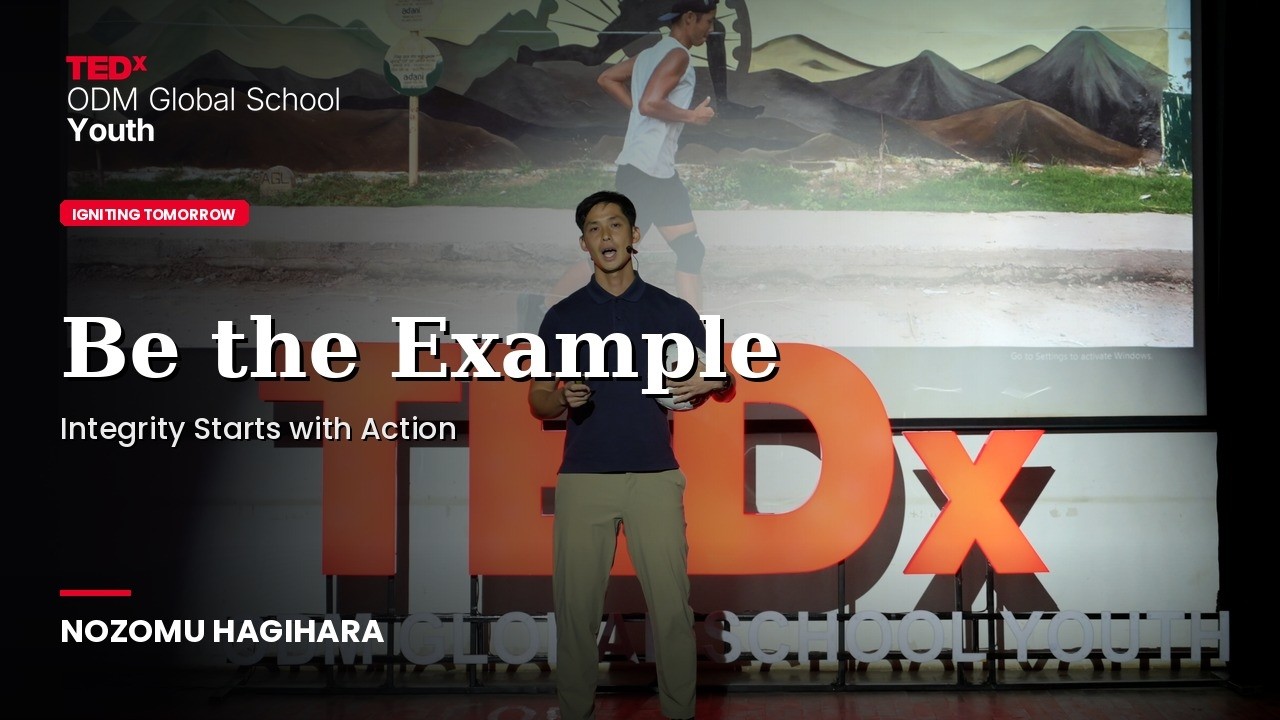
Be the Example: Integrity Starts with Action | Nozomu Hagihara | TEDxODM Global School Youth
Keywords
Summary
195 words
Critical Evaluation
Value of the Information & Strength of the Argument
The value of this talk lies in its concrete, lived example of integrity: Hagihara does not simply theorize but offers a physically demonstrable commitment. The argumentation is built on a personal narrative that convincingly illustrates the gap between stated values and behavior, and the necessity to bridge it. The reasoning is straightforward and emotionally compelling, though it relies primarily on anecdotal evidence rather than systematic analysis. The speaker’s journey from corporate life to social entrepreneurship adds credibility, and his challenge serves as a powerful metaphor for personal accountability. The talk successfully argues that integrity is not a static trait but an active, continuous practice, reinforced by the daily discipline of taking small steps toward a larger vision.
Scientific Rigor, Source Quality, Title Accuracy
The talk does not rely on scholarly sources; instead, it is an original testimony. The only reference provided is the general TEDx platform link, which validates the format but offers no external citations. The content is internally consistent, and the anecdotal evidence is presented transparently. The title accurately matches the content: it foregrounds integrity and action, which are the central themes. While not scientifically rigorous, the talk is intellectually honest and well-structured, with a clear progression from problem to solution. The audience feedback (not provided) would further inform on public reception, but no comment data is available.
229 words
Title / Content Match
The title accurately reflects the core message of the talk, linking integrity to concrete action, as illustrated by the speaker's 2,000 km football dribbling journey.
Quality & Reliability
6/10
The talk is a personal testimony offering a coherent and sincere message about integrity and action, but it lacks empirical evidence or verifiable data beyond the speaker's own experience.
Key Moments
Markers derived by PSI from the transcript: the creator did not define chapters.
- Opening scene: the speaker reflects on the extreme heat and physical exhaustion of his journey, posing the question 'What am I doing here?'
- Introduction: Hagihara shares his background, leaving a corporate job at Toyota to work in international development in India.
- The decision: he explains the need to align his actions with his words, leading to the idea of dribbling a football 2,000 km across India.
- Detailing the journey: daily distances, weather extremes, and physical hardships, including a 100 km single-day challenge.
- The turning point: reflecting on the meaning of the challenge, emphasizing that integrity means doing the right thing when no one watches.
- The key lesson: the importance of small daily actions in creating long-term change, and the question 'What can I do today?'
- Conclusion: a call to action, urging the audience to take the smallest step today toward their dreams, and a nod to his promise to the children.
Cited Sources
- TEDx Program — The talk is part of the TEDx series, provided as the only reference in the video description.
Contribution & Novelties
The original contribution of this talk is the tangible, extreme demonstration of integrity through a physical challenge. Rather than offering abstract advice, Hagihara provides a concrete example of putting values into action, showing that integrity is not merely a moral ideal but a daily practice. His story adds a personal and cultural dimension to discussions on leadership and personal development.
Pour aller plus loin :
- Integrity (Wikipedia) — A general definition and philosophical perspectives on the concept.
- Sport for Development (Wikipedia) — Overview of using sports to achieve social and educational goals, relevant to Hagihara’s work.
- Social Entrepreneurship (Wikipedia) — Context for his transition from corporate to social enterprise and the impact model.
113 words
Radar Profile
The score profile indicates a talk with moderate information quantity and quality, low technical depth, and overall reliability based on personal testimony rather than empirical research. The strengths lie in the clarity and emotional impact of the narrative, while weaknesses include a lack of external evidence and a narrow focus.