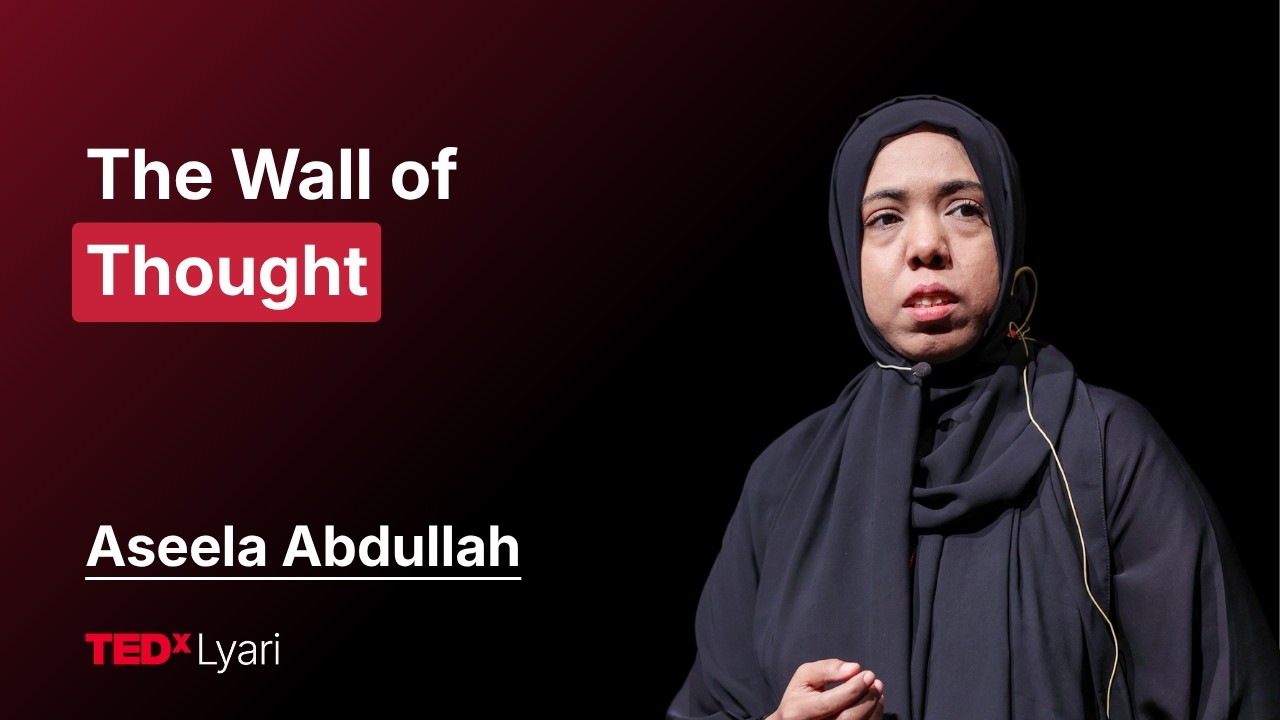
The Wall of Thought | Aseela Abdullah Dehwari | TEDxLyari
Keywords
Summary
125 words
Critical Evaluation
Value of the Information & Strength of the Argument
The talk offers a compelling personal testimony that illustrates systemic gender-based constraints in a specific cultural context. Its value lies in the authenticity of lived experience and the articulation of a collective approach to social change. The argumentation is largely anecdotal and emotional, relying on shared cultural references and poetic citations. While it lacks empirical evidence or theoretical depth, it persuasively conveys the need to recognize and dismantle invisible societal walls. The speaker’s call for strategic goal-setting and long-term impact is a pragmatic suggestion, but the reasoning is not critically examined in terms of feasibility or generalizability.
Scientific Rigor, Source Quality, Title Accuracy
The talk is primarily a personal story without formal citations or scientific sources, which limits its scholarly rigor. The only reference is a generic TEDx link, not specific to the content. The title ‘The Wall of Thought’ accurately captures the central metaphor of mental and social barriers. However, the content does not engage with existing research on gender studies or social psychology, focusing instead on motivational narrative. Adequation between title and content is strong, but the lack of verifiable sources and the anecdotal nature of the evidence reduce its scientific reliability.
203 words
Title / Content Match
The title accurately reflects the core theme of mental and societal barriers, though it is somewhat abstract.
Quality & Reliability
6/10
Personal narrative and social commentary; lacks verifiable data but offers authentic perspective and practical insights from lived experience in a marginalized community.
Key Moments
Markers derived by PSI from the transcript: the creator did not define chapters.
- Introduction of Aseela's background as a teacher, activist, and social entrepreneur.
- Story of the girl who defied societal norms to study science and philosophy, foreshadowing Aseela's own journey.
- Realization that her barriers are invisible mental walls rather than physical ones.
- Discussion on the shift from individualistic to collective action and its impact on society.
- Importance of strategic life design and leaving a lasting legacy for future generations.
- Conclusion: reframing past barriers as a support system and looking toward the future.
Cited Sources
- TEDx Program — This is the official TEDx platform where the talk was published and further information about the program can be found.
Concurring Sources
- TEDx Program — General platform reference, no specific contradiction with the talk's claims.
Dissenting Sources
- No specific sources — The talk does not engage with academic research, so no discordant sources are identified.
Contribution & Novelties
The talk provides a personal perspective on how women in a Pakistani community experience and overcome social constraints. Its novelty lies in the metaphor of ‘invisible walls’ that are culturally transmitted, and the argument that individual acts can instigate collective shifts. The speaker’s integration of local poetry and storytelling enriches the emotional appeal.
Pour aller plus loin :
- Social exclusion — relevant to the concept of invisible barriers and marginalization.
- Women’s empowerment — connects to the call for strategic action and societal change.
- Collective action — directly relates to the distinction between individual and collective struggles mentioned in the talk.
100 words
Radar Profile
The radar profile shows moderate scores in information quantity and quality, but low technical depth and average reliability. This indicates a talk that is engaging and authentic but lacks scientific rigor and complex analysis, fitting its motivational and community-focused nature.