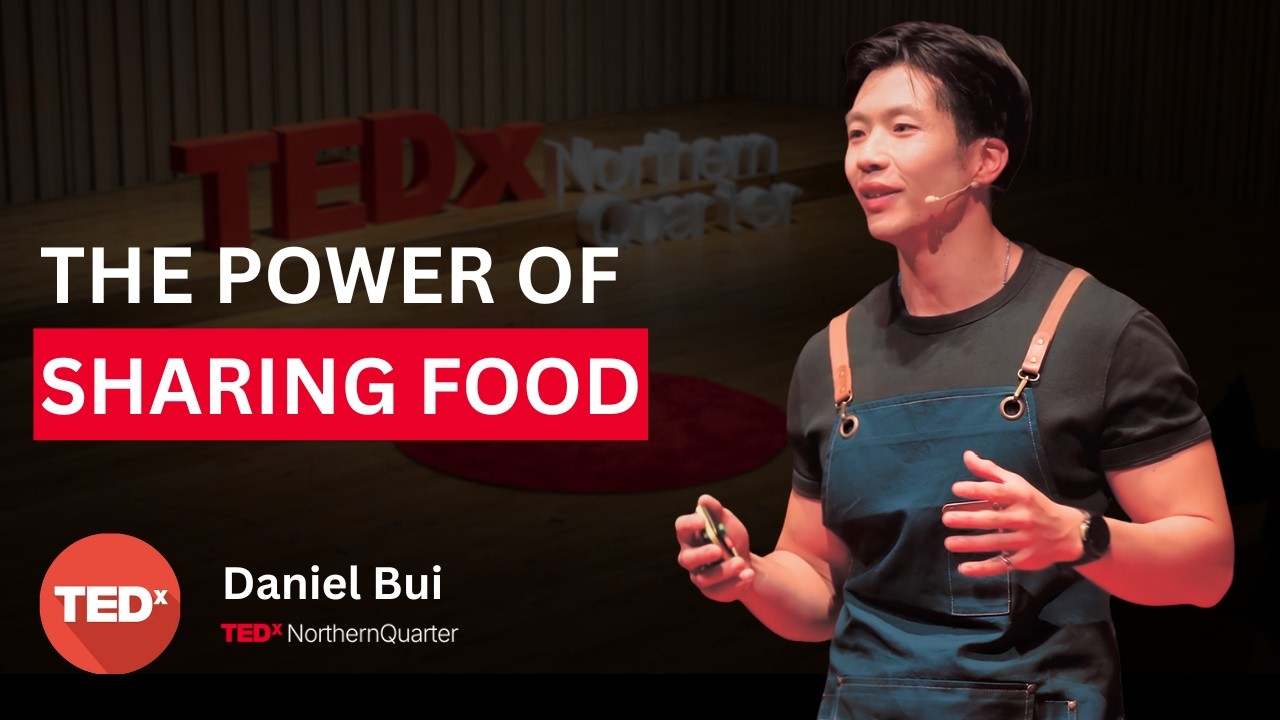
The power of sharing food | Daniel Bui | TEDxNorthern Quarter
Keywords
Summary
272 words
Critical Evaluation
Value of the Information & Strength of the Argument
The talk’s core value lies in its synthesis of heterogeneous evidence — neuroendocrinology, social psychology, epidemiology, history, and comparative religion — into a single accessible thesis about communal eating. The argument is structured as a persuasive case rather than a neutral review: Bui explicitly states his aim is to ‘make the case’ that food is the most powerful social technology, which frames the selection and presentation of evidence. The strongest argumentative move is the convergence argument: independent cultural and religious traditions (Japanese tea ceremony, Ethiopian gursha, Passover, communion, iftar) all arrive at the same conclusion about the table, which he presents as evidence of a universal human need. The historical Christmas Truce anecdote is vivid and well-documented in historiography, though Bui uses it rhetorically to extrapolate from a singular event to a general principle about food’s power. The scientific claims are presented with confidence but without hedging: the oxytocin mechanism is simplified (oxytocin is involved in many social and non-social processes, and its role in human bonding is debated), and the causal direction of the Dunbar finding is asserted rather than problematized. The loneliness statistics are the most empirically grounded portion, drawing on a meta-analysis and a government report, though the talk does not name the meta-analysis authors or provide a citation. The salt metaphor is a rhetorical device, not an argument, and is presented as such. Overall, the argumentation is coherent, emotionally resonant, and internally consistent, but it is advocacy rather than balanced analysis — counterarguments (e.g., that correlation between shared meals and well-being may be confounded by pre-existing social capital) are not addressed.
Scientific Rigor, Source Quality, Title Accuracy
The talk references several identifiable sources: Professor Robin Dunbar’s 2017 Oxford University study on eating together and social connection; a meta-analysis of approximately 148 studies on loneliness and mortality risk; the 2023 UK Chief Medical Officer’s annual report; and research by Oxford University and the Eden Project on solo meals. These are real, traceable bodies of work, and the figures cited (one in four British adults chronically lonely, 10 of 21 weekly meals eaten alone, one third going a week without a shared meal, mortality risk comparable to 15 cigarettes a day) are consistent with published findings from those sources. However, the talk provides no direct citations, author names beyond Dunbar, publication titles, or links. The description contains only the generic TEDx page (https://www.ted.com/tedx) , which is not a source for any specific claim. The historical claims about the Christmas Truce are well-supported by historiography, though the specific figure of 100,000 soldiers participating is at the high end of scholarly estimates. The cultural and religious descriptions are accurate in broad strokes. The title is fully adequate to the content: the talk is precisely about the power of sharing food, and the title promises nothing the talk does not deliver. No advertising sequence is present in the transcript. Comments were not provided for analysis.
493 words
Title / Content Match
The title accurately reflects the content: the talk is entirely about the social and emotional power of sharing food, communal eating, and breaking bread across cultures.
Quality & Reliability
6/10
The talk blends credible scientific references (Robin Dunbar's 2017 Oxford study, a 148-study meta-analysis on loneliness mortality, the 2023 UK Chief Medical Officer's report, Oxford/Eden Project data on solo meals) with historical anecdote (the 1914 Christmas Truce) and cultural/religious description. The scientific claims are broadly consistent with published literature, but the talk cites no specific papers, authors, or links in the description beyond the generic TEDx page, and several figures are presented without precise attribution. The rhetorical framing ('food is the most powerful social technology') is an argumentative thesis rather than a demonstrated scientific conclusion, and the causal language around oxytocin and behavioral coupling is simplified.
Key Moments
Markers derived by PSI from the transcript: the creator did not define chapters.
- Bui opens with the question of his favorite thing to cook and introduces the 3,000-year-old phrase 'breaking bread'.
- Thesis statement: food is the most powerful social technology, more powerful than language, money, or law.
- Neuroscientific evidence: oxytocin release during shared meals and Robin Dunbar's 2017 Oxford study on eating together.
- Historical case study: the Christmas Eve 1914 truce and the exchange of food between British and German soldiers.
- Cross-cultural survey: chanoyu, gursha, Passover Seder, communion, and iftar as convergent rituals of shared eating.
- The loneliness crisis: 2023 UK Chief Medical Officer's report, one in four adults chronically lonely, mortality risk comparable to 15 cigarettes a day.
- Oxford and Eden Project data: 10 of 21 weekly meals eaten alone, one third go a week without sharing a meal.
- The salt metaphor: like salt on food, the right people amplify rather than overpower us.
- Closing challenge: invite someone new to dinner this week and break bread with the person beside you.
Cited Sources
- TEDx official page — Generic TEDx program page provided in the video description; not a source for any specific claim in the talk.
Concurring Sources
- Robin Dunbar's research on eating together and social bonding — Oxford University study cited in the talk; found eating together is a strong predictor of social connection and well-being.
- UK Chief Medical Officer's Annual Report 2023 — Government report cited in the talk; identified loneliness as a major public-health concern.
- Meta-analysis on loneliness and mortality risk — The 148-study meta-analysis referenced in the talk; found social isolation carries a mortality risk comparable to major health risk factors.
Contribution & Novelties
The talk’s original contribution is not new scientific data but a synthesis: it assembles neuroendocrine, social-psychological, epidemiological, historical, and comparative-religious evidence into a single accessible argument that communal eating is a foundational and underused social technology. The framing of food as ‘infrastructure of human belonging’ and the salt metaphor for social amplification are rhetorical innovations that translate abstract social-science findings into a memorable practical challenge. The talk also bridges the loneliness literature with culinary practice, positioning the dinner table as a public-health intervention rather than a private pleasure.
Pour aller plus loin :
- Robin Dunbar — Oxford evolutionary psychologist whose 2017 study on eating together and social connection is the talk’s central scientific reference.
- Oxytocin — Neuropeptide discussed in the talk; its role in human social bonding is an active and debated research area.
- Christmas truce — Historical event of December 1914 used as the talk’s central historical case study.
- Loneliness — Public-health literature on loneliness and mortality, including the meta-analytic evidence referenced in the talk.
- Commensality — Anthropological concept of eating together, directly underlying the talk’s thesis.
178 words
Radar Profile
The profile is high in information quantity and moderate in quality, reflecting a talk rich in references and figures but light on precise citations. Technical level is low, as the talk is aimed at a general audience and simplifies mechanisms. Overall reliability is moderate: the sources are real and the figures broadly accurate, but the argument is advocacy-driven and selective.