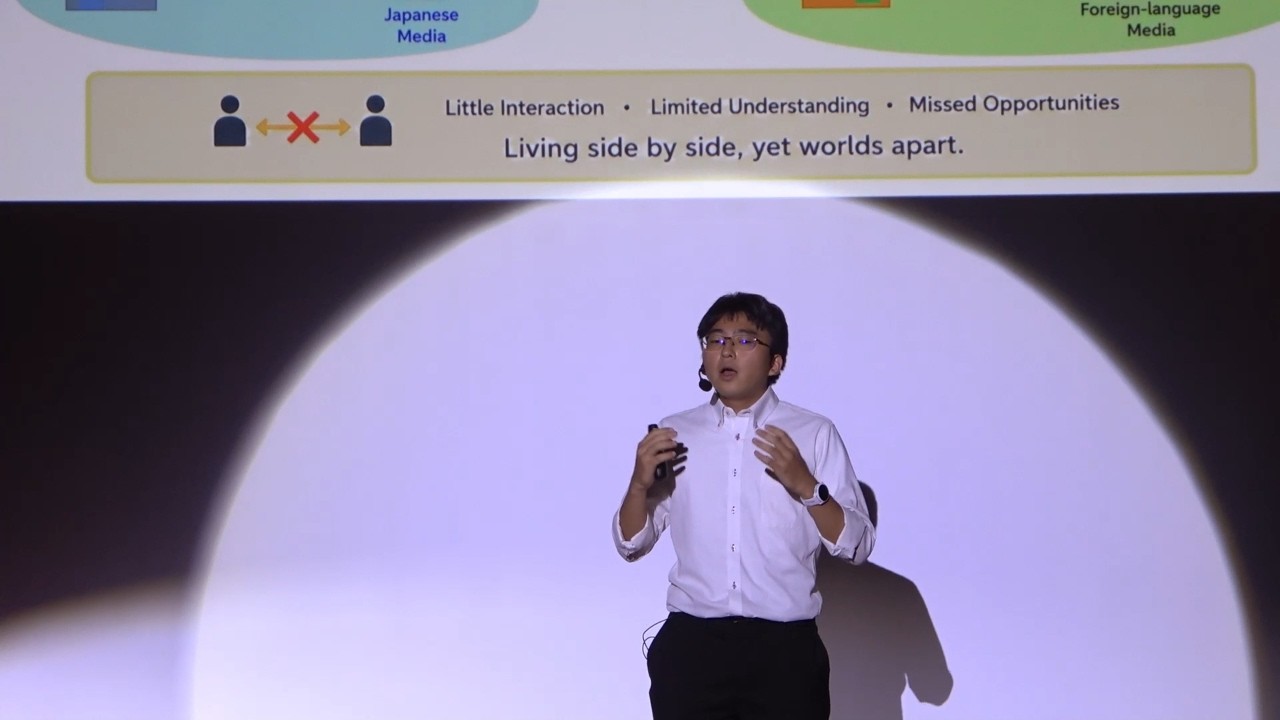
Why Diversity Is Not Enough | Yuga Morioka | TEDxUTsukuba Salon
Keywords
Summary
159 words
Critical Evaluation
Value of the Information & Strength of the Argument
The talk provides a heartfelt and accessible argument that diversity is insufficient for social cohesion. The value lies in its clear articulation of the difference between proximity and belonging, supported by the speaker’s long-term engagement with international students. The argumentation follows a logical progression: observing a problem, identifying causes (uncertainty, media, lack of trust), and proposing a solution (facilitating repeated encounters). While anecdotal, it aligns with established social psychology concepts like the contact hypothesis and the idea of social distance. The argument is persuasive, though it could be strengthened by citing specific studies or data. The speaker’s personal credibility and practical experience add value, but the lack of concrete evidence makes the argument more suggestive than rigorous.
Scientific Rigor, Source Quality, Title Accuracy
The talk is a personal narrative rather than a formal research presentation. It references sociological terms like ‘parallel society’ and mentions that social psychologists have shown that interactions reduce prejudice, but does not name specific researchers or studies. The only external source provided is the TEDx organization itself. The title accurately reflects the content, and the talk is well-structured. However, the scientific rigor is limited by the absence of citations and the reliance on anecdote. The description provides a link to TED’s website, but no specific references. Overall, the talk is informative for a general audience but not suitable as a primary scientific source.
236 words
Title / Content Match
The title accurately summarizes the core argument: diversity alone does not build community; deliberate connection is essential.
Quality & Reliability
6/10
The talk draws on established sociological and psychological concepts (parallel society, contact hypothesis) but relies primarily on personal anecdote and lacks specific citations or empirical data, resulting in moderate reliability.
Key Moments
Markers derived by PSI from the transcript: the creator did not define chapters.
- Speaker asks about cafeteria seating patterns and observes self-segregation.
- Introduction of the speaker's background and the realization that diversity alone doesn't create community.
- Discussion of 'parallel societies' in Germany as an example of living side-by-side without connection.
- Explanation of causes: uncertainty, media amplification, and lack of trust.
- Emphasis on social distance rather than physical distance as the core challenge.
- Discussion of legal status versus social belonging in Japan.
- Proposal to build trust through repeated encounters and the creation of community spaces.
- Conclusion: diversity brings together, connection makes a community.
Cited Sources
- TEDx Program — The talk was given at a TEDx event, and the organizer's link is provided in the video description.
Contribution & Novelties
The talk offers a personal and accessible perspective on why diversity initiatives often fail without deliberate community-building efforts. It shifts the focus from legal or policy solutions to interpersonal trust and repeated encounters. While the ideas are not new, the speaker’s specific experiences and the framing of ‘belonging’ as separate from legal status provide a nuanced contribution to discussions on integration.
Pour aller plus loin :
- Contact hypothesis — Key theory supporting the claim that interactions reduce prejudice.
- Parallel society — Concept discussed in the talk regarding social segregation.
- Social integration — Relevant to the broader theme of creating belonging in diverse societies.
103 words
Radar Profile
The radar profile shows moderate scores across quality and reliability, with lower scores for technical level and quantity of concrete data. The talk is strong on personal narrative and conceptual explanation but lacks empirical depth, resulting in a balanced but not exceptional profile.