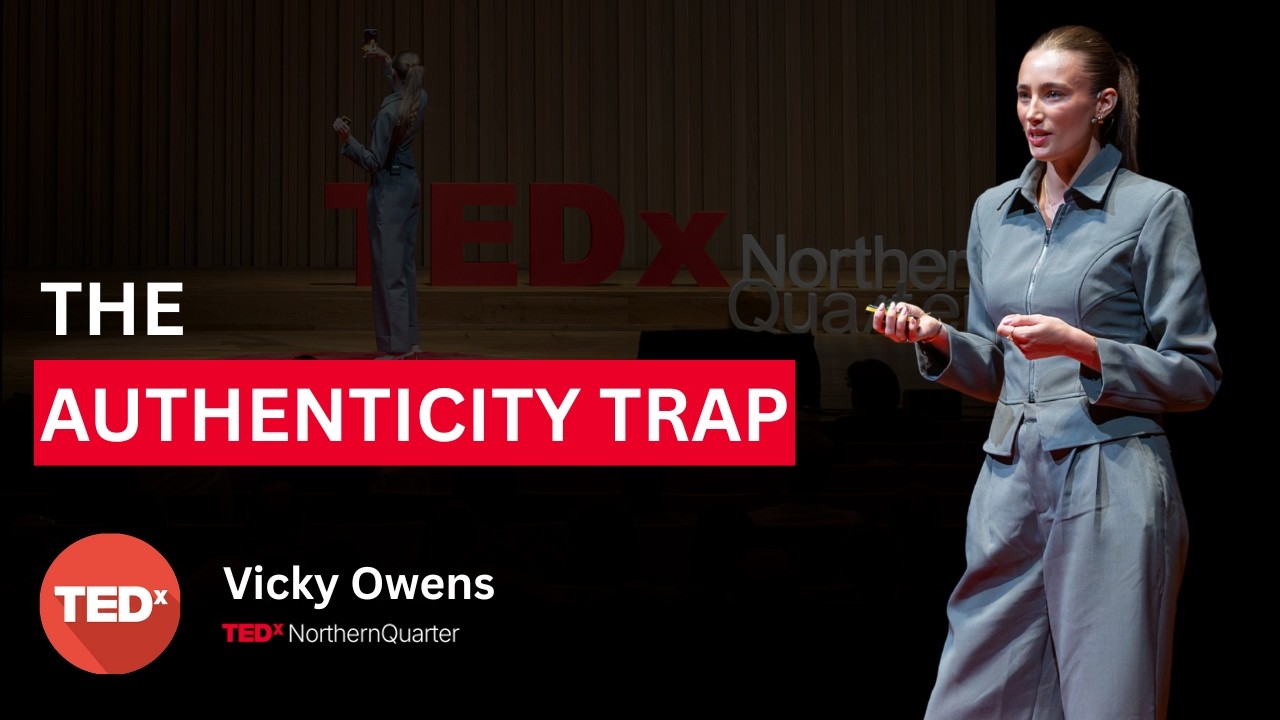
The authenticity trap | Vicky Owens | TEDxNorthern Quarter
Keywords
Summary
137 words
Critical Evaluation
Value of the Information & Strength of the Argument
The value of the talk lies in its relatable examples and the speaker’s personal testimony, which effectively illustrate the psychological pressure of social media. The argumentation is clear and well-structured, moving from observations to a personal case study, then to a broader conclusion. However, the reasoning is primarily anecdotal and lacks empirical evidence or references to research on social media psychology. While the speaker’s credibility as a social media professional adds some weight, the argument would be stronger if supported by studies or data. The talk’s strength is its accessibility and the memorable distinction between ’looking good’ and ‘feeling good’.
Scientific Rigor, Source Quality, Title Accuracy
The title ‘The authenticity trap’ is apt and captures the central theme. The content aligns well with the title, as the speaker repeatedly illustrates the paradox of performing authenticity. In terms of scientific rigor, the talk does not cite any external sources; the only reference is the official TEDx page, which is not substantive. The speaker makes a statistical claim (‘8 in 10 people’) without attribution, reducing reliability. The absence of references and reliance on personal anecdotes limits the talk’s academic credibility, though it is presented as an opinion piece rather than a research summary. Public reaction is not known as no comments were provided.
220 words
Title / Content Match
The title accurately reflects the content: the speaker argues that the demand for authenticity on social media can become a performance.
Quality & Reliability
5/10
The talk is based on personal experience and anecdotal evidence. It makes some claims without citing sources (e.g., 8 in 10 people). While engaging, it lacks scientific rigor.
Key Moments
Markers derived by PSI from the transcript: the creator did not define chapters.
- Speaker takes a photo and posts it on her story, prompting the question about how we perform online.
- Introduces the gap between personal authenticity and online authenticity, citing Santorini and the Mona Lisa as examples.
- Explains why we perform: the mixed audience on social media leads to filtering and self-presentation.
- Personal story of waking up with a rash on Christmas Day and the worry about how it would affect her online image.
- Posts about the condition vulnerably, goes viral, and realizes she was performing authenticity.
- Introduces the rule: 'Does it look good or feel good?' and argues authenticity is a feeling, not a post.
- Concludes with a question: how would you live your life if you took the audience away?
Cited Sources
- TEDx Official — Mentioned in the description as the official TEDx event page, providing context for the TEDx format.
Contribution & Novelties
The talk offers a fresh angle on social media authenticity by framing it as a performance trap, supported by the speaker’s personal journey. It contributes a memorable heuristic (’look good vs. feel good’) for self-evaluation. However, it does not introduce new academic concepts; it repackages existing ideas in an accessible way. The originality lies in the personal narrative and the concrete examples from the speaker’s career.
Pour aller plus loin :
- Impression management — Goffman’s concept of how individuals curate their behavior for audiences, directly relevant to the talk’s theme.
- Social comparison theory — Festinger’s idea that people evaluate themselves by comparing to others, which underpins the stress of highlight reels.
- Digital self — The online representation of self, which the talk argues is unavoidably performative.
126 words
Radar Profile
The radar profile shows moderate information quantity but low technicality and reliability. The talk is accessible and covers multiple examples, but lacks depth and scientific backing, making it a personal opinion piece rather than a rigorous analysis.