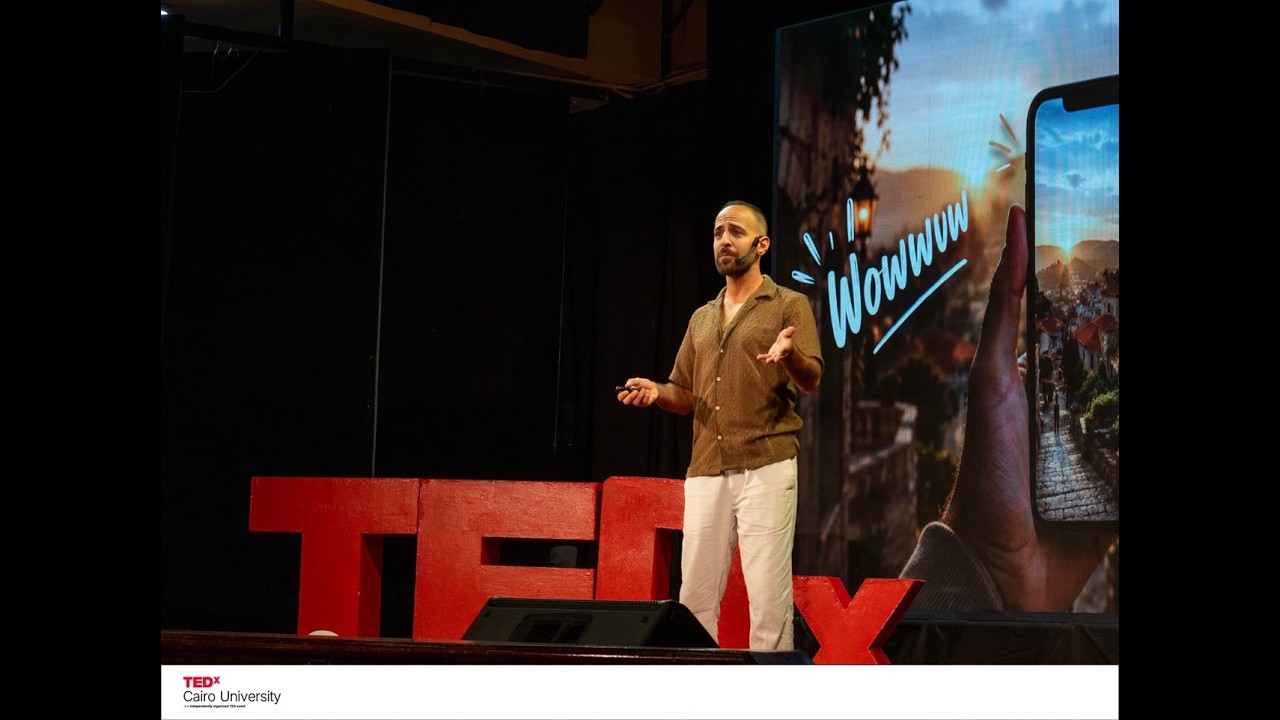
Why Does Everything Look Better Somewhere Else? | Marwan Ojaimie | TEDxCairo University
Keywords
Summary
177 words
Critical Evaluation
Value of the Information & Strength of the Argument
The talk offers valuable insights into how our perception of familiar spaces is shaped by psychological mechanisms like habituation and novelty bias. The speaker’s personal stories are relatable and effectively convey the idea that attention, not distance, determines our appreciation of places. However, the argumentation relies heavily on anecdotal evidence rather than systematic research, and the psychological concepts are presented in a simplified manner without references. While the message is compelling and thought-provoking, the scientific backing is thin, and the talk would benefit from more rigorous citations or empirical examples.
Scientific Rigor, Source Quality, Title Accuracy
The scientific rigor is moderate: the speaker correctly identifies well-known psychological phenomena (habituation and novelty bias) but does not cite any specific studies or sources. The only reference provided is the generic TEDx link in the description, offering no direct access to the underlying research. The title accurately captures the essence of the talk, and the content aligns well with it. There are no notable discrepancies between the title and the content delivered.
178 words
Title / Content Match
The title accurately reflects the central theme of why familiar places or things lose their appeal compared to novel ones, and the talk directly addresses this phenomenon.
Quality & Reliability
5/10
The talk presents valid psychological concepts (habituation, novelty bias) but without formal citations or deep scientific grounding. The speaker relies on personal anecdotes and general observations, making the information plausible but not rigorously verified.
Key Moments
Markers derived by PSI from the transcript: the creator did not define chapters.
- Introduction to the speaker's background as an architect and his shift to exploring local areas.
- Observations about how people miss places close to them, with audience poll about visiting local museums.
- Introduction of psychological concepts: habituation (appreciation) and novelty bias.
- Anecdote of returning to Lebanon and experiencing familiar food and a mountain view as if for the first time.
- Application to relationships, except for toxic ones, and the role of absence in appreciating people.
- Final message urging the audience to notice what is already in front of them and to question their own perception.
Cited Sources
- TEDx Program — The talk was given at a TEDx event, and this link provides general information about the TEDx format.
Contribution & Novelties
The talk provides a fresh perspective on travel and exploration by shifting from external discovery to internal attention. It bridges architecture, storytelling, and psychology in an accessible way, encouraging local exploration as a form of mindfulness. While it does not present original research, its value lies in synthesizing known psychological concepts and applying them to everyday life.
Pour aller plus loin :
- Habituation - Wikipedia — Relevant to the core concept of decreased response to repeated stimuli.
- Mindfulness - Wikipedia — The practice of paying attention to the present moment, which relates to the speaker’s advice to notice familiar surroundings. (No URL provided as exact address uncertain)
- Novelty seeking - Wikipedia — This concept underlies the appeal of new experiences mentioned in the talk. (No URL provided as exact address uncertain)
131 words
Radar Profile
The profile shows moderate scores across all dimensions, with quality of information slightly exceeding quantity and technical level. The fiabilité is average, reflecting the lack of robust citations. Overall, the talk is balanced but leans more toward inspirational narrative than rigorous scientific exposition.