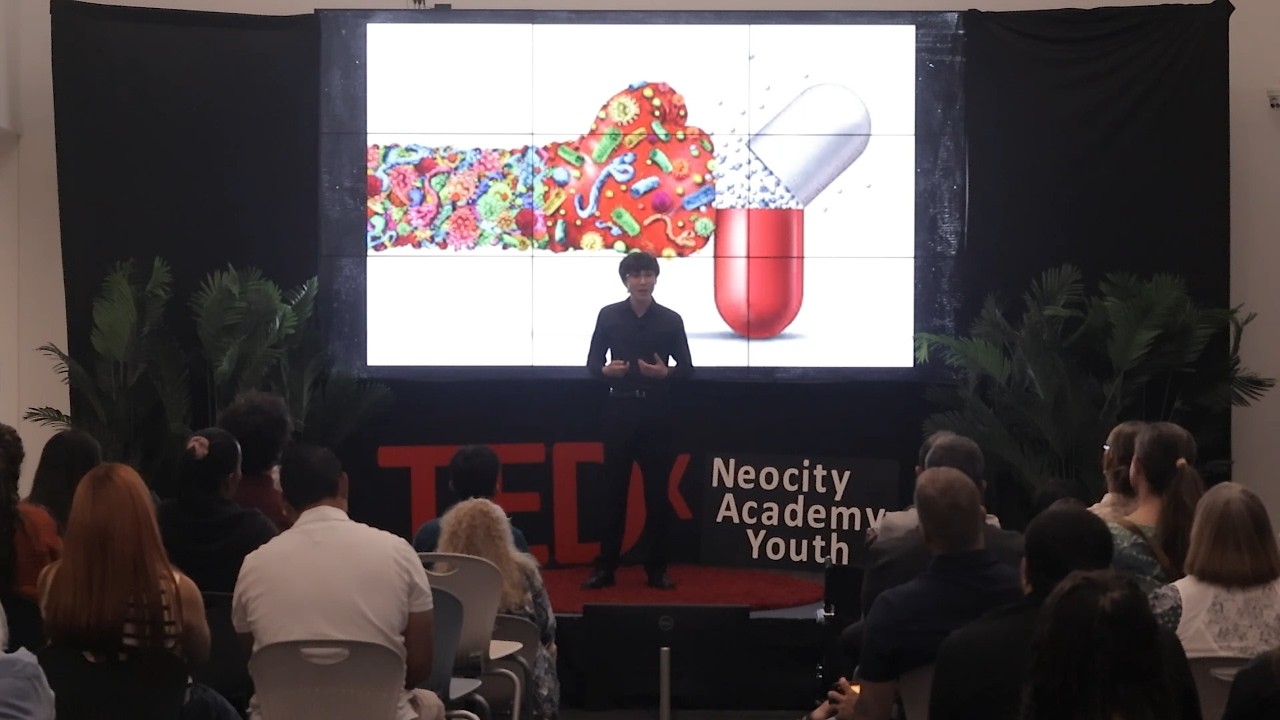
Doctors are using Killers to save our lives | Caleb Ubach | TEDxNeoCity Academy Youth
Keywords
Summary
172 words
Critical Evaluation
Value of the Information & Strength of the Argument
The talk provides a clear and accessible narrative on the potential of phage therapy, using a personal story and a compelling medical case to illustrate scientific points. The argumentation is logically structured: it establishes the problem (antibiotic resistance), presents a solution (phages), and justifies why this solution is superior through comparisons with antibiotics. However, the evidence is largely anecdotal and relies on simplified explanations without rigorous peer-reviewed citations. The speaker’s enthusiasm is evident, but the lack of precise sources and occasional factual errors weaken the argument’s robustness.
Scientific Rigor, Source Quality, Title Accuracy
The scientific rigor is moderate; the talk is intended for a general audience and thus simplifies complex topics, but this leads to inaccuracies such as misclassifying phages as RNA viruses (most are DNA viruses) and misquoting WHO death figures. The speaker references studies (e.g., by Hendrix, Chan, Fujiki) without providing specifics, making verification difficult. The title is apt and not misleading. The only external source listed in the description is the TEDx page, which does not support the specific claims made.
183 words
Title / Content Match
The title aptly reflects the content: it highlights the paradoxical use of bacteriophages (killers) to treat bacterial infections, which is the central theme of the talk.
Quality & Reliability
6/10
The talk is engaging and covers key concepts of bacteriophages and phage therapy, but contains several factual inaccuracies (e.g., describing phages as RNA viruses, misquoting WHO statistics, and overstating phage numbers in a rhetorical manner). The speaker is a student, not a domain expert, and relies on secondary sources without precise references, reducing overall reliability.
Key Moments
Markers derived by PSI from the transcript: the creator did not define chapters.
- Speaker describes discovering phages through a Kurzgesagt video at age 10, sparking his interest in microbiology.
- Structural description of bacteriophages: capsid, tail, tail fibers, tail spike protein, resembling a self-propelled syringe.
- Phages only attack bacteria, not human cells; hence their name 'bacteria-eater'.
- History of antibiotics from Fleming's discovery to overuse and the rise of antimicrobial resistance (AMR).
- WHO statistics on AMR deaths in the European region (130,000 direct, 540,000 indirect annually).
- Case study: Dr. Ali Kodust infected with Pseudomonas aeruginosa, successful phage therapy after four years of ineffective antibiotics.
- Comparison between antibiotics and phages: specificity, preservation of gut microbiome, and reduction of side effects.
- Phages evolve quickly and bacteria cannot simultaneously resist antibiotics and phages, creating a winning loop for humanity.
- Phage therapy lacks FDA approval and faces regulatory hurdles; need for policy change as AMR worsens.
- Conclusion: phages offer a promising future to combat bacterial infections and prevent projected millions of deaths.
Cited Sources
- TEDx Program — General link from the video description to the TEDx platform, indicating the talk is part of a TEDx event.
Contribution & Novelties
The talk offers a personal and passionate introduction to phage therapy, making complex biology accessible to a lay audience. While not providing new scientific findings, it synthesizes existing knowledge into a coherent narrative that highlights the promise of phages against AMR. The emphasis on the evolutionary interplay between phages and bacteria is a useful conceptual framework.
Pour aller plus loin :
- Bacteriophage — Overview of phage biology and classification.
- Phage therapy — Detailed discussion of therapeutic applications and clinical trials.
- Antimicrobial resistance — Global health threat and associated policies.
89 words
Radar Profile
The radar profile shows a balanced but moderate performance across all dimensions, with quantity of information slightly higher than quality and reliability. This reflects a talk that delivers a substantial amount of content in an accessible manner, but with notable inaccuracies and limited source rigor, common in popular science communication.