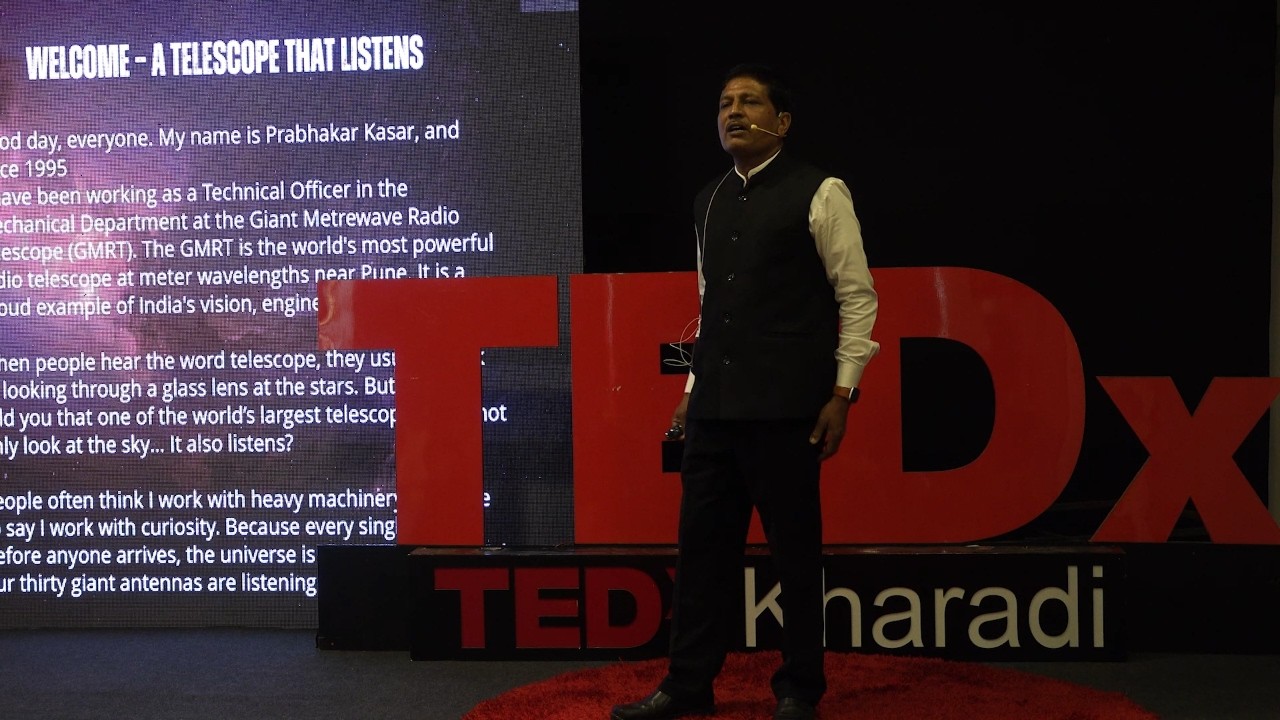
LISTENING TO THE UNIVERSE - The Story and Science behind GMRT | Prabhakar Nana Kasar | TEDxKharadi
Keywords
Summary
216 words
Critical Evaluation
Value of the Information & Strength of the Argument
The information value lies in presenting GMRT’s scale, capabilities, and historical development from the unique perspective of a mechanical engineer, rather than a primary researcher. It effectively communicates the importance of radio astronomy and engineering in modern astrophysics, linking basic concepts like parabolic shapes and frequency ranges to accessible analogies like satellite dishes, which aids in public understanding. The argumentation follows a logical progression: starting with the fundamental idea of ‘hearing’ the universe, then introducing the specific instrument, its operation, its history, and finally the human element of teamwork. While the speaker’s passionate and personal anecdotes strengthen credibility, the scientific argumentation is limited to descriptive statements and lacks rigorous data or comparative analysis with other telescopes, keeping the discussion at an introductory level without deep technical or statistical backing.
Scientific Rigor, Source Quality, Title Accuracy
The scientific rigor is moderate, as the talk provides a high-level overview without citing specific publications, measurements, or external references. The speaker relies on his professional role to establish authority, which adds credibility to the operational details but limits the verifiability of the scientific claims. The title and subject are perfectly aligned; the talk delivers on its promise to discuss both the engineering story and scientific purpose of GMRT. No audience comments were provided for analysis.
220 words
Title / Content Match
The title accurately reflects the content, as the entire talk focuses on both the personal story and the technical science behind GMRT.
Quality & Reliability
6/10
The talk draws on the speaker's long personal tenure at GMRT, providing credible first-hand experience, but lacks external citations or verifiable scientific data points presented with rigor. The claims are anecdotal and relayed in a simplified manner for a general audience, making the overall reliability moderate and dependent on the speaker's authority.
Key Moments
Markers derived by PSI from the transcript: the creator did not define chapters.
- Opening and introduction of the speaker and his role at GMRT.
- Explaining the concept of radio waves and how GMRT 'listens' to the universe.
- Describing the Y-shape and 25 km extent of GMRT's antenna array.
- Highlighting GMRT's distinction as the world's largest radio telescope and its 28 GB/s data collection.
- History of Dr. Govind Swarup and his earlier telescopes in Kalyani and Ooty.
- Discussing the design and universal frequency band (50 MHz to 1420 MHz) of GMRT.
- Details on the parabolic antenna shape and its function with the receiver system.
- Selection of the site in Pune village based on wind, seismic, and natural wave conditions.
- Closing message about teamwork and the potential for joint research with other global arrays like SKA.
Cited Sources
- TEDx Talks - Official Website — The description states 'Learn more at https://www.ted.com/tedx' as a general reference for the independently organized TED event.
Contribution & Novelties
This talk’s original contribution is its rare insider glimpse into the mechanical engineering and maintenance of GMRT, typically dominated by purely astronomical or astrophysical narratives. It positions the technical and engineering viewpoints as crucial for scientific progress, enriching how the public understands the infrastructure behind major discoveries. The personal anecdotes from a three-decade career add a human-centric layer to instrumental science.
For further reading:
- Giant Metrewave Radio Telescope (Wikipedia) — Detailed technical specifications and history of the facility.
- Radio astronomy (Wikipedia) — Broad scientific background of the field.
- National Centre for Radio Astrophysics (Wikipedia) — The parent institution that operates GMRT.
- Square Kilometre Array (Wikipedia) — The next-generation radio telescope mentioned implicitly by the speaker’s futuristic vision.
117 words
Radar Profile
The radar profile shows a moderate to low scoring across most dimensions, with 'information quantity' and 'technical level' being relatively modest, reflecting its introductory nature. The profile suggests balanced weaknesses in rigorous sourcing and depth, but the accessible presentation style helps offset these deficiencies in terms of engagement value.